
Ava D.
VerifiedMarketing Consultant
“The results were easy to understand and gave me some practical ideas I could actually use. 👍”
Every day, millions of people ask ChatGPT, Perplexity, and Google AI a question instead of searching Google. The AI picks one source to cite. If your website is not structured correctly, it never gets picked, no matter if the answer is right there on your webpage.
Answer Engine Optimization (AEO) is the practice of structuring your website so AI tools can read it, understand it, and cite it as a direct answer.
Traditional SEO focuses on ranking in a list. AEO focuses on becoming the answer itself.
ChatGPT, for example, does not browse ten pages and rank them. Rather, the AI program identifies a page that responds to the query in a direct and clear manner. AI's citation criteria include answerability, efficiency in format, and directness. So, if your content is lengthy and/or organized in paragraphs, is devoid of schema markups, and/or is a marketing copy, your content is sidestepped and overlooked.
It is infrequently a writing issue. It is usually structural, logical, and focused.
AI search tools are now the first stop for millions of people who want a fast answer. If your website does not get cited among the answer sets, valuable traffic that once came through traditional search is slipping away, and that loss is widening at a notable rate every month.
Traditionally, SEO is not being set aside, but instead being built on, in this instance. Improvements in direct answerability, organizational clarity, and content structure (including FAQ schema) serve both AI search assistance and, more critically, Google. If the content is optimized for AI search assistance, the results are equally rewarding for Google search.
In the near future, sites that rank well for AEO are bound to get cited more, published more, and be respected more for the clarity of the content. When you are included in AI-generated responsive content, more people view your brand, and more of the content is repeatedly linked.
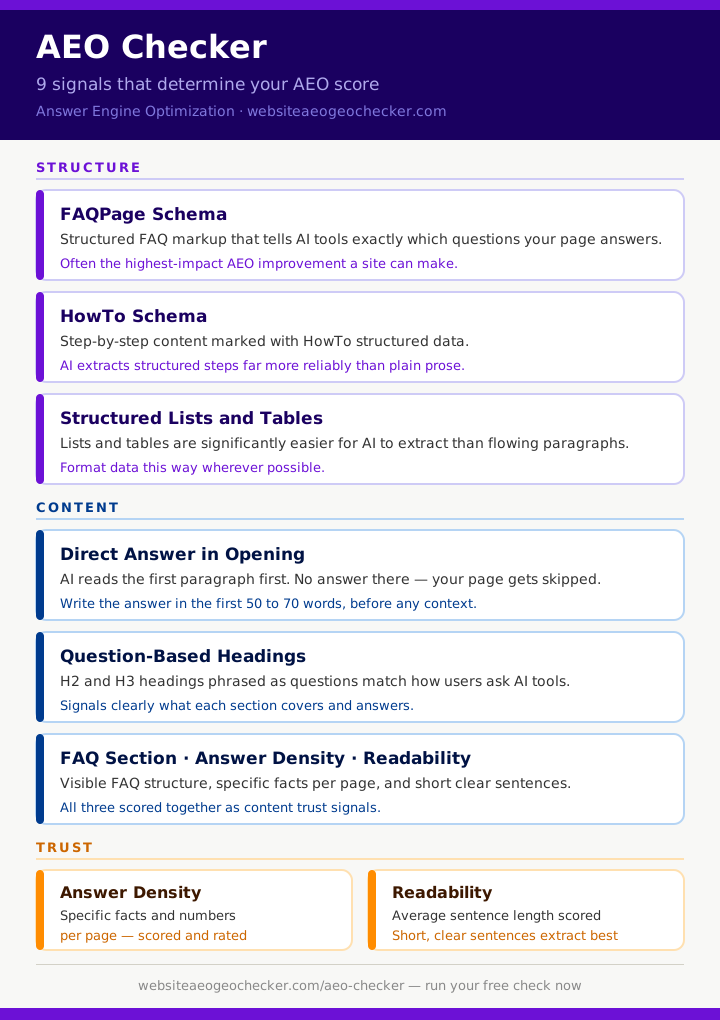
We check 9 signals that determine whether AI tools can find, read, and cite your content.
FAQPage Schema Checks whether your page has structured FAQ markup. This tells AI search tools exactly which questions your page answers , and is often the highest-impact AEO fix available.
Direct Answer in Opening Checks whether your first paragraph answers the main question directly. AI systems extract the opening chunk first. If the answer is not there, it gets skipped.
Question-Based Headings Checks whether your H2 and H3 headings are phrased as questions. Question headings match how users ask AI search tools , and signal exactly what each section answers.
Content Depth Checks total word count. Longer, more thorough pages give AI tools more to work with , and signal that the page is a genuine resource rather than thin content.
Answer Density Checks how many paragraphs contain specific facts, numbers, or verifiable information. Vague, general content gets passed over. Specific, citable content gets cited.
HowTo Schema Checks whether step-by-step content is marked up with 'HowTo' structured data. AI tools extract structured steps far more reliably than unformatted prose.
Readability Checks average sentence length. Short, clear sentences are easier for AI to extract and quote. Long, complex sentences reduce extraction probability.
FAQ Section in HTML Checks whether your page contains a visible FAQ section , even without formal schema markup. A well written FAQ gives AI systems pre-formatted question and answer content that is easy to parse.
Structured Lists and Tables Checks whether content is formatted with lists or tables. These formats are significantly easier for AI to extract, than flowing paragraphs.
Four changes make the biggest difference. Most take under an hour each.
Add FAQPage schema to any page that already has question and answer content. This is the single highest-impact AEO improvement. It tells AI tools exactly which questions your page answers, in a format and language they can read directly.
Rewrite at least three subheadings so they start with a question word: What, How, Why, When, or Is. These match how people phrase queries to AI tools and signal clearly what each section covers.
Write a direct answer in your first paragraph. Do not make AI systems scroll to find the point. The opening sentence or two should answer the main question the page is about , immediately & completely.
Add a visible FAQ section to your most important pages. Even without a schema, a well-written FAQ gives AI systems clean, structured Q&A content that is easy to extract and cite.
Run this AEO tool again after each round of fixes to see your score move. Bookmark your results URL and re-check monthly, that turns a one-time AEO checker into an ongoing AEO tracker for your site.
0 to 3 - Needs work Your site has significant structural gaps. AI tools are likely skipping your content even when your answers are relevant. Start with FAQPage schema and direct answer openings.
4 to 6 - Improving You have some of the right signals in place but key elements are missing. Focus on the specific issues flagged in your results.
7 to 9 - Strong Your content is well-structured for AI extraction. Keep pages updated, refresh content quarterly, and check new pages as you publish them.
No account needed. No payment required. Enter your URL and get your score in seconds.
Want to understand what the results mean in detail? Read our Complete AEO Guide or browse all our free tools at the Tools Directory.
AEO is the practice of optimizing your website so AI-powered answer engines, including ChatGPT, Perplexity, Gemini, and Google AI Overviews, directly cite and quote your content when answering user questions. Unlike traditional SEO which targets search rankings, AEO targets AI citations.
Traditional SEO optimizes for Google's ranking algorithm, keywords, backlinks, and page speed. AEO optimizes for AI comprehension, structured data, question-based headings, direct answers, and FAQ schema. Both matter, but they require different tactics.
Our tool analyzes signals that affect all major AI answer engines: ChatGPT, Gemini, Perplexity, Google AI Overviews, and Microsoft Copilot. The same AEO signals, FAQ schema, direct answers, and question headings, improve visibility across all of them.
A score of 75 or above is rated Good. A score of 90+ is Excellent. Most websites score 40-60 when first checked, and the fixes are usually straightforward once you know what to focus on.
The highest-impact improvements are: (1) Add FAQPage schema markup, (2) Rewrite at least 3 subheadings as questions, (3) Add a direct answer in your opening paragraph, (4) Add an FAQ section to the page. These four changes alone often add 30-40 points.
It is built specifically to test the same signals, FAQPage schema, direct answers, question headings, that determine whether ChatGPT and Perplexity cite a page. Compare it against other AEO tools yourself. The report is free and takes seconds to run.
Yes. Save your results URL and re-run the check after each fix or on a monthly schedule to see your AEO score move over time.
Real feedback from website owners and digital marketing specialists using our AI search tools.
Marketing Consultant
“The results were easy to understand and gave me some practical ideas I could actually use. 👍”
SEO Agency Owner
“I've been looking at AI search from a client perspective, so I tested a few sites with this. The results are presented clearly. 👍”
Business Consultant
“I wanted a quick way to see whether our website was ready for the growing AI search space, I feel it can be improved..!”
Content Manager
“Really useful for checking how a website is prepared for AI search, I liked the quick results and clear suggestions. Definitely a tool I'll keep using. 😊”
Agency Owner
“It's refreshing to see a free tool that delivers real value instead of limiting every feature. Highly recommended. 👍”
Software Developer
“There are any tool, some are either paid or useless. This is best for me. Recommended..!”
Content Marketer
“This made AI search optimization much easier to understand. The recommendations were clear, practical & didn't feel overwhelming.”
Software Engineer
“I wasn't expecting much from a free tool, but it actually delivered useful insights. Thanks”
Marketing Consultant
“The results were easy to understand and gave me some practical ideas I could actually use. 👍”
SEO Agency Owner
“I've been looking at AI search from a client perspective, so I tested a few sites with this. The results are presented clearly. 👍”
Business Consultant
“I wanted a quick way to see whether our website was ready for the growing AI search space, I feel it can be improved..!”
Content Manager
“Really useful for checking how a website is prepared for AI search, I liked the quick results and clear suggestions. Definitely a tool I'll keep using. 😊”
Agency Owner
“It's refreshing to see a free tool that delivers real value instead of limiting every feature. Highly recommended. 👍”
Software Developer
“There are any tool, some are either paid or useless. This is best for me. Recommended..!”
Content Marketer
“This made AI search optimization much easier to understand. The recommendations were clear, practical & didn't feel overwhelming.”
Software Engineer
“I wasn't expecting much from a free tool, but it actually delivered useful insights. Thanks”
Your review helps website owners and SEO creators optimize their sites for ChatGPT, Gemini, and AI search engines.