
Noah Richard
VerifiedMarketing Agency
“I used this as a second opinion during a website review. It brought up some points that weren't obvious from a normal SEO audit, which made it useful for our discussion with the client. 🔎”
When someone asks ChatGPT, Perplexity, or Gemini a question, the AI pulls from sources it trusts. It summarises, combines, and cites. Your website either makes the cut or it does not.
This free checker tests the 9 signals that determine whether AI tools treat your site as a source worth using.
Generative Engine Optimization (GEO) is the practice of making your website easy for AI tools to discover, trust, and cite when generating answers.
When you ask an AI assistant a question, it pulls answers in snippets from multiple webpages. GEO aims for your website to be part of those sources.
Signals are more than just keywords. Whether your website contains an llms.txt, includes an 'about the author' section, dates your webpages, includes references, and is understandable and organized enough for an AI to comprehend the purpose of each page are all signals.
In summary, an easier-to-trust website that is clearly organized and understandable is more likely to be referenced in AI answers on virtually every platform, including ChatGPT, Perplexity, Gemini, and beyond.
Both GEO and AEO focus on AI search visibility. They solve different parts of the same problem.
AEO focuses on how well a single page can respond to a question. It evaluates the presence of FAQ sections, schema markup, question-based headings, and answers at the top of the section to improve response efficiency.
GEO focuses on whether an AI should be cited as a trustworthy information source. This includes signals of AI author trust, how recent the information is, the presence of llms.txt, whether external citations are present, and how well it's structured. It assesses the information source's credibility.
Both are necessary for a fully optimized website. AEO focuses on making a page easy to cite, while GEO focuses on making the entire website a reliable source.
A page with a perfect FAQ section but no visible author, no dates, and no evidence behind its claims is still a weak source. A trustworthy site with poor structure can also miss citations because the answer is too hard to extract. The best results come from improving both together.
For a full breakdown of how AEO and GEO differ, read our AEO vs SEO vs GEO guide.
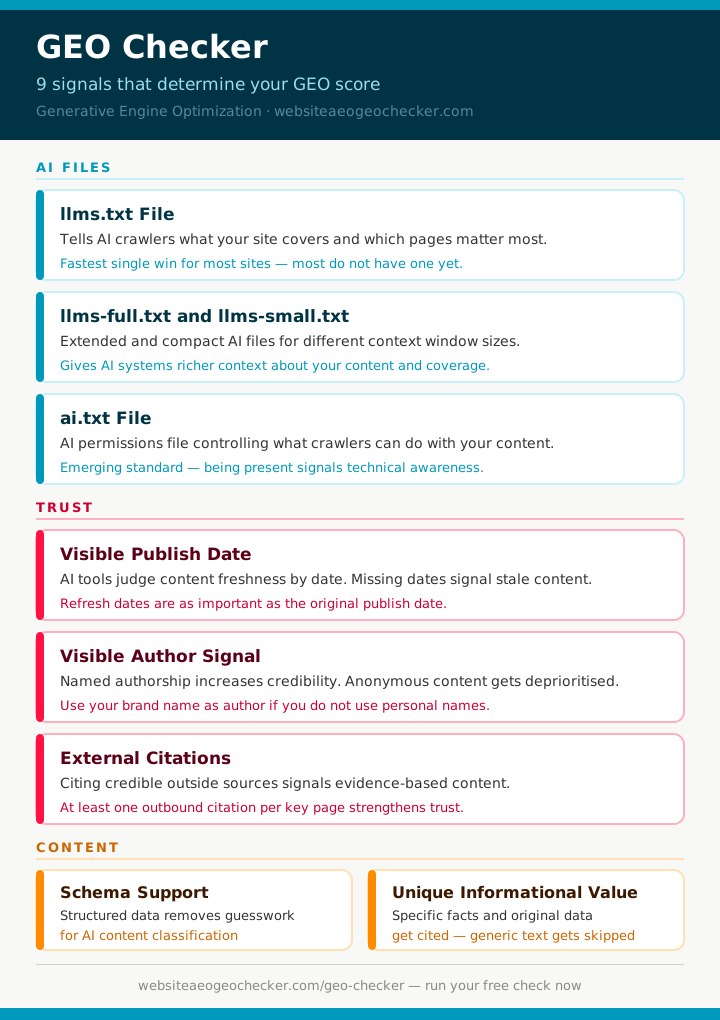
We check 9 signals that determine whether AI tools discover, understand, and trust your site.
llms.txt File Checks if your site has an llms.txt file, that tells AI crawlers what your site is about & which pages matter most. This is one of the simplest improvements most sites can make right now.
Visible Author Signal Checks if the page clearly identifies who wrote the content. Named authorship increases credibility and citation probability.
External Citations Checks if the content references outside sources for important claims or data. Citing credible external sources signals that your content is grounded in evidence rather than opinion.
llms-full.txt File Checks if your site offers a detailed version of the AI file with deeper content & broader context for AI systems that can handle longer inputs.
llms-small.txt File Checks if your site provides a compact version for AI tools, that work with smaller context windows.
ai.txt File Checks whether your site publishes the emerging AI permissions file in the well-known folder. This file sets out what AI crawlers are permitted to do with your content.
Visible Publish Date Checks if the page shows a clear publication date. Freshness is a key trust signal. AI tools use dates to judge whether content is current enough to cite.
Schema Support Checks whether structured data helps AI tools understand the page type & topic. Schema removes the guesswork from content classification.
Unique Informational Value Checks whether the page offers specific details, examples, or original facts rather than generic marketing text. Specific, citable content gets cited. Vague content is always gets skipped.
An llms.txt file is a plain text file placed at the root of your domain. It tells AI crawlers what your site is about. It also tells which pages are most important and what topics you cover.
It is like creating a sitemap for AI instead of search engines.
Most sites do not currently have that. This signals a huge opportunity. Instead of guessing which pages have important information, AI crawlers will have a list. This job is primarily editorial, which likely applies to small teams. You will be explaining your website in a formal, clear, and concise summary that is understandable by AI.
Our tool shows you in real time whether there is an llms.txt page on your site, the relevance of other versions, and the purpose of those versions. This GEO analysis works as both a quick GEO checker and a deeper GEO audit tool, free to run on any website, with GEO optimization recommendations included in every report.
Not sure what an llms.txt file should include? Read our complete guide to llms.txt or check your current file with our dedicated llms.txt Checker.
0 to 3 - Needs work Your site has significant trust and structure gaps. AI tools are likely overlooking it as a source, even when your content is relevant. You can start with llms.txt and visible authorship.
4 to 6 - Improving Some signals are in place but key elements are missing. Focus on the specific issues flagged in your results. Freshness, citations, and schema are usually the fastest gaps to close.
7 to 9 - Strong Your site sends clear, consistent trust signals to AI systems. Keep content updated, refresh key pages quarterly, and check new pages as you publish them.
No account needed. No payment required. Enter your URL and see your score in seconds.
Want to go deeper? Read our Complete GEO Guide or browse all our free tools at the Tools Directory.
Real feedback from website owners and digital marketing specialists using our AI search tools.
Marketing Agency
“I used this as a second opinion during a website review. It brought up some points that weren't obvious from a normal SEO audit, which made it useful for our discussion with the client. 🔎”
Business Owner
“I ran my company website through it just to see where we stood. It pointed out a few things I hadn't thought about & the recommendations were simple enough to follow.”
Online Business Consultant
“I found this surprisingly useful for a free checker. It gave me a quick overview of my website & showed where I could make improvements for AI search. 🙂”
Website Manager
“Very handy for a quick website health check. I liked that the results weren't just a number; they actually gave me ideas on what to improve.”
Product Marketing
“I used it before updating our website, and it helped me spot some gaps in our content & structure; The report gave me a much clearer idea of what AI search engines might be looking for.”
Startup
“I was curious about how my site would perform in ChatGPT and other AI tools, so I gave this a try. The results were surprisingly helpful, and I found a few easy improvements right away. 🚀”
Digital PR
“The report was clear, well organized, and easy to share with my team. Everyone understood what needed to be fixed.”
SEO Advisor
“Highly Recommended...!! I use this tool almost daily. I share PDF with Clients.”
Marketing Agency
“I used this as a second opinion during a website review. It brought up some points that weren't obvious from a normal SEO audit, which made it useful for our discussion with the client. 🔎”
Business Owner
“I ran my company website through it just to see where we stood. It pointed out a few things I hadn't thought about & the recommendations were simple enough to follow.”
Online Business Consultant
“I found this surprisingly useful for a free checker. It gave me a quick overview of my website & showed where I could make improvements for AI search. 🙂”
Website Manager
“Very handy for a quick website health check. I liked that the results weren't just a number; they actually gave me ideas on what to improve.”
Product Marketing
“I used it before updating our website, and it helped me spot some gaps in our content & structure; The report gave me a much clearer idea of what AI search engines might be looking for.”
Startup
“I was curious about how my site would perform in ChatGPT and other AI tools, so I gave this a try. The results were surprisingly helpful, and I found a few easy improvements right away. 🚀”
Digital PR
“The report was clear, well organized, and easy to share with my team. Everyone understood what needed to be fixed.”
SEO Advisor
“Highly Recommended...!! I use this tool almost daily. I share PDF with Clients.”
Your review helps website owners and SEO creators optimize their sites for ChatGPT, Gemini, and AI search engines.