What AEO means
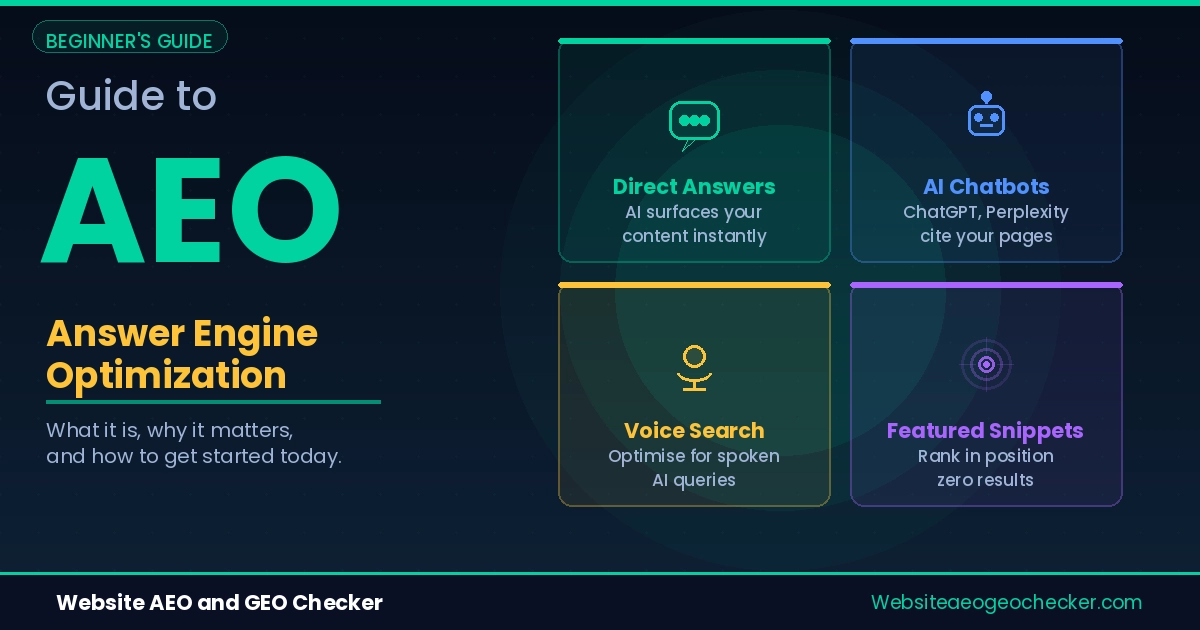
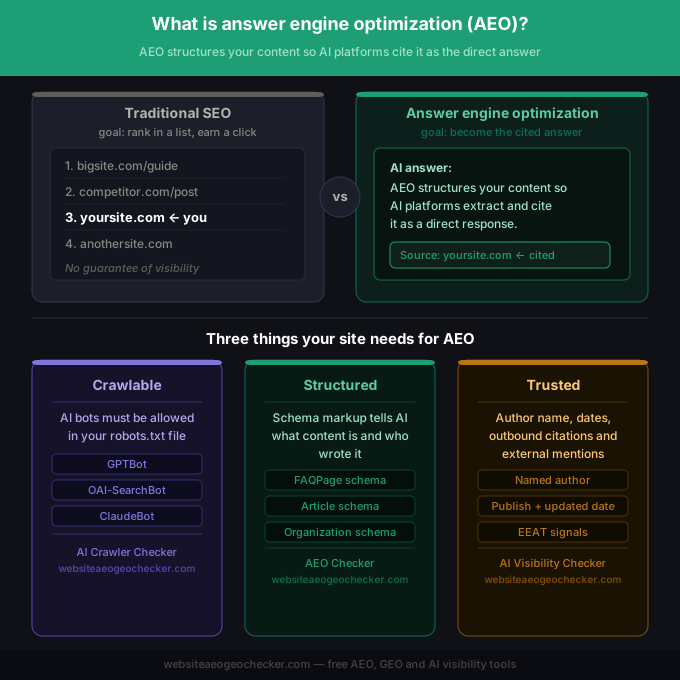
Answer Engine Optimization (AEO) is optimizing your website so AI systems can use it as a source when they answer questions. Instead of focusing only on ranking positions, AEO focuses on being cited, quoted, and summarized. AI answer engines now show results as direct responses, AI Overviews, and chat-style explanations. That changes the goal: the best page is not always the page with the best keywords; it is the page that is easiest to interpret, verify, and extract.
AEO is not a replacement for SEO. It sits next to it. AEO benefits from fast pages, clear titles, and strong authority, but it also needs content structure that models can reliably parse. When an AI system chooses sources, it looks for patterns: clear questions, clear answers, headings that map to user intent, and supporting facts that reduce the risk of hallucination.
How AI engines choose what to cite
Different AI engines have different pipelines, but the citation logic is often similar. The engine needs a source that is:
- Accessible (not blocked by robots.txt).
- Relevant to the query.
- Clear and extractable (structured headings, direct answers).
- Trustworthy (dates, author signals, citations, strong entity clarity).
When a system is unsure, it will prefer pages that make extraction easy. That is why FAQ sections, HowTo steps, tables, and lists are repeatedly cited in AI answers. They provide “clean” units of information that can be reused without rewriting the whole page.
The highest-impact AEO content structure
If you only improve one thing, improve structure. The most common reason websites fail at AEO is that the content is written like a brochure. AI engines do not need hype. They need answers.
Here is the structure that performs well:
- A short label or context line.
- A clear H1 that matches what the page answers.
- An opening paragraph that directly answers the primary question.
- Multiple H2 and H3 headings that are phrased as questions.
- Sections that include facts, numbers, and examples.
- An FAQ section that repeats and clarifies key questions.
This structure is not “for bots”. It is also better for humans, because it reduces scrolling and confusion.
Writing a direct answer opening paragraph
Many pages start with history, vague introductions, or brand storytelling. For AEO, that is rarely ideal. A direct answer opening paragraph should:
- Be long enough to provide context (often 80+ words).
- Include a concrete claim or definition.
- Mention key entities and terms.
- Include at least one verifiable detail when possible.
For example, if the page is about “robots.txt for AI crawlers”, the opening paragraph should mention GPTBot, ClaudeBot, and the impact of blocking those bots. That makes the page immediately useful to an AI engine that is deciding whether this is the right source for a question.
Question-based headings that match AI prompts
Users ask AI assistants questions. Your headings should match those questions. Rewrite headings like:
- “Benefits” → “What are the benefits of X?”
- “Implementation” → “How do you implement X?”
- “Mistakes” → “What are common mistakes with X?”
You do not need every heading to be a question, but having at least three question headings on a page often improves extraction because it gives the model clear “entry points” for answers.
FAQ sections and FAQPage schema
FAQ sections are one of the most consistently cited formats across AI answer engines. They work because they reduce ambiguity. A question and answer pair is already a self-contained unit.
For best results:
- Use 3 to 10 high-intent questions.
- Keep answers short but complete.
- Include one or two factual details when possible.
- Avoid repeating the same question with minor wording changes.
Then make sure the page template can extract FAQ schema from the visible FAQ content. Schema does not replace good content, but it helps machines confirm what the questions are and where the answers are.
HowTo steps, lists, and tables
If your page includes a process, use steps. If it includes comparisons, use a table. If it includes multiple items, use a list. These formats are easier to cite because the model can quote a step or a row without rewriting.
Examples:
- “How to create llms.txt” should be a step list.
- “Which bots should I allow” could be a table by tier.
- “AEO improvements” can be a bullet list with clear action verbs.
Factual density: the anti-hallucination signal
AI engines prefer content that reduces hallucination risk. The easiest way to do that is to include verifiable facts:
- Numbers and percentages.
- Benchmarks such as Google's LCP guidance that explains why under 2.5 seconds is considered good.
- Cited sources such as Schema.org FAQPage or official platform documentation.
- Concrete examples.
You do not need to turn every page into a research paper. But you should support claims with details. A page that says “page speed matters” is weaker than a page that says “LCP under 2.5 seconds is considered good and improves perceived load time.”
Technical basics that still matter
Even though AEO is content-focused, technical issues can block visibility:
- robots.txt rules can block key AI crawlers.
- Missing viewport tags can hurt mobile rendering.
- Broken canonical tags can confuse page selection.
- Slow pages can time out during fetch.
Treat technical SEO as the foundation. Then build AEO structure on top. You can verify these issues with our AI Crawler Checker, Page Speed Checker, and AEO Checker.
A simple AEO checklist you can use today
Use this checklist for any page you want AI engines to cite:
- Does the page answer a specific question?
- Is the answer stated clearly in the first paragraph?
- Are there at least 3 question-style H2/H3 headings?
- Is there an FAQ section with high-intent questions?
- Are there lists, steps, or tables where appropriate?
- Are key claims supported with facts or citations?
- Is the page accessible to AI crawlers in robots.txt?
- Does the page have relevant schema markup?
If you implement these consistently across your site, you will usually see meaningful improvements in AEO scores and in the quality of AI summaries of your content.
How to use our AEO checker effectively
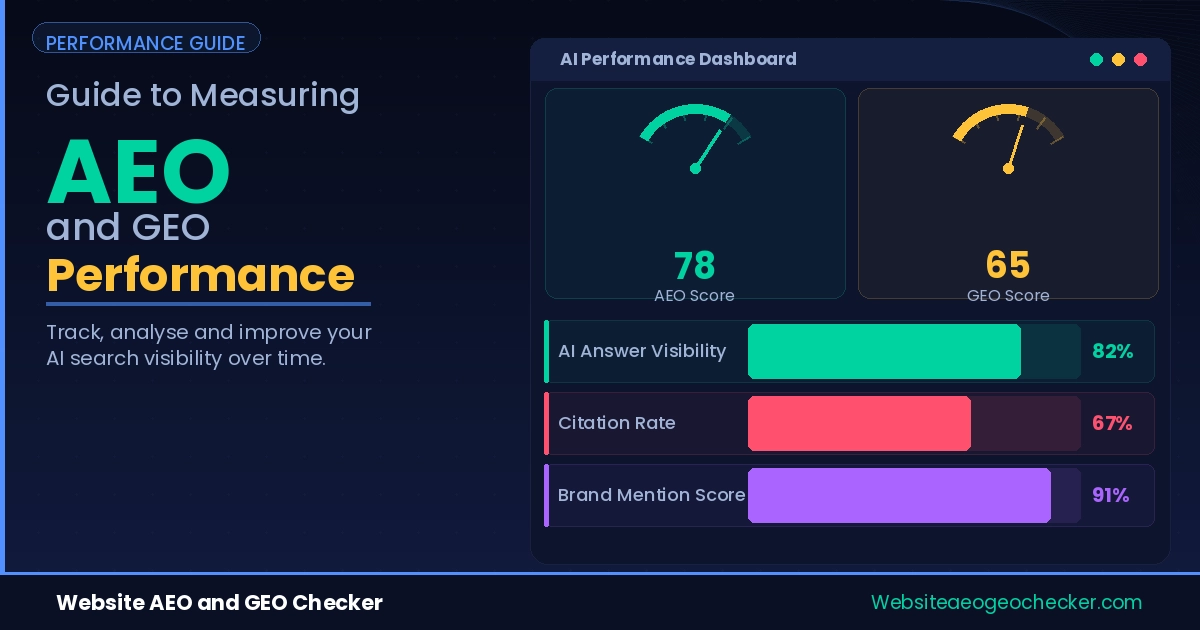
Run the audit on one important page first, not your homepage. Pick a page that is meant to rank and be cited. Review the Top Fixes section and implement the highest-impact changes. Then rerun the report and compare the before and after.
AEO is iterative. The best approach is to improve structure and clarity, then add schema, then expand content depth and factual density. Each round should make the page easier to extract and safer to cite.
AEO vs GEO
AEO and GEO cover different parts of the same problem. AEO is about whether AI systems can extract a clear answer from a specific page. The structure work this guide covers: direct openings, question headings, FAQ schema. GEO is broader. It is about whether your brand is recognized and trusted as an entity across the AI-visible web, your schema, your consistency across other sites, and how your content holds up across engines that retrieve information differently.
In practice, most sites need both. A page can be perfectly structured for AEO and still get skipped if the site behind it has no Organization schema or no external presence AI engines can verify. Run your Free GEO score alongside your AEO score to see whether a gap is a content problem or a trust problem. For the full breakdown, our Complete GEO Guide covers the GEO side in the same depth this guide covers AEO.
FAQs for AEO Guide
What is the fastest way to improve AEO on an existing page?
Start by rewriting the opening paragraph so it answers the main question directly. Then add question-style headings, a visible FAQ section, and at least one list or table. These changes make the page easier for both users and AI systems to understand.
How many FAQ questions should I include on a page?
Five strong questions is a practical target for most pages. That is enough to cover related intent without making the page repetitive. Each question should match a real user query and have a clear answer right below it.
Do I need external citations in every AEO guide?
You do not need citations in every paragraph, but you should support important claims with credible sources. Official docs, Google guidance, and Schema.org references are good options. External citations improve trust and reduce ambiguity.
Should I focus on AEO or technical fixes first?
Fix any blockers first, especially crawler access and rendering issues. After that, improve structure, clarity, and schema markup. A page that AI systems cannot fetch will not benefit from better copy alone.
How do I measure whether AEO changes are working?
Track your audit score, the fixes completed, and whether your key pages are easier to crawl and understand. Then re-run checks after major edits to confirm the changes are live. Consistent small improvements usually outperform one large rewrite.
About the Author
This guide is created by Website AEO GEO Checker.
We built this tool after testing many websites that ranked in search but did not appear in AI answers. The issue was often simple. Content was not clear, structured, or easy for AI to use.
Our free tool checks your website across 50+ AEO and GEO signals. It shows what is working, what is missing, and what you can fix.