
Temmie
VerifiedDigital Merketing
“I tried a few times. It's simple and easy to use. Love this!!”
Millions of people now get answers directly from ChatGPT, Perplexity, Gemini, and Claude instead of clicking through search results. If your website is not showing up as a cited source in those answers, you are missing a channel that is growing every month.
This free checker runs 50+ tests across six scoring modules and shows you exactly where your site stands and what to fix first.
AI search visibility is how often and how clearly your website gets cited when AI tools answer questions related to your topic.
Traditional search visibility is about ranking position. AI search visibility is about whether your site becomes one of the sources behind the answer. That is a different problem with different signals. This free AI visibility checker tool doubles as an AI visibility audit, so you get your AI visibility score and a fix list in the same free report.
AI systems need to do two things with your site before they will cite it. First, they need to discover your site, which involves crawling every page and analyzing the information on each. After that, they have to be confident enough in your site to consider it a reliable source in response to a user question. If either step is not met, your page is invisible to AI search engines, even with a favorable Google ranking.
If a site is designed to meet only the traditional search engine optimization (SEO) criteria, then the site will be more and more unable to meet the AI citation criteria. A site that is structured, has schema markup, has clear and direct answers, has authorship and trust signals, and has pages that are designed to facilitate crawling will be cited across ChatGPT, Perplexity, and Google AI.
AI crawlers blocked in robots.txt If AI bots cannot access your site, they cannot use your pages in answers. This is the most common cause of complete AI invisibility. Check yours with our AI Crawler Checker.
Content hidden behind JavaScript Many AI crawlers do not execute JavaScript. If your content loads client-side, crawlers see an empty page. Your site may look fine in a browser but be completely unreadable to AI.
No schema markup Without structured labels, AI tools have a harder time understanding your page type, topic & question-answer structure. Schema removes the guesswork entirely.
No direct answers Pages written as marketing copy are difficult to quote. Pages that open each section with a direct, clear answer to a real question are easy to extract and cite.
Missing trust signals If your pages have no visible author, no publish date & no outbound citations, AI systems have fewer reasons to treat them as reliable sources. Trust signals are checked before content quality.
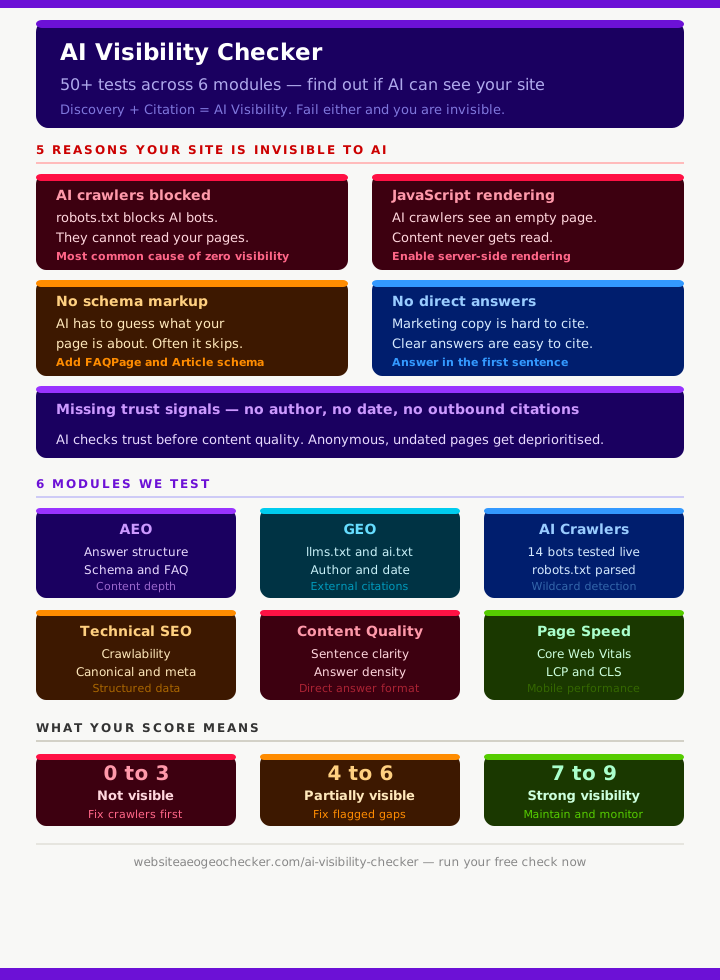
We fetch the real HTML of your page and run it through six scoring modules. Each one tests a different part of AI readiness.
AEO module Reviews answer structure, question-based headings, FAQ sections, schema markup, and content depth. These signals determine whether AI can extract your content as a direct answer.
Content Quality module Checks sentence clarity, answer density, specificity versus generic text, and direct answer formatting.
GEO module Reviews freshness signals, authorship, llms.txt and ai.txt files, external citations, and unique informational value. These are the trust signals that determine whether AI treats your site as a reliable source.
AI Crawler module Tests your live robots.txt file against 14 AI crawlers. Shows exactly which bots are allowed, which are blocked, & which are caught by indirect wildcard rules.
Technical module Checks core on-page setup including crawlability, canonical tags, meta descriptions, and structured data implementation.
Page Speed module Uses real performance data to check Core Web Vitals including LCP, CLS, and mobile load time. AI systems use page speed as a trust signal when selecting sources.
The final report evaluates all six modules, providing a single score along with a ranked list of recommendations. Most sites have more than one area that needs improvement. A page could have strong content but be blocked to crawlers. Another page could load quickly, but have no schema or trust signals. The final report shows which factors are truly holding your site back, rather than suggesting that all issues are equally concerning.
0 to 3 - Not visible AI systems are likely ignoring your site entirely. Start with the AI Crawler Checker, blocked crawlers are the most common cause.
4 to 6 - Partially visible Some signals are working but key gaps are reducing your citation probability. Focus on the specific issues flagged in your results.
7 to 9 - Strong visibility Your site sends consistent, clear signals to AI systems. Keep content fresh, check new pages as you publish, and monitor your citation frequency monthly.
One-off fixes help. But long-term AI visibility comes from consistent habits.
Publish pages that answer real questions directly and clearly. Keep important pages updated so they do not look stale. Show who wrote the content and when it was last reviewed. Cite outside sources when you make factual claims. Keep your technical foundations clean so crawlers can fetch your full HTML quickly.
Add FAQ sections where they make sense. Create an llms.txt file if you have not already. Over time, these habits create a site that is easier for machines to understand and easier for users to trust. That combination gives you the best chance of being cited consistently as AI search becomes the dominant way people find answers.
For a complete strategy guide read our Guide to AI Search Visibility or learn about Technical AI Readiness Checklist at Technical AI Readiness Guide.
AI search visibility means your website can be discovered, crawled, and selected as a source when AI engines answer questions. It is not just about ranking; it is about being a citable reference. Visibility depends on access, content structure, and trust signals.
Common reasons include blocked crawlers in robots.txt, thin content that lacks direct answers, missing schema markup, or weak topical authority compared to competitors. Some pages also rely on JavaScript rendering that crawlers may not fully process. Improving structure and access usually increases the chance of being cited.
You cannot see a complete index, but you can test readiness signals that affect discovery and citations. Check whether AI crawlers can access your site, whether your content answers questions clearly, and whether you publish helpful schema markup. This audit combines those checks into a single report.
Start with the highest-impact basics: allow key AI crawlers, add an FAQ section with FAQPage schema, and rewrite headings as questions with direct answers near the top. Then add author/date signals and citations for important claims. These changes often improve visibility quickly because they reduce ambiguity for models.
No. SEO ranking is about where you appear in traditional search results. AI visibility is about whether AI systems can understand, trust, and cite your content in generated answers. They overlap, but AI readiness requires more structure and extraction-friendly formatting.
It is completely free, no signup, no account. You enter your URL and get your AI visibility score in seconds.
The audit is the full report, all six modules, ranked fixes, not just the number. Every free check on this page already runs the full audit, there's no separate paid tier for it.
Real feedback from website owners and digital marketing specialists using our AI search tools.
Digital Merketing
“I tried a few times. It's simple and easy to use. Love this!!”
SaaS Founder
“This is one of those tools you can use in a couple of minutes and still learn something valuable. 💚 The recommendations were practical & easy to follow.”
SEO Director
“It's free, its Swesome, It's Simple to use!! I have been using this platform for months. This has helped me a lot in optimizing my website.”
SEO Consultant
“I use this with every client to establish an AI visibility baseline. The before/after comparisons clearly demonstrate the value of AI-focused optimization.”
Content Marketing Lead
“The visibility analysis revealed blind spots in our content strategy that we hadn't considered. The AI-specific insights are invaluable.”
Digital Marketing Manager
“We integrated the AI Visibility Checker into our monthly reporting. The visibility trends have become a key metric for our content strategy.”
Head of SEO
“The AI Visibility Checker is unique. No other tool gives this level of insight into how AI search engines perceive and surface your content.”
Marketing Analyst
“Very useful for benchmarking our AI search visibility. The scoring system makes it easy to set targets and track progress.”
Digital Merketing
“I tried a few times. It's simple and easy to use. Love this!!”
SaaS Founder
“This is one of those tools you can use in a couple of minutes and still learn something valuable. 💚 The recommendations were practical & easy to follow.”
SEO Director
“It's free, its Swesome, It's Simple to use!! I have been using this platform for months. This has helped me a lot in optimizing my website.”
SEO Consultant
“I use this with every client to establish an AI visibility baseline. The before/after comparisons clearly demonstrate the value of AI-focused optimization.”
Content Marketing Lead
“The visibility analysis revealed blind spots in our content strategy that we hadn't considered. The AI-specific insights are invaluable.”
Digital Marketing Manager
“We integrated the AI Visibility Checker into our monthly reporting. The visibility trends have become a key metric for our content strategy.”
Head of SEO
“The AI Visibility Checker is unique. No other tool gives this level of insight into how AI search engines perceive and surface your content.”
Marketing Analyst
“Very useful for benchmarking our AI search visibility. The scoring system makes it easy to set targets and track progress.”
Your review helps website owners and SEO creators optimize their sites for ChatGPT, Gemini, and AI search engines.