You have solid Google rankings. Your content is good. But when someone asks ChatGPT or Perplexity about your topic, your brand is nowhere.
That is not a content problem. It is a GEO problem.
Generative Engine Optimization (GEO) is optimizing your online content and digital presence so that AI-based platforms cite your business as a trusted source when responding to questions.
During the course of this guide, you will learn the multiple ways you can structure, optimize, and distribute your content so that AI platforms like ChatGPT, Perplexity, and Google AI Overviews cite your brand in their responses.
If you want to see where your site stands right now, run a free scan with our GEO Checker. It tests over 50 signals and shows you exactly what to fix first.
What Is Generative Engine Optimization (GEO)?
Generative Engine Optimization (GEO) focuses on getting AI-enabled search engines to cite your digital brand.
GEO helps you earn valuable citations on AI platforms by optimizing your digital content so it appears in responses to user queries. AI platforms like ChatGPT and Perplexity do not answer questions by listing websites. They create answers by pulling information from sources they trust. GEO is the practice of becoming one of those trusted sources.
GEO, AEO, GSO, and AI SEO are all terms in the same family of AI content optimization. The community has not yet agreed on a single term, but they all share the same aim: getting your content cited by AI systems.
Research from Princeton University (Aggarwal et al., 2024) was the first to formally quantify this. Their study found that targeted GEO techniques can boost content visibility in generative engine responses by 30 to 40%. The highest-impact tactics were adding citations, including statistics, and structuring content for direct extraction.
How GEO Differs from SEO
SEO and GEO share the same foundation but have different goals.
SEO puts your site in a list on Google. A successful result is a click. GEO gets your material cited in a response generated by AI. In most cases, there is no click. The user finds the answer, your brand is credited, and the citation is built, all without a page visit.
These methods have different optimization signals too. SEO favors keyword density, backlinks, and domain authority. GEO favors factual density, content structure, specific data, and brand credibility for citation. A page may rank on the first page of Google but still not appear in a ChatGPT response because the structural signals GEO requires are absent.
That said, strong SEO is still the foundation. Frase's research found that 38% of AI Overview citations come from pages already ranking in Google's top 10. You cannot skip SEO and expect GEO to work. They are layers, not alternatives.
How GEO Differs from AEO
Answer Engine Optimization (AEO) focuses on Google AI Overviews, featured snippets, and answers provided by virtual assistants. It targets specific, targeted extraction points.
GEO is broader. It tries to earn citations across all generative AI models. When ChatGPT composes a multi-paragraph answer citing five sources, GEO determines whether your site is one of those five. AEO is part of GEO rather than a separate process. For a deep dive into AEO, see our Complete AEO Guide.
How Generative Engines Select What to Cite
To optimize for GEO, you need to understand the selection process. It is not a ranking algorithm. It is a retrieval and synthesis pipeline. Here is how it works across the three main platforms.
How ChatGPT Selects Sources
ChatGPT uses real-time web search via its browsing integration. When a user asks a question, it breaks the query into sub-queries, runs them against a live index, retrieves candidate pages, extracts relevant passages, and synthesizes a response.
Your page can be used as a retrieval source as long as your page permits GPTBot in your robots.txt file. This is the most common point of failure. Many sites block GPTBot through security plugins or CDN settings without knowing.
ChatGPT evaluates the relevance and structure of the page, how recently it was updated, and how trustworthy the page appears. Pages that contain answers in question-and-answer format, include specific data, name authors, and are recently updated score higher.
How Perplexity Selects Sources
PerplexityBot is Perplexity's in-house crawler. Perplexity places the strongest emphasis on authority and corroboration from multiple sources. When multiple independent domains, trade publications, review sites, or news sites mention your brand, Perplexity has higher confidence in your content.
LLMrefs reports that Cloudflare recently changed its default configuration to block AI bots. If your site runs on Cloudflare, your AI bot traffic may have been cut off automatically without any action on your part. Check your crawler access with our free AI Crawler Checker.
How Google AI Overviews Select Sources
Google AI Overviews cite mainly from Google's own search index. Your chances of being cited are directly tied to your Google rankings. Over 38% of AI Overview citations come from pages in Google's top 10.
Strong SEO is more important here than on any other platform. The inclusion of FAQPage schema and question-style headings (H2s and H3s) also increases the chances of content being cited. Google AI Overviews are more likely to cite content that pre-structures questions and answers before extraction.
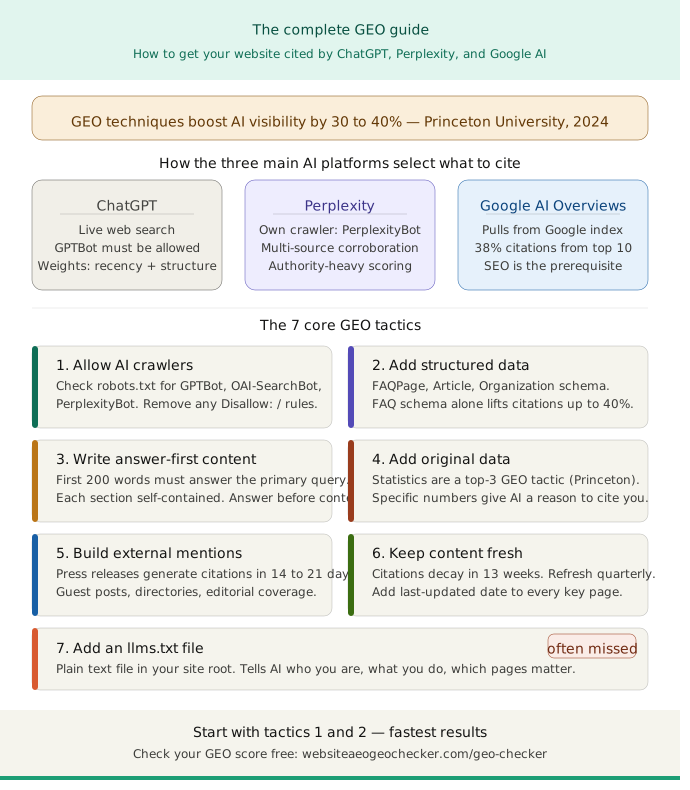
The 7 Core GEO Tactics
These are the tactics with the strongest evidence behind them. Start at the top. Each one you complete removes a barrier between your content and an AI citation.
1. Allow AI Crawlers in Your robots.txt
Before anything else, AI platforms need to be able to read your site. If they cannot, no other GEO tactic matters.
Open yoursite.com/robots.txt in your browser. Check for blocks on GPTBot, OAI-SearchBot, PerplexityBot, and ClaudeBot. If any of those show Disallow: /, remove the block immediately.
If you use Cloudflare, check your firewall rules separately. The platform changed its default settings to block AI crawlers, and many site owners were affected without realizing. Our free AI Crawler Checker shows you exactly which bots are blocked and which are allowed in seconds.
2. Add Structured Data (Schema Markup)
Schema markup tells AI systems what your content is, who wrote it, and what type of information it contains. Without it, AI has to guess. When it is guessing, it often prefers a competitor whose content is explicitly labeled.
The three schema types that matter most for GEO:
- FAQPage schema: pre-parses question-answer pairs into machine-readable format. The Princeton research identified this as one of the highest-impact GEO tactics, associated with up to 40% visibility gains.
- Article schema: identifies author, publish date, and content type.
- Organization schema: establishes your brand as a verified entity with a name, URL, and description.
Check whether your pages have the right schema in place with our GEO Checker.
3. Write Answer-First Content
The first 200 words of any article should directly and completely answer the primary query. Not build toward it. Not set context. Answer it.
AI systems that use real-time retrieval evaluate a page's relevance primarily from its opening content. If your introduction is background and scene-setting, the page scores lower than a competitor that opens with the direct answer.
Apply this to every section too. Each H2 should open with a self-contained answer in the first two sentences. Supporting detail comes after. This is the format AI systems extract from. Our Complete AEO Guide covers how to write direct answer openings in detail.
4. Add Original Data and Specific Statistics
Generic content does not get cited. Specific, verifiable content does.
Princeton's GEO study states that the addition of statistics, specific numbers, percentages, and evidence is one of the three top-impact techniques for AI visibility. AI systems depend on statistics to substantiate the claims they cite.
This is also true for original data. AI engines cite more easily when the data is original and not widely available elsewhere. It is likely to be one of the strongest differentiators available for GEO.
5. Build External Citations and Brand Mentions
AI systems require external verification to validate your brand. Your own site claiming expertise is not enough. AI systems confirm your information by checking whether it is corroborated across multiple unbiased sources.
Press releases distributed through media wire services can begin creating AI-recognizable mentions in under a month. Mentions can also be built by posting on relevant industry sites, inclusion in directories, or editorial citations in industry publications.
Real example: Omar runs a SaaS project management tool with a well-optimized marketing site and solid Google rankings. When he asked ChatGPT and Perplexity about project management tools for remote teams, his product was not mentioned once. He ran our GEO Checker and found the problem immediately: his brand existed only on his own domain. No directory listings, no external reviews, no third-party mentions. He spent six weeks getting listed in five SaaS directories, contributing to two guest posts on productivity blogs, and submitting one press release about a product update. Within three weeks of the press release being indexed, Perplexity started including his tool in comparison responses for relevant queries.
6. Keep Content Fresh
Search Engine Land's 2026 GEO analysis found that AI citations decay in approximately 13 weeks. Pages not updated at least quarterly are three times more likely to lose their citations compared to recently refreshed pages. AI systems weight recency heavily, especially for fast-moving topics.
The fix is not a full rewrite. Add a visible "last updated" date to every key page. Refresh statistics, update examples, and add a new FAQ question each quarter. That signals ongoing editorial oversight, which is exactly what AI systems look for.
Set a 90-day reminder for every important page on your site. Treat it the same way you would treat renewing a domain. Non-negotiable maintenance.
7. Add an llms.txt File
An llms.txt file is a plain text file in your site's root directory that tells AI systems who you are, what you do, and which pages matter most. Think of it as a sitemap written specifically for AI crawlers.
A basic llms.txt includes your brand name, a one-paragraph description of what your site covers, and a list of your most important URLs with a short description of each. Some sites also include their preferred citation format and a summary of their expertise area.
Check whether your site has one with our free llms.txt Checker. If it is missing or formatted incorrectly, the checker shows you exactly what to add.