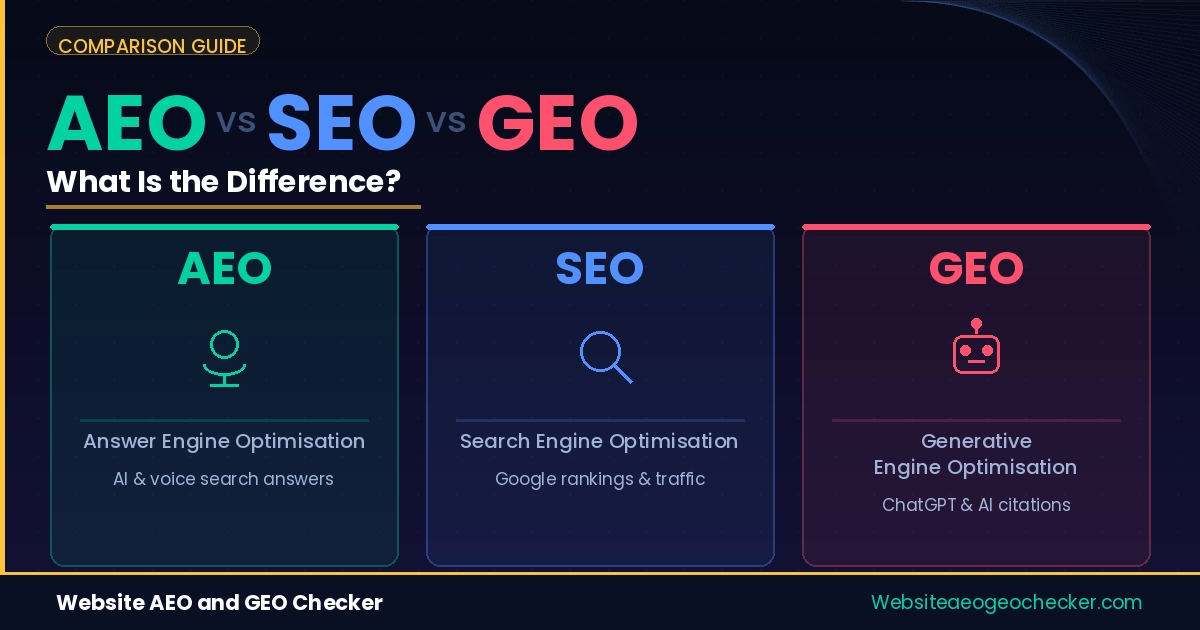
You keep seeing these three terms. SEO you know. AEO and GEO are newer, and most explanations make them sound either identical or completely unrelated. Neither is true.
SEO, AEO, and GEO are three different strategies targeting three different places where people find answers. They share the same foundation, but each one has a different goal, a different surface, and a different definition of success.
This article breaks down exactly what each one means, where they differ, and which one your site needs to focus on first. If you want to see how your site performs across all three, run a free check with our GEO Checker.
The Quick Answer
- SEO gets your page into a ranked list of blue links on Google or Bing. The goal is a click.
- AEO gets your content selected as the direct answer inside AI-powered features: Google AI Overviews, featured snippets, Bing Copilot, and voice assistants. The goal is to be the cited answer.
- GEO gets your brand referenced inside AI-generated responses from platforms like ChatGPT, Perplexity, and Google AI Mode. The goal is to be a trusted source that AI synthesises from.
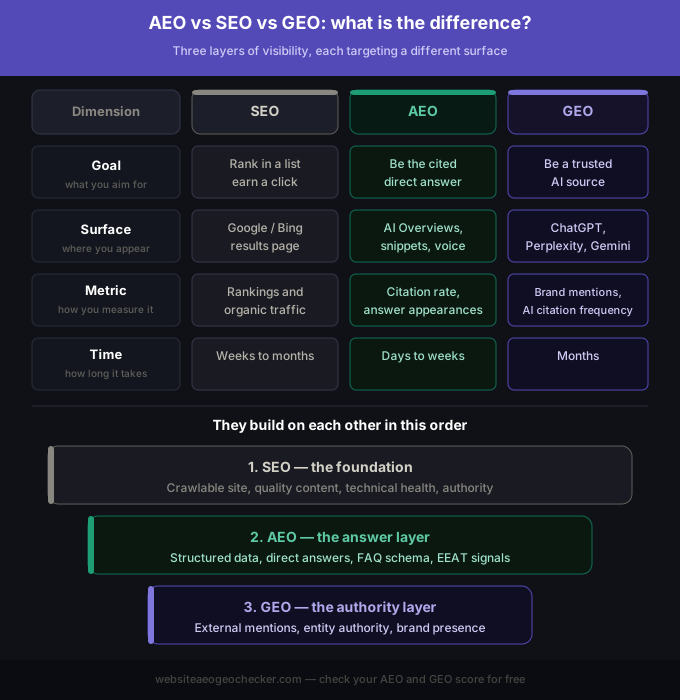
They are not competing strategies. They are three layers of the same overall visibility goal. Most sites need all three, but the order in which you address them matters.
What Is SEO?
SEO is the process through which pages are optimized to rank higher in the results of conventional search engines. So, the process has had the majority of the online marketplace presence for more than twenty years.
The results of a Google search are your marketplace, and the objective is to rank among the first three spots for the results of the search query of your audience. You are considered successful if you achieve high rankings, gain increasing traffic, and get the most clicks.
At the grassroots level, SEO includes factors like page title, the presence or omission of one or more of the headings usually required to create the page, the page content, and the links both to and from the page.
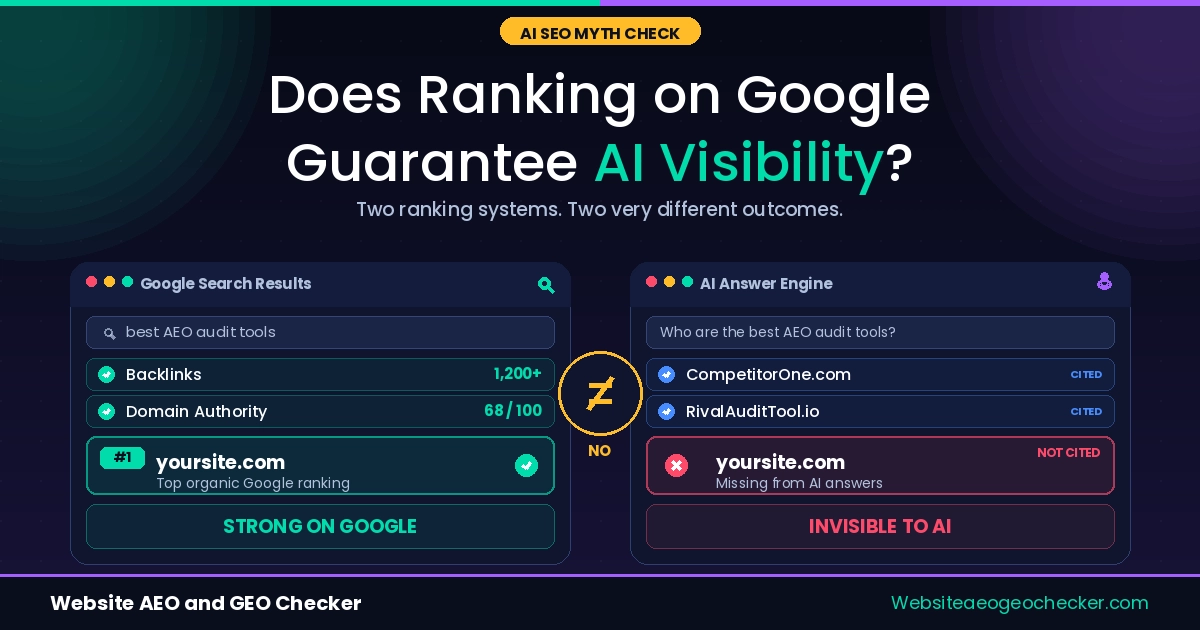
SEO still drives the largest share of commercial traffic in 2026. It is not dying. But its share is shrinking as AI-powered answer surfaces absorb more and more quick-answer queries, and as zero-click searches continue to grow. Research from Jasper found that AI Overviews have reduced click-through rates for top-ranking Google content by 58%. People get the answer on the page. They do not need to click.
What Is AEO?
AEO (Answer Engine Optimization) is the practice of structuring your content so AI-powered answer features select it as the cited source for a direct answer.
The surfaces AEO targets include:
- Google AI Overviews (the AI-generated summary at the top of Google results)
- Featured snippets and People Also Ask boxes
- Voice assistant responses (Google Assistant, Siri, Alexa)
- Bing Copilot answers
AEO operates at the level of facts, and not at the page level. AI breaks the page into chunks, and each chunk is either usable or not. For SEO, a page may rank first, but for AEO, it may fail because the content is not chunked and structured for extraction.
With SEO, the objective is to rank first. With AEO, it is to be the answer that is preferred over SEO rank. SEO puts you on the menu, but AEO selects you as the recommended dish.
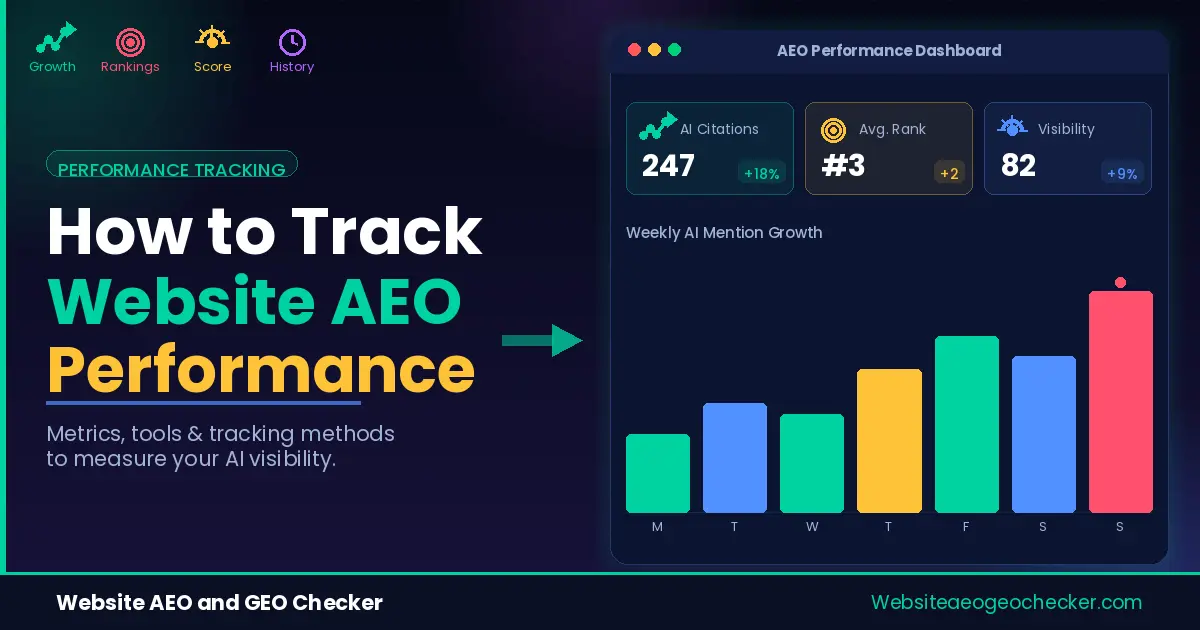
AEO also has distinct metrics for success. New metrics come from being cited, getting pulled into AI, and being included in answer boxes.
What Is GEO?
GEO (Generative Engine Optimization) is the practice of making your brand a trusted source that AI language models cite when generating answers from scratch.
The surfaces GEO targets are different from AEO:
- ChatGPT (including browsing mode and SearchGPT)
- Perplexity AI
- Google AI Mode
- Claude, Gemini, Meta AI
While AEO prioritizes the extraction of a given answer, GEO favors inclusion in a synthesised answer constructed from many sources. GEO refers to the AI reading dozens of pages to generate its own answer. Your brand may or may not get named in the answer.
GEO prioritises entity and authority. It does not originate from your site. Your brand should be mentioned and included in numerous well-reputed websites. This includes training data inclusion, citation of your brand by a trusted third-party, and popularity along with consistency of your brand entity sites throughout the web.
Neil Patel's analysis summarises the distinction well: AEO helps you win visibility in high-intent, answer-focused moments. GEO builds lasting trust and relevance as search evolves. They serve different purposes and work best together.
Check how your site performs in generative AI responses with our GEO Checker.
SEO vs AEO vs GEO: Side by Side
| SEO | AEO | GEO | |
|---|---|---|---|
| Goal | Rank in a list | Be the cited answer | Be a trusted AI source |
| Surface | Google/Bing results page | AI Overviews, snippets, voice | ChatGPT, Perplexity, AI Mode |
| Success metric | Rankings, clicks, traffic | Citation rate, answer appearances | Brand mentions, AI citation frequency |
| Works at | Page level | Fact/chunk level | Entity/authority level |
| Requires | Keywords, links, technical SEO | Structured content, schema, direct answers | External mentions, entity consistency, authority |
| Time to results | Weeks to months | Days to weeks (for live search) | Months (for training data) |