Someone in your town just asked ChatGPT for the best accountant nearby. Or the best plumber. Or the most reliable web designer for a small business.
Did your name come up?
Do you know if your competitors are using AI search? For most local businesses, the answer is actually no. It is not because you're lacking skills in your field. People search differently now, and small businesses generally can't keep up with search engine advancements because of how time-consuming the process is.
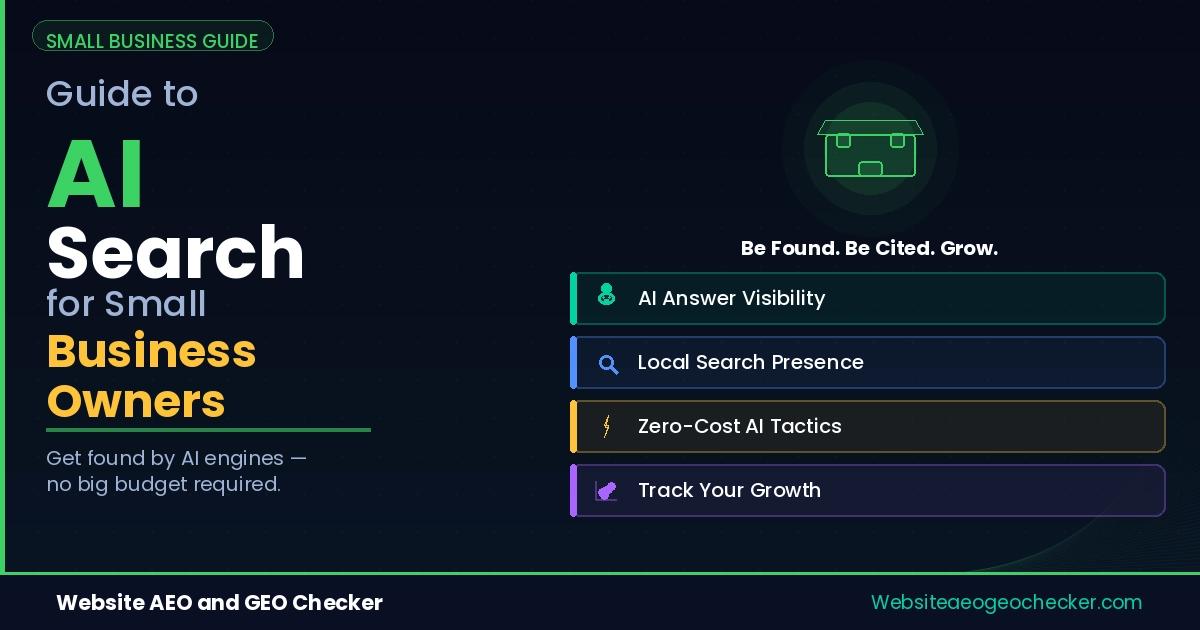
This AI search guide is meant for small businesses. The search engine is plain and simply explained. There are no codes, no technical nonsense, and no complicated processes. All that exists is the what and the why AI search engines matter for your business, and what steps you can take that are simple and free, and that can be completed in a couple of hours.
Run a free check on your website before you start. It shows you exactly where you stand right now.
Key Points: AI Search and What It Means for Small Businesses
- • 44% of consumers now use AI as their primary source of information when making purchasing decisions, meaning small businesses invisible to AI are missing an active and growing buyer segment.
- • Branded web mentions correlate with AI visibility at 0.664 versus backlinks at 0.218, meaning your presence on review platforms and local directories matters more than your link profile for AI citation.
- • Only 23% of marketers are currently optimizing for AI visibility, leaving the competitive landscape inside AI generated answers significantly more open than traditional search results pages.
- • When you run your site through Website AEO GEO Checker, it shows exactly where your business stands on the signals AI platforms use to decide which businesses to recommend.
Check Your AI Visibility Free Before You Start
Before working through any of the fixes below, spend two minutes finding out where you actually stand. Our free AI visibility checker looks at the same signals AI platforms use to decide whether to recommend a business, crawler access, schema, content structure, and gives you one score plus a list of what's missing. You don't need an account, and there's no cost to run it. This AI visibility checker tool is free the same way every tool on this site is. Run it on your homepage first, then your two or three most important service pages, since those are usually the ones a customer's question would actually land on.
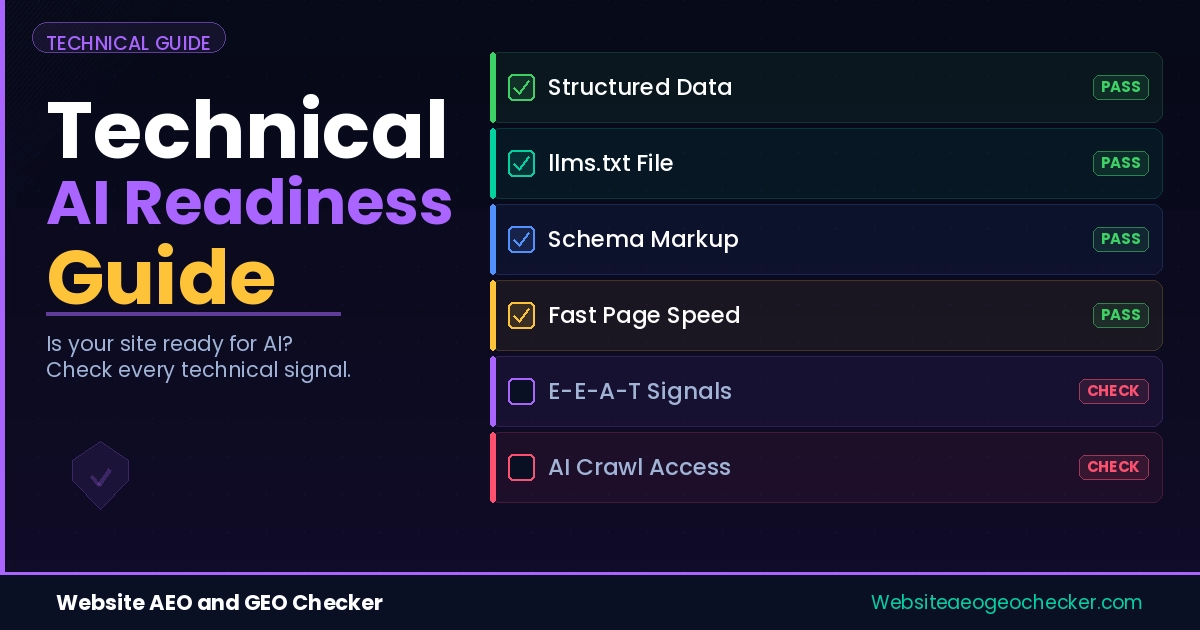
Once you have your starting score, work through the seven signals below in order. They're the same things the checker just scored, explained here in plain language.
What Has Actually Changed About Search
For twenty years, getting found online meant one thing: ranking on Google. You put keywords on your pages, built some links and hoped to appear near the top of the list.
That is still relevant. But it is no longer the whole picture.
Research from Entrepreneur found that 64% of consumers now use AI tools to discover new products and businesses. Among frequent online shoppers, that rises to 66%. ChatGPT alone processes over 2 billion queries a day.
With AI search, customers are no longer provided with a simple list of links. Instead, they are provided with one, or maybe two or three answers. If your small business isn't included in the answer, the customer isn't being influenced by your business.
A search engine's preference for larger, big-name businesses is not the case for AI search. The search engine favors authoritative and well-structured content, and most importantly, helpful content. That means small businesses that provide trustworthy, helpful, and witty content can still play in the same space as the big businesses.
From our analysis, small businesses with structured, question-focused content achieved up to 30% higher inclusion in AI-generated answers. - Website AEO GEO Checker
Why AI Search Is Different from Google
Google shows you a list. You rank somewhere in that list. You might be third or seventh, and people scroll and click.
AI search is a little more complicated. For example, if someone searches "who is the best electrician in Bristol," or "what accounting software should I use for a small retail shop," the AI doesn't provide relevant links. Instead, the AI synthesizes trustworthy content from relevant links. Time spent creating web content is a time investment for your business.
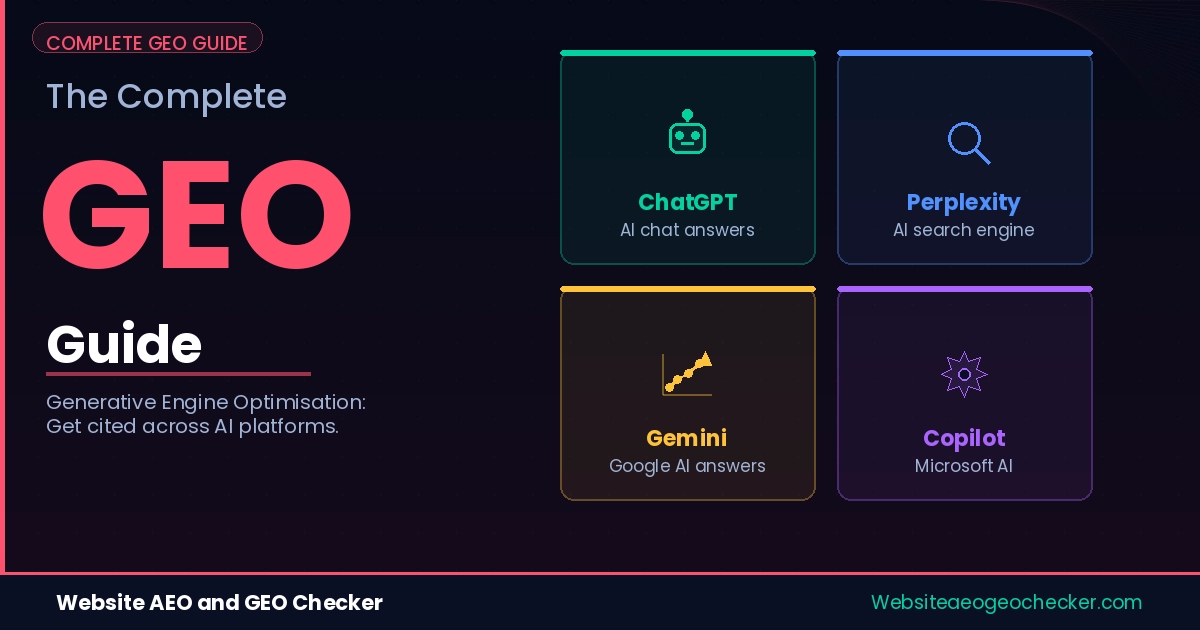
A SOCi study analysing nearly 350,000 business locations found that ChatGPT recommended only 1.2% of locations. Gemini recommended 11%. Perplexity recommended 7.4%. Those are very small windows. But they are also an enormous opportunity for the businesses that appear in them, because the people asking are already close to a decision.
Often, buyers choose options before visiting a site. To assess credibility, they rely on summaries, comparisons, and third-party descriptions. This context underscores the importance of AI search for small businesses.
Remember, You are not simply competing for a single click. You are competing for a name customers trust before they open a browser tab.
7 Things That Determine Whether AI Recommends Your Business
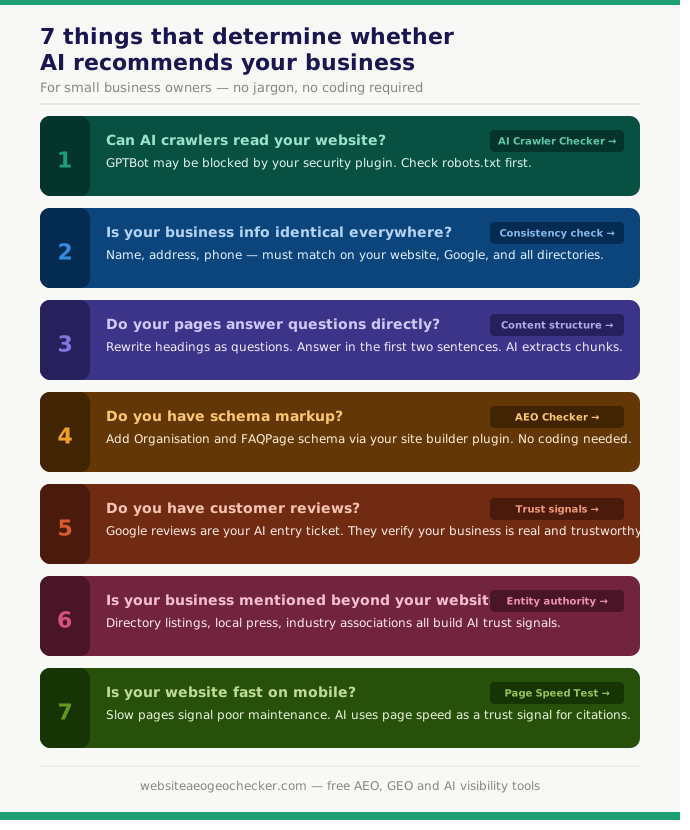
1. Can AI Crawlers Actually Read Your Website?
Before anything else, AI platforms need to be able to access your website. Most people do not know this. But many websites accidentally block AI crawlers through security settings or hosting configurations.
The main AI crawler for ChatGPT is called GPTBot. If your website is blocking it, ChatGPT cannot read your pages. You can check your current setting with our free AI Crawler Checker. It takes about 30 seconds and shows you exactly which AI systems can and cannot access your site.
2. Is Your Business Information Consistent Everywhere?
Ensure all your business details match across platforms. Even small discrepancies can impact your visibility. Inconsistent information can confuse AI systems and lower your visibility.
You should provide the same name, address, phone number, and service descriptions for your Google Business, social media, and directory listings, plus your website. AI validates your identity using all of these. A mismatch between these listings is interpreted as unreliable.
3. Do Your Pages Answer Questions Directly?
AI systems extract answers from web pages. They look for a clear question followed by a direct answer in the first one or two sentences below it.
The majority of small business sites prefer the sales copy format. For the family runs a plumbing business, it is an unsaleable sentence for the AI, but it is fine for human readers. The problem is that the AI's answer to "what is the cost of an emergency plumbing service in Manchester" is the sale copy itself.
Would you say "the Manchester family plumbing service is over 20 years old" is a clear service page; which is the case for the majority of sales info-heavy pages? The better option, remember to answer a specific question and keep it brief.
4. Do You Have Schema Markup?
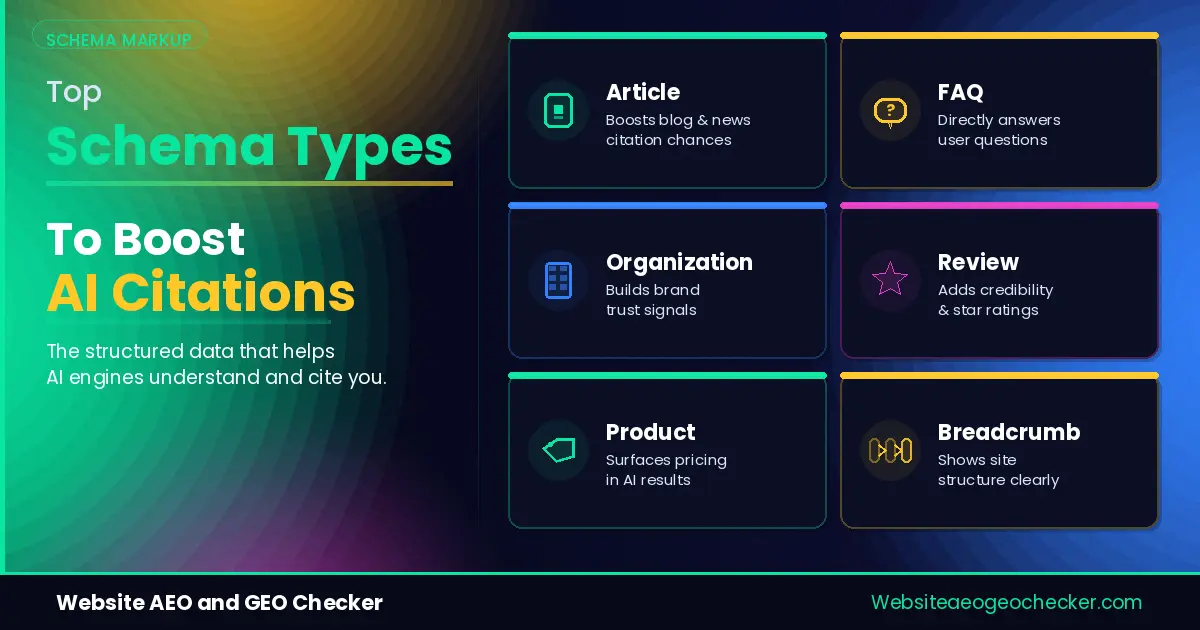
Schema markup is a small piece of code that tells AI systems what type of business you are, what services you offer, where you are located, and who you are. Most small business websites have none.
You do not need to write code to add it. Many website builders (Squarespace, Wix, Webflow and WordPress) allow for schema implementation. Add Organization schema to your home page and FAQPage schema to question-and-answer pages.
Check whether your site has the right schema with our AEO Checker.
Real example: Karen runs a small bookkeeping firm in Leeds. She had a well-designed website and good Google rankings for local searches but never appeared when potential clients asked ChatGPT for accounting help for small businesses; She ran our AEO Checker and found two problems: no schema markup anywhere on her site & her service pages were written entirely in marketing language with no direct answers to common questions; She spent one Saturday adding Organisation & FAQPage schema through her WordPress plugin and rewrote the headings on her three main service pages as questions. 6 weeks later, Perplexity was citing her FAQ page when users asked about bookkeeping costs for small businesses in Yorkshire.
5. Do You Have Customer Reviews on Trusted Platforms?
AI search uses threshold logic. It does not rank all companies. It only selects those that exceed a quality threshold. Reviews are your entry ticket.
Google reviews, Trustpilot, industry-specific directories - these external signals tell AI systems that real customers have verified your business. A business with 40 detailed Google reviews is far more likely to be cited by AI search engines than an equivalent business with none.
Ask your current customers for reviews. Make it easy by sending a direct link. Do not ask for five stars specifically - ask for an honest account of their experience. Genuine, detailed reviews carry more weight than generic ones.
6. Is Your Business Mentioned Anywhere Besides Your Own Website?
Consistent business listings across directories strengthen trust signals and improve AI visibility. Recent, detailed customer reviews influence both rankings and consumer decision-making.
To define your business, AI systems need external verification of your business's location and relevance. AI has no proof that your business exists outside your website if your business exists outside your website. Be listed on appropriate directories. Be mentioned in local journalism, if it can be achieved. Be a member of trade groups that provide the lists of their members.
7. Is Your Website Fast and Easy to Use on Mobile?
Google said that the majority of traffic from AI search tools to websites tends to have customers engaging with the content and being more likely to be converted due to its greater relevance. However, AIs must first be able to display the website.
A slow website signals poor maintenance. AI systems factor performance into trust signals. If your pages take six seconds to load on mobile, that works against you. Check your speed and AI readiness with our Page Speed Test.
The Small Business AI Search Action Plan
You do not need to do everything at once. This is the order that gets results fastest with the least time investment.
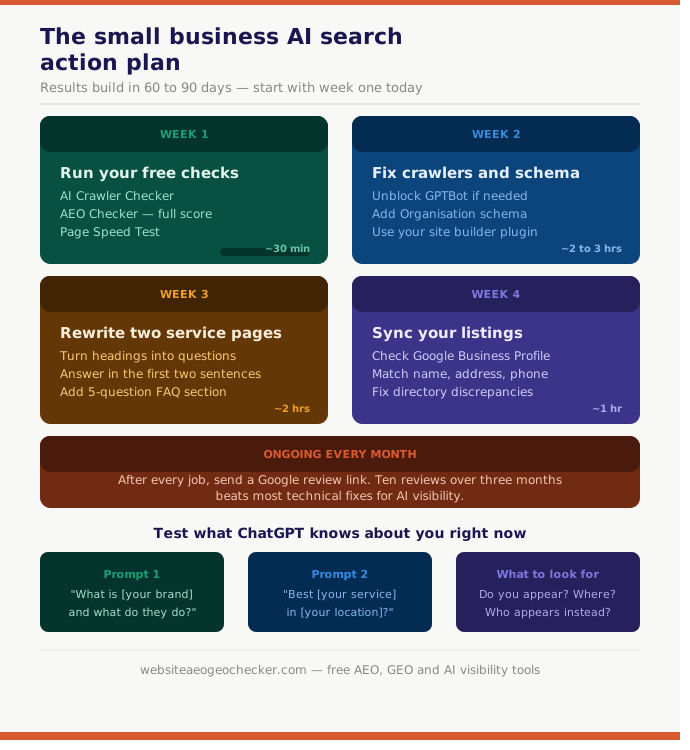
Week 1: Run your checks (30 minutes)
Use our free Tools Directory to run three checks: AI crawler access, AEO score, and page speed. Write down what fails. These are your priorities.
Week 2: Fix crawler access and add schema (2 to 3 hours)
If AI crawlers are completely blocked from accessing your website, it needs to be prioritized. If that's been rectified, the next most important thing is adding the Organisation schema to your homepage. (Then, make sure that website builders have schema plugins on their websites. If they do not, add a JSON-LD block to the homepage header. You can generate the code if you need to.)
Week 3: Rewrite two service pages (2 hours)
Pick your two most important service pages. Change every heading into a question. Then rewrite the first paragraph of each section so it answers the question directly in two sentences. Also add a FAQ section at the bottom with five real questions your customers ask, answered clearly.
Week 4: Update your business listings (1 hour)
Always check your Google Business Profile, main social profiles, and top three directory listings. Make sure your business name, address, phone number and services are identical everywhere. Always fix any discrepancies.
Ongoing: Ask for reviews monthly
After every successful job or a positive customer interaction, send a humble follow-up message with a direct link to your Google review page. Ten new reviews over 3 months does more for your AI visibility than most technical fixes.
Websites maintaining consistent updates and clean technical signals saw a 2x increase in AI visibility within three months. - Website AEO GEO Checker