You fixed your robots.txt. You added schema. You restructured your key pages. You check GA4 a week later and see nothing different.
That is not a sign the work is not having an effect. It is a sign that GA4 was never built to measure what you just improved.
Standard analytics capture clicks. AEO and GEO results may produce visibility without clicks. Your brand can be named in a ChatGPT answer and viewed by thousands, and your clicks will stay at zero. This experience gap is why most site owners either give up on AEO and GEO or do not know whether they are working.
This guide explains what to measure and how to do it without paid tools, plus a realistic monthly reporting routine. You will have a measurement system that illustrates what is actually occurring within AI search, rather than what GA4 is telling you.
Run a baseline check before you start: our free Website AEO Checker and Website GEO Checker give you a score to measure future progress against.
Why Traditional Analytics Miss AEO and GEO Performance
When a brand is referenced in a ChatGPT response, one of three things happens. Your link is clicked. Your brand name is noted but there is no click. Or the information is retained and they move on with the brand name remembered.
GA4 measures the first scenario. It misses the second and third entirely.
Research from Conductor found that major publishers like Reuters and The Guardian receive less than 1% of their referral traffic from ChatGPT and Perplexity despite being among the most frequently cited sources on both platforms. Citation and traffic are not the same thing. Citation builds brand awareness and trust at the top of the funnel. Traffic is a downstream effect that may come later, through branded search, direct visits, or referrals from people who remembered you from an AI answer.
What GA4 cannot tell you on its own:
- Which AI platforms are citing your pages
- Whether your brand appears in synthesized answers at all
- How your citation frequency compares to competitors
- Whether AI mentions frame your brand positively or negatively
- Which of your pages are earning citations and which have dropped off
To measure AEO and GEO properly, you need a different set of metrics alongside your existing analytics, not instead of them.
From our analysis, brands that appear consistently in AI responses often achieve a Share of Model above 30%, showing strong visibility across prompts. - Website AEO GEO Checker
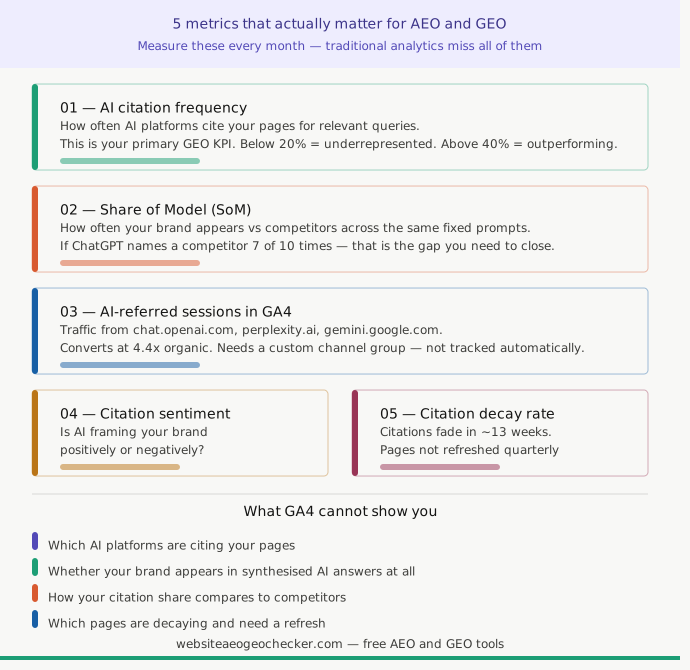
The Five Metrics That Actually Matter
1. AI Citation Frequency
AI citation frequency measures how often AI platforms mention your brand or cite your pages when answering questions relevant to your topic area.
This is the primary KPI for GEO performance. You measure it manually by running a consistent set of prompts across AI platforms each month and recording whether your brand appears in the response.
Benchmarks from WebFX give a useful rule of thumb: an AI visibility rate below 20% across your tracked queries means you are underrepresented in your space. Above 40% means you are outperforming most competitors. Most sites starting out sit close to zero.
The number matters less than the direction. A site going from 0% to 12% citation rate over three months is making real progress, even if 12% sounds low in isolation.
2. Share of Model
Share of Model (SoM) and share of voice have one thing in common: they both attempt to quantify a brand's visibility in the marketplace. SoM takes this a step further by explicitly evaluating a brand's visibility in comparison to competitors each time an AI model is prompted to answer a question.
Suppose your competition is cited in 70% of responses in a series of answers, and your site is cited in just 20%, demonstrating a 70% to 20% share of the model. In your traditional marketing toolkit, this serves as a competitive benchmark. It shows where your competitive advantage comes from and where it is lacking.
Real example: Chris runs an e-commerce platform helping independent retailers. His AEO and GEO scores had improved over two months but his GA4 traffic showed no change. He ran ten buyer-intent prompts through ChatGPT and Perplexity, questions like "best platform for small retail stores" and "how to sell online as an independent shop." A competitor appeared in eight of the ten ChatGPT responses. His own site appeared in none. He identified the gap: his competitor had been cited in three industry publications that he had not. He spent 6 weeks getting mentioned in two of those publications and restructuring his comparison page. Six weeks later, he appeared in 4 of the 10 prompts. His branded search on Google also increased 18% in the same period, a downstream effect of the AI citations building awareness.
3. AI-Referred Sessions in GA4
AI referral traffic is small in absolute terms but highly valuable in quality. Data from LLM Pulse shows AI referral traffic converts at 4.4 to 5 times the rate of traditional organic search. People who click through from an AI citation are further along in their decision journey than someone browsing a search results page.
GA4 does capture some of this traffic, but not automatically in a useful form. You need to set up a custom channel group to track it properly. The sessions show up as referral traffic from domains like chat.openai.com, perplexity.ai, gemini.google.com, and bing.com/chat.
AI referral traffic currently accounts for about 1.08% of all website traffic across tracked properties, growing at roughly 1% month over month. That trajectory is worth tracking now, before it becomes a major channel, so you have historical data when it does.
4. Citation Sentiment
Not all citations are equal. If an AI model says "an approach that works well is based on [your brand]," that is far better than "there are some issues based on [your brand]'s approach."
Sentiment is hard to quantify at scale, but your manual prompt audits will capture it. Note whether each citation frames your brand positively, neutrally, or negatively. A brand that is cited negatively has a content or reputation gap that is far more important to address than marginal content improvements.
5. Citation Decay Rate
AI citations are not permanent. Research has shown that citation priority decays if source content is not updated or refreshed within approximately 3 months.
Pages not updated quarterly are three times more likely to lose their AI citations compared to recently updated ones.
Citation decay rate is measured by comparing your prompt audit results month over month. If a page that earned citations in January shows none by April, that is a decay signal. The fix is almost always a content refresh: updated statistics, a new FAQ question, revised examples, and a new "last updated" date.
Tracking which pages are decaying tells you exactly where to spend your refresh effort each month, rather than guessing.
Where AI Visibility Score Fits Into Your Dashboard
The five metrics listed previously assess AI answers themselves (citations, sentiment, decay, etc.). Your AI visibility score assesses something that is more fundamental to those metrics: whether your site can be cited structurally. This score captures your AEO and GEO scores. Like your AEO and GEO scores, this score should appear in the same dashboard, but in a different row.
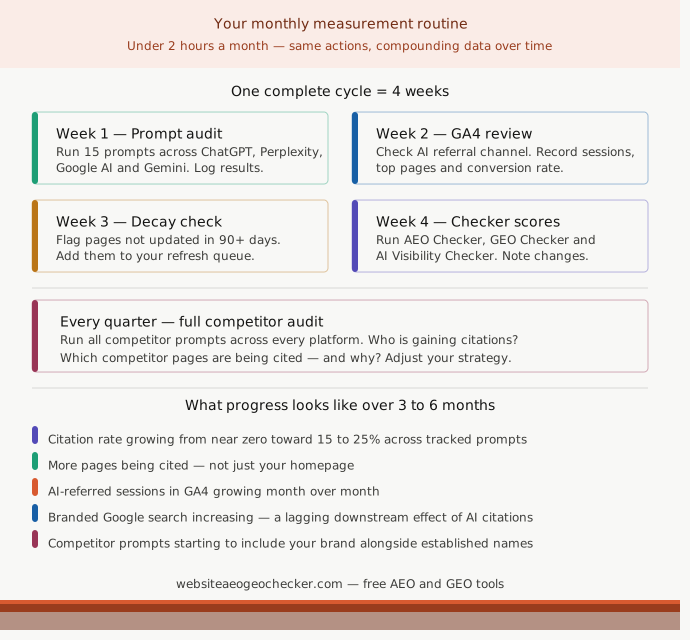
Think of it as your leading indicator. A prompt audit tells you what happened last month. Your AI visibility score tells you what's likely to happen next month, since it's measuring the crawlability, schema, and content structure that determine whether AI systems can cite you at all. Run a free AI visibility audit alongside your Week 4 checker scores, and log the number the same way you log citation frequency: same day each month, same pages, same spreadsheet tab.
The scores should change concurrently over a quarter. If your AI visibility score increases and the citation frequency does not change, you have done the structural changes and the gap is now a competitive one. If citation frequency increases and your score does not change, it is a result of something else (e.g., a strong external mention, a viral moment) and the momentum will not last.
Key Points: How to Measure AEO and GEO Performance
- • Only 16% of brands systematically track AI search performance despite 43% naming it a core priority, creating an enormous gap between investment and measurement across the industry.
- • The same brand can see citation volumes differ by hundreds of times across different AI platforms, making platform specific measurement essential rather than optional.
- • Perplexity converts referred traffic at 10.5% per session versus 1.76% for Google organic, meaning businesses measuring only total AI referral traffic are missing the most commercially valuable platform signal.
- • At Website AEO GEO Checker, we consistently see businesses that have invested in optimization but have no systematic way to verify whether that investment is producing actual AI visibility.
How to Track AI Citations Manually
You do not need a paid tool to start measuring. This method takes about 90 minutes a month and gives you reliable, actionable data.
Step 1: Build Your Prompt Library
A prompt library is a fixed set of questions you run across AI platforms every month. Because you use the same prompts each time, changes in your results reflect actual changes in your AI visibility rather than query variation.
Build three types of prompts:
Brand prompts: Direct questions about your brand:
- "What is [your brand name]?"
- "What does [your brand name] do?"
- "Is [your brand name] a reliable source for [your topic]?"
Topic prompts: Questions in your subject area that do not mention your brand:
- "What is the best way to check AEO readiness?"
- "How do I improve my website's AI visibility?"
- "What tools check if AI crawlers can access my site?"
Competitor prompts: Questions where competitors are likely to appear:
- "What are the best AEO tools in 2026?"
- "How do I check my GEO score?"
- "Which website checker tests AI crawlability?"
Aim for 10 to 15 prompts in total. Keep them stable month over month. Rewrite prompts only when they no longer reflect real user intent.
Step 2: Run Prompts Across Platforms
Run each prompt through ChatGPT (with browsing on), Perplexity, Google AI Overviews (by searching on Google), and Gemini. That is four platforms per prompt.
For each result, record:
- Did your brand appear? Yes or no
- Where in the response? First mention, secondary mention, or not cited
- Which URL was cited, if any
- Sentiment: positive, neutral, or negative
- Which competitor appeared instead, if applicable
This takes about 60 minutes for a library of 15 prompts across four platforms.
Step 3: Build Your Tracking Spreadsheet
Set up a simple spreadsheet with these columns:
| Prompt | Platform | Cited? | Position | URL Cited | Sentiment | Competitor Cited | Date |
|---|
Run the same prompts each month and add a new set of rows. After three months you will have enough data to calculate your citation frequency, Share of Model, and decay patterns. This spreadsheet is your AEO tracker, the same file you open every month for the rest of this routine, not a one-time export you run once and forget.
Your citation frequency is: total prompts where you were cited divided by total prompts run, expressed as a percentage.
Your Share of Model is: prompts where you were cited divided by prompts where any brand was cited.
In our testing, even a small increase in AI mentions can significantly improve Share of Model, highlighting how competitive AI visibility has become. - Website AEO GEO Checker
How to Track AI-Referred Traffic in GA4
GA4 does not automatically separate AI referral traffic from other referral sources. Here is how to set it up.
Step 1: Create a custom channel group
In GA4, go to Admin, then Channel Groups, then Create New Channel Group. Name it "AI Referral."
Add rules to match sessions where the session source contains any of these domains:
- chat.openai.com
- perplexity.ai
- gemini.google.com
- bing.com (for Copilot traffic)
- you.com
- claude.ai
Step 2: Create a segment
In Explore, create a user segment filtered by session source matching the same domains. This lets you analyze the behavior and conversion rate of AI-referred visitors separately from organic traffic.
Step 3: What to track monthly
- Total AI-referred sessions
- Top landing pages from AI referrals
- Conversion rate of AI-referred sessions versus organic
- Month-over-month growth rate
The absolute numbers will be small at first. Focus on the growth rate and the conversion quality. Both should improve as your citation frequency improves.