Website AEO and GEO Checker logoWebsite AEO and GEO Checker
WEBSITE AEO AND GEO CHECKER

The Complete Guide to AI Search Visibility

2026-04-30 · 18 min read · Difficulty: Intermediate

The complete guide to AI search visibility — technical foundations, content strategy, platform tactics, and brand authority for ChatGPT, Perplexity, and Google AI Overviews

Something changed in how people search. You may have already noticed it in your traffic.

Users have shifted from scanning ten Google results to opening ChatGPT and getting a one-sentence answer. If your brand is included, you gain visibility. If it is not, you receive no ranking, no clicks, and no impressions.

Search sessions with AI do not result in a website click 93% of the time, with AI Overviews reducing clicks to the number one page by 58%. This is happening in real time, billions of times every week.

AI search visibility is making your brand cited in AI search. This guide covers everything from site infrastructure to brand visibility and measurement.

The Scale of AI Search Right Now

Before optimizing for something, it helps to understand how large it actually is.

ChatGPT processes 2.5 billion prompts each day and has 800 million weekly users. Google AI Overviews reach 1.5 billion monthly users, and AI referral traffic is growing roughly 1% month over month across all industries.

Citation patterns show 80% of LLM citations do not come from pages ranking in the top 100 results. AI search is not simply a Google SEO extension. It uses different source selection channels that can surface pages outside your most visible organic content.

Perplexity receives 6 to 10 times as many clicks as ChatGPT. It delivers a 20 to 30% conversion rate for brands on trial and demo sign-up pages, which is among the highest-intent traffic available. The volume is below Google's, but the intent quality is above.

Content with statistics, citations, and quotations achieves 30 to 40% higher visibility in AI responses, and pages updated within 2 months earn 28% more citations than older content.

Understanding this landscape is the starting point. Everything that follows is about positioning your site to capture a share of it.

What AI Search Visibility Actually Means

AI search visibility has three components. All three need to work together.

Being retrievable. AI platforms need to be able to crawl and read your pages. If they cannot, you do not exist in this channel regardless of how good your content is. This is the technical layer.

Being citable. Even if AI can read your pages, it still needs to select them. Pages that are well-structured, specific, fresh, and authoritative get cited. Pages that are generic, slow, or anonymous get passed over. This is the content and authority layer.

Being measurable. Without tracking, you have no way to know whether your efforts are working, where competitors are appearing instead of you, or which pages are already performing. This is the measurement layer.

Most guides focus on one of these three. This guide covers all of them.

AI search engines do not rank pages the same way as traditional search. They prioritize clarity, structure, and machine readability over keyword density. - Website AEO and GEO Checker

Part 1: The Technical Foundation

AI search visibility starts with technical access. Every other effort depends on this being in place.

Crawler Access

AI platforms send their own bots to read your site. If those bots are blocked, nothing else matters.

Check your robots.txt file at yoursite.com/robots.txt. The bots to allow are GPTBot (ChatGPT), OAI-SearchBot (ChatGPT search), PerplexityBot (Perplexity), ClaudeBot (Claude), and Google-Extended (Google AI features). Any Disallow: / under those names removes you from that platform entirely.

Also check your CDN and firewall. Cloudflare and many WAFs block AI bots by default as part of bot protection settings. This overrides your robots.txt and is silent in your logs unless you know to look for it.

Use our free AI Crawler Checker to test which bots can access your site in seconds.

JavaScript Rendering

Most AI crawlers fetch raw HTML without executing JavaScript. If your content loads client-side through React, Vue, or a JavaScript-heavy framework, AI systems see an empty page.

Test this by disabling JavaScript in your browser (Chrome DevTools > Settings > Disable JavaScript) and loading your key pages. What you see is roughly what AI crawlers see. If your main content disappears, you have a rendering problem.

The fix is server-side rendering (SSR) or static site generation (SSG). Enable it for all public content pages. This is the single most impactful technical fix for sites built on modern JavaScript frameworks.

Page Speed

AI crawlers operate with timeouts of one to five seconds. Pages delivering LCP under 2.5 seconds were 1.47 times more likely to appear in AI outputs than slower pages. Target LCP under 2.5 seconds, CLS under 0.1, and TTFB under 200ms.

Check your current scores with our Page Speed Test with AI Readiness.

Structured Data

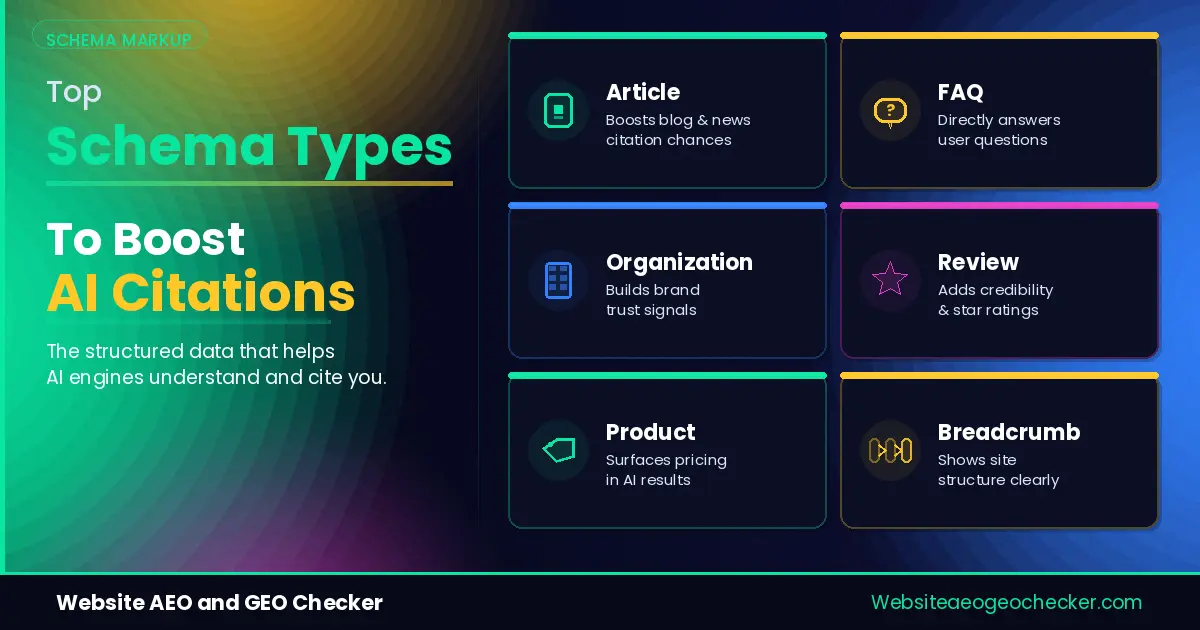
Schema markup tells AI systems what your content is, who created it, and how trustworthy it is. Implement Organization schema on your homepage, Article schema on every post, and FAQPage schema on pages with questions and answers. All schema should be implemented using server-rendered JSON-LD. Never inject them using JavaScript.

For the full technical checklist, read our Technical AI Readiness Guide.
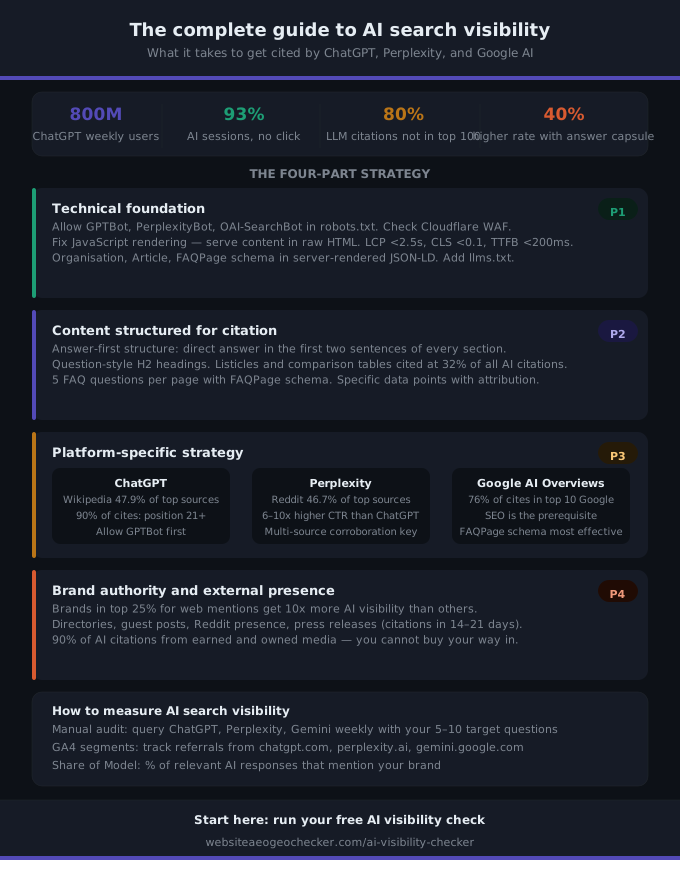
The complete guide to AI search visibility infographic — shows the four-part strategy covering technical foundation, content for AI citation, platform-specific tactics for ChatGPT Perplexity and Google AI Overviews, and brand authority building with key statistics

Part 2: Content for AI Citation

Technical access gets you into the selection pool. Content quality determines whether you get selected.

Answer-First Structure

Pages that include answer capsules have a 40% higher citation rate than alternatives where AI is forced to pull information together from disparate sources. An answer capsule is an answer to the primary question placed in the first paragraph, positioned before any preliminary or supporting information.

Each key page should begin with an answer to the primary question of that page. Each H2 section should begin similarly. AI systems extract the first one to two sentences of a section. If those sentences provide context rather than the actual answer, the section will not be cited.

Question-Style Headings

Pages with well-organized headings are 2.8 times more likely to earn citations in AI search results. Write your headings the way users ask questions: "How does structured data affect AI visibility?" not "Structured data overview."

This applies to H2 and H3 headings throughout every article and guide. Question headings signal the answer they introduce, which is exactly the pattern AI extraction systems look for.

Specific Data Points

Content with statistics, citations, and quotations is 30 to 50% more visible to AI systems. Generic claims are not specific and do not give AI systems a reason to cite the source. AI systems need concrete data points that can be attributed to specific sources.

Each key article must have two to three significant data points from credible sources. If you can publish original data, include that as well. AI systems prefer sources with data points that can be directly extracted and attributed.

Content Freshness

Pages updated within 2 months earn 28% more citations than older content. AI systems weigh recency heavily, especially for fast-moving topics.

Add a visible last-updated date to every key page. Set a 90-day refresh cycle for your most important content. Updating statistics, adding a new FAQ question, and refreshing the introduction is usually enough to reset the freshness signal.

Listicles and Structured Formats

According to analysis of 177 million AI citations, listicles make up 32% of all citations, surpassing the next most-cited format at just 9.9%. AI systems prefer to extract information from a single comprehensive source rather than aggregate from multiple pages.

Well-structured lists, numbered processes, and comparison tables are extracted at consistently high rates. Build these formats into your key pages wherever the content allows it.

FAQ Sections

Every key page needs a FAQ section with at least five questions written the way users actually ask them. Pair it with FAQPage schema so AI systems can read the question-answer pairs in machine-readable format without interpreting your HTML.

Most websites are not failing because of content quality, but because they are not structured for AI systems to understand, extract, and rank their information. - Website AEO and GEO Checker

Part 3: Platform-Specific Strategy

Each AI platform has different citation preferences. Analysis of 30 million citations found that the top 10 most-cited sources vary drastically across each platform, signaling a clear need for tailored strategies.

ChatGPT

Wikipedia is the most cited source in ChatGPT at 7.8%, followed by Reddit at 1.8%, Forbes at 1.1%, and G2 at 1.1%. ChatGPT Search primarily cites lower-ranking pages at position 21 or beyond around 90% of the time. This means Google rankings are not a reliable proxy for ChatGPT visibility.

For ChatGPT specifically: allow GPTBot in robots.txt, get mentioned on Wikipedia or Wikidata if relevant, build presence on Reddit and high-authority industry sites, and focus on answer-first content structure.

Perplexity

YouTube makes up 13.9% of Perplexity's citations. Reddit makes up 46.7%. No other platform places so much emphasis on rewarding citations from diverse sources. Perplexity increases citation likelihood for independent mentions across several authoritative sources.

Allow PerplexityBot access in robots.txt. Create an external presence in Perplexity-approved sources. Comparison tables and numbered lists are highly effective in Perplexity's extraction system.

Google AI Overviews and AI Mode

76.1% of sources cited in AI Overviews are in Google's top 10 results. Google AI Overviews are the most dependent on conventional SEO. High rankings directly benefit AI Overview citations. Google AI Mode shows less reliance on Google's top 10 with a 54% overlap. As AI Mode draws from additional sources, well-organized authoritative content may be incorporated from lower-ranking pages.

For both: FAQPage schema, question headings, and answer-first structure are the most reliable content signals.

Real example: Lena runs content for a B2B SaaS company in the compliance space. Their blog ranked consistently on Google but generated no AI referral traffic in GA4. She ran our AI Visibility Checker and identified three gaps: GPTBot was blocked by a Cloudflare rule, none of their articles had FAQPage schema, and their content always opened with problem framing rather than a direct answer. She fixed the crawler block first. Added FAQPage schema to eight articles. Rewrote the opening paragraph of those same articles to lead with the direct answer. Within 6 weeks, AI-referred sessions in GA4 appeared for the first time, and three of the eight articles were being cited in Perplexity responses for queries in their target category.
Part 4: Building Brand Authority for AI

Technical access and content structure get you cited on your own pages. Brand authority determines whether AI platforms cite you for topics even when the question is not directly about your site.

The Sources AI Trusts Most

Each platform has a set of sources it defaults to when establishing facts. Wikipedia and Reddit are key for ChatGPT. YouTube and Reddit are important for Perplexity. Reddit and Quora matter for Google AI Overviews. These are editorially trusted, authorially verified, and community-validated.

Having your brand mentioned on these platforms, even without links, facilitates multi-source corroboration, which is what AI systems look for.

Building External Mentions

Brands in the top 25% for web mentions get 10 times more AI visibility than others. The gap between brands with strong external presence and those without is enormous.

Practical steps:

  • Get listed in relevant industry directories and review platforms
  • Contribute genuine answers on Reddit in your topic area (never as promotion)
  • Write guest posts on sites that already have AI citation authority
  • Issue press releases for product launches and significant company updates (these generate citations within 14 to 21 days of indexing)
  • Pursue mentions in trade publications and editorial coverage

Research from Amsive found that 90% of AI citations driving brand visibility originate from earned and owned media, not paid placements. You cannot buy your way into AI citations. You earn them.

Entity Consistency

AI systems verify your brand identity by matching information across multiple sources. If your brand name appears three different ways across your site, schema, social profiles, and directory listings, AI systems have a harder time confirming it is the same entity.

Standardize your brand name, logo, description, and contact information everywhere. Consistent entity signals across the web are a foundational trust signal for generative AI platforms.

Part 5: Measuring AI Search Visibility

Unlike traditional SEO where you can check Google Search Console and know exactly where you rank, AI search operates as a black box. You have no visibility into whether AI engines are citing your content, mentioning your brand, or positioning competitors as the authority instead.

Measurement requires building your own tracking system.

Manual Citation Audit

Once a week, query ChatGPT, Perplexity, and Gemini with the five to ten questions your customers are most likely to ask. Note whether your brand appears, where in the response it appears, and which competitors are cited instead. This is your Share of Model baseline.

Track this in a simple spreadsheet. Same queries, same platforms, same day each week. Over time, you will see which optimizations are working and where gaps remain.

GA4 AI Referral Traffic

In Google Analytics 4, set up a channel group or segment filtering sessions by source. Look for:

  • chatgpt.com
  • chat.openai.com
  • perplexity.ai
  • gemini.google.com
  • copilot.microsoft.com
  • bing.com/chat

Note that some ChatGPT-referred visits arrive as direct traffic because users copy a URL from the response and paste it into a browser. With increased AI-driven brand awareness, keep an eye on branded search volume in Search Console as a secondary metric.

Share of Model Tracking

For each of your target queries, track how often your brand appears across platforms compared to competitors. This percentage is your Share of Model score. A brand that appears in 10 out of 50 relevant AI responses has a 20% Share of Model for those queries.

Run our GEO Checker and AEO Checker regularly and track your scores over time as you make improvements.

Key Points: The Complete Picture of AI Search Visibility

  • AI crawlers visit websites 3.6 times more frequently than Googlebot, and 92% of ChatGPT queries rely on Bing rather than live crawling, meaning Bing indexation directly affects your most important AI citation channel.
  • Sequential heading structure increases citation odds by 2.8 times, and 44.2% of all AI citations come from the first 30% of an article, making content structure as important as content quality for AI visibility.
  • Branded web mentions correlate with AI visibility three times more strongly than backlinks, and brands are 6.5 times more likely to be cited through third party sources than through their own website.
  • When you run your site through Website AEO and GEO Checker, it evaluates technical accessibility, content structure, authority signals, and measurement baseline in a single audit.

The AI Search Visibility Roadmap

This is the order that gets results fastest, based on dependency and speed-to-result.

Week 1: Fix technical access. Check and fix robots.txt crawler blocks. Check CDN and WAF firewall settings. Verify JavaScript rendering on key pages. These are the fastest fixes with the most immediate impact.

Week 2: Add schema. Add Organization schema to homepage. Add Article schema to all blog posts and guides. Add FAQPage schema to pages with Q&A content. Ensure all schema is server-rendered, not JavaScript-injected.

Week 3: Restructure content. Rewrite the opening paragraph of your ten highest-traffic pages to lead with a direct answer. Convert subheadings to question format. Add or expand FAQ sections. Add specific data points with attribution.

Week 4: Set up measurement. Configure GA4 AI referral traffic segments. Run your baseline manual citation audit across ChatGPT, Perplexity, and Gemini. Record your Share of Model for your top ten queries.

Ongoing: Build external presence. Start building external mentions through directories, guest posts, and editorial coverage. Refresh key pages every 90 days. Monitor your citation tracking weekly and adjust based on what is working.

How to Check Your AI Search Visibility Right Now

Browse our full Tools Directory for targeted checks, or start with the tools that give you the broadest picture:

FAQs for AI Search Visibility Guide

What is AI search visibility?

AI search visibility is the measure of how often and how prominently your brand and content appear in AI-generated answers across platforms like ChatGPT, Perplexity, Google AI Overviews, and Gemini. Unlike traditional search visibility measured by rankings and clicks, AI search visibility is measured by citation frequency, brand mention rate, and Share of Model across target queries. Run our free AI Visibility Checker to see your current score.

Does Google SEO still matter for AI search visibility?

Yes, but differently depending on the platform. Google AI Overviews have a strong overlap with traditional search rankings: 76% of AI Overview citations also rank in Google's top 10. Citations from ChatGPT and Perplexity come from a diverse range of sources, and 80% of LLM citations will not be represented in Google's top 100 rankings. Strong SEO remains the foundation, but AI search requires additional optimization.

How do I know if AI platforms are citing my site?

The most direct method is manual: query ChatGPT, Perplexity, and Gemini with your target questions and check whether your brand appears. In GA4, track referral sessions from chatgpt.com, perplexity.ai, and gemini.google.com. Track branded search volume in Google Search Console as a secondary indicator, since some AI-referred visits arrive as direct traffic. Our AEO Checker and GEO Checker provide the technical picture behind what you find.

Which AI platform should I optimize for first?

Start with technical fixes that benefit all platforms: allowing AI crawlers, improving JavaScript rendering, adding schema, and optimizing page speed. For platform-specific work, start with Google AI Overviews if your business relies on Google traffic, then move to ChatGPT and Perplexity which drive the most AI search traffic.

How long does it take to see results?

Technical optimizations deliver the fastest results. Unblocking AI crawler access and fixing JavaScript rendering can show increased citations within 2 to 4 weeks. Schema changes usually take two to six weeks. Content restructuring shows results in 4 to 8 weeks as pages are recrawled and indexed. Building external brand mentions takes 1 to 3 months.

About the Author

This guide is created by Website AEO and GEO Checker.

AI search visibility is not a single tactic. It is a stack: technical access at the base, content structured for extraction above that, brand authority built through external presence above that, and measurement running continuously so you know what is working. The brands investing in this stack now are building citation authority that compounds over time.

Start with the technical layer. Fix crawler access. Add schema. Check your rendering. Those are the fastest wins and the ones everything else depends on.

Suggested Read

Related guides

AI search for small business owners — a complete guide to getting your business recommended by ChatGPT, Perplexity, and Google AI Overviews
2026-05-03AI Search for Small Business Owners

Learn why ChatGPT, Perplexity, and Google AI Overviews recommend some businesses over others. Includes a free 4-week action plan. Check your AI visibility free with Website AEO and GEO Checker.

The complete AEO guide — everything you need to know about answer engine optimization for AI search engines
2026-04-15The Complete AEO Guide

Learn what AEO is, how it works, and how to optimize your website for AI search engines in 2026. Check your Answer Engine Optimization score free with Website AEO and GEO Checker.

The complete GEO guide — generative engine optimization tactics to get cited by ChatGPT, Perplexity, and Google AI Overviews
2026-04-29The Complete GEO Guide

Learn how AI platforms select sources and apply 7 proven GEO tactics to get cited by ChatGPT, Perplexity, and Google AI Overviews. Track your GEO performance with Website AEO and GEO Checker.