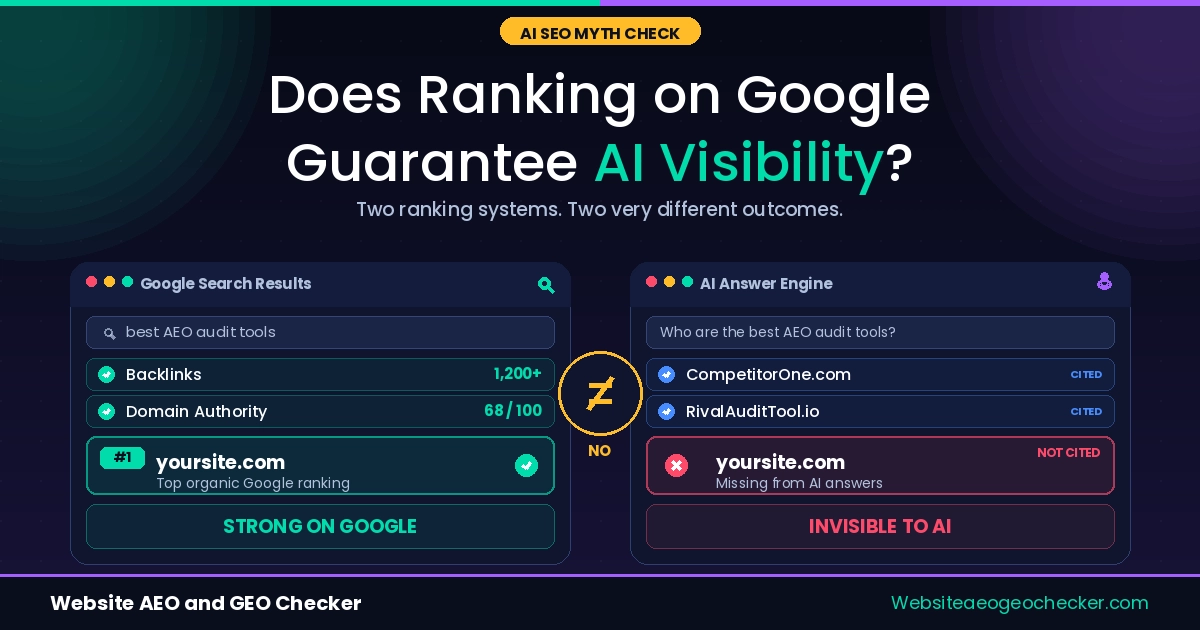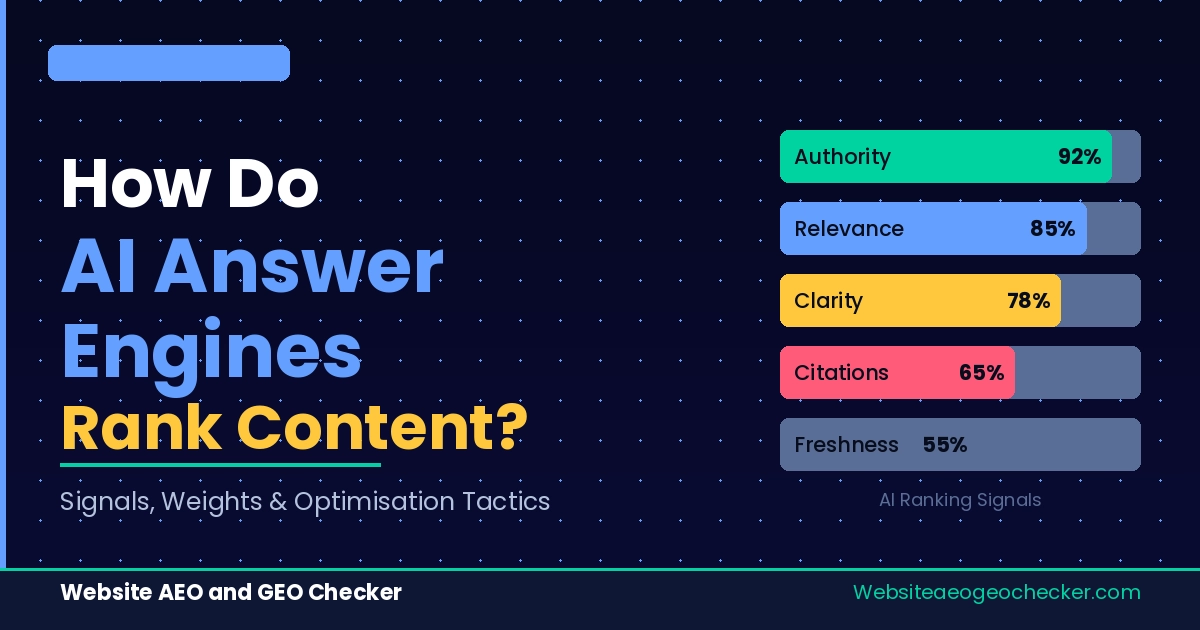
You fixed your SEO. Your pages rank well on Google. But ChatGPT and Perplexity still do not mention your site.
Google rankings and AI content is prioritized differently, so they use different processes, rules, and signals for prioritization. Internally, AI answer engines probably care about content ranking using signals we can't see, like engagement data, and how trustworthy and helpful they think a content piece is.
Answering how ChatGPT and Perplexity rank answers is important for your AI visibility even if answer engines likely are using signals outside your visibility.
AI Answer Engines Do Not Use a Ranked List
AI visibility differs from traditional search engines, where Google crawls, builds, and ranks based on hundreds of criteria to display a clickable list.
AI answer engines like ChatGPT and Perplexity work differently from their traditional counterparts. When you search in these engines, you are not presented with dozens of clickable links. Their answer engines pull from their sources, process the information, and generate a cohesive answer.
The major shift for website owners requires a shift in optimization and expectation from traditional search engine first ranking to a citation-based model from trusted sources. Your competition is not for the top of the list, but for the trust and citations.
The underlying technology that makes this possible is called RAG: Retrieval-Augmented Generation.
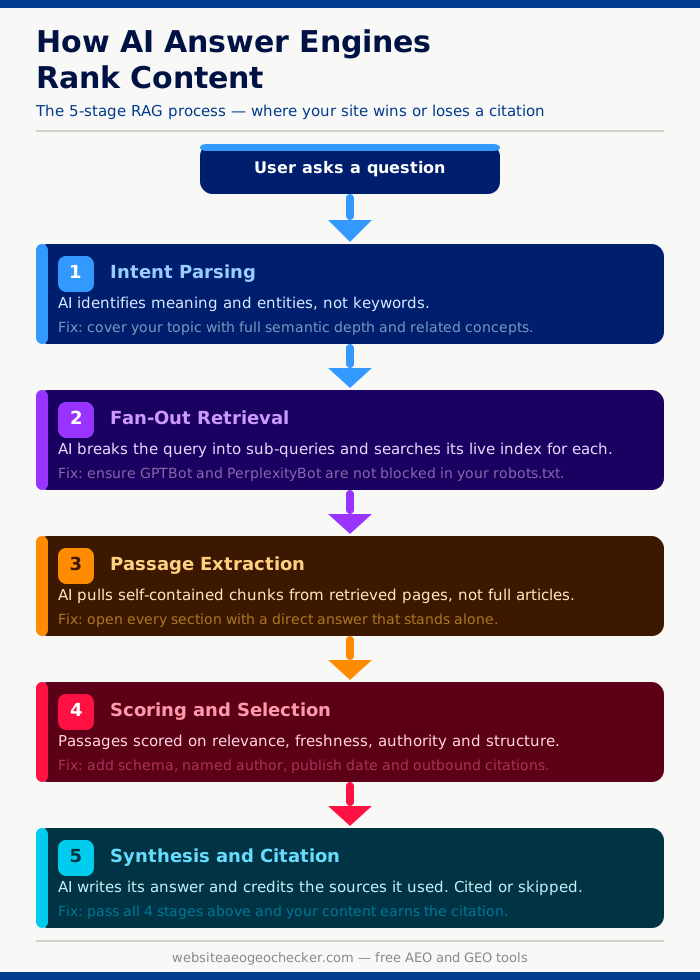
How RAG Works: The 5-Stage Process
RAG is the framework AI answer engines use to find, evaluate, and synthesise content. Research from Frase analysing 17 million AI citations broke this down into five distinct stages. Understanding each one tells you exactly where your content can win or lose.
Stage 1: Intent Parsing
The AI does not search for your exact words. It identifies the underlying intent of the question: what the user actually wants to know, which entities are involved and what kind of answer format would best serve the request.
This is why two questions phrased completely differently can return the same sources. "What is AEO?" & "Explain answer engine optimisation for beginners" are the same question to an AI system. It is working from meaning, not keywords.
Stage 2: Fan-Out Retrieval
The AI breaks the question into smaller sub-queries and runs separate searches for each one. These are called fan-out queries.
If this question were posed to the system, it would likely query "improving AEO score", "AEO ranking factors 2027", and "answer engines and structured data" as individual searches. Your content must rank for these sub-queries, rather than the main question alone.
A sub-query exists and generates results against a current web index. ChatGPT performs searches via the browsing option. Perplexity has its own crawler, named PerplexityBot. Google AI Overviews access Google's own search index.
Stage 3: Passage Extraction
Retrieved pages are not read in full. The system extracts specific passages, chunks, and data points. It looks for content that is self-contained, clear, and directly answers a sub-query without needing surrounding context.
The most common section where sites fail AEO is answer extraction. A web page can be in Google's top 10 and may receive no answer extraction AI mentions. Some content is meant for humans and is not machine-readable. Long unbroken paragraphs, answers hidden within paragraphs, and unhelpful headings suppress extraction.
Stage 4: Scoring and Selection
Extracted passages are scored. The factors that matter most are relevance to the query, content freshness, structural quality, and authority signals.
Freshness counts even more than most people expect. The same Frase study finds that AI-expected URLs average 25.7% more freshness than the conventional search results. AI systems even extract content, where topical content changes regularly, and answers need to be on the latest.
The passage quality refers to its structural quality, its readability, whether it answer and question, whether it gives verifiable claims, and whether it answers the question. Does it include verifiable claims?
Stage 5: Synthesis and Citation
The AI reads the top-scored source passages and writes its response, drawing from multiple sources. It does not copy text verbatim. It synthesises. Then it attributes specific claims to the source pages that provided them.
This is where your URL either appears as a citation, or it does not. If your passage made it through stages 1 to 4, this is where you get credited.
Use our AEO Checker to see how your pages score across the signals that matter at each stage.
What AI Answer Engines Actually Look For
Now that the process is clear, here is what specifically determines whether your content gets retrieved and cited.
Content Structure
In AEO, the highest-leverage variable is structure. Pages that open each section with a clear, concise answer, as opposed to context, enjoy a dramatic increase in citations.
This is the optimal structure. Give your question as a section header, answer it in the first two sentences, and then put the rest of your supporting details below. Each section must be able to stand alone. An AI that only retrieves that section must be able to use that section independently from the rest of the article.
Schema Markup
FAQ schema (FAQPage in JSON-LD) is particularly powerful. It pre-parses your questions and answers into machine-readable format, which means the AI does not have to interpret your content structure. It reads the schema directly. Pages with FAQPage schema are consistently cited at higher rates than equivalent pages without it.
Check whether your pages have the right schema in place with our AI Visibility Checker.
Specificity Over Generality
AI is less likely to pick your answer if you are vague and answer at a high level. Rather than saying, "schema markup can help your AI visibility," it is easier to cite, "schema markup by 28 to 40%," because it gives your AI a specific example to retrieve from and attribute to.
Real example: Sarah runs a digital marketing blog and noticed that her SEO tutorials ranked consistently in Google but never appeared in ChatGPT or Perplexity responses. She ran our AEO Checker and identified two structural problems. First, her headings were descriptive labels rather than questions, so the AI had no clear signal about what each section answered. Second, every section opened with context and background before getting to the point. She restructured five key posts to lead with direct answers and changed all headings to question format. Within six weeks, three of her posts were being cited in Perplexity responses for queries she was already ranking for on Google.
Freshness and Regular Updates
AI systems weight content recency. A well-structured page that was last updated 18 months ago will lose to an equivalent page updated last month. Adding a "last updated" date to your content and refreshing your key pages with new data and examples is a simple, high-impact AEO action.
Authority and Trust Signals
AI answer engines apply a credibility filter before citing any source. Named authors, publish dates, outbound citations to reputable sources, and external mentions of your brand all increase the probability that your content gets selected over an anonymous, unverified page.