Website AEO and GEO Checker logoWebsite AEO and GEO Checker
WEBSITE AEO AND GEO CHECKER

6 Steps to Get Your Local Business Showing Up in ChatGPT Maps

2026-07-14 · 14 min read

6 Steps to Get Your Local Business Showing Up in ChatGPT Maps

Your competitor down the street has worse reviews than you. Maybe even a worse website. But when someone asks ChatGPT for "the best [your service] near me," their name comes up and yours doesn't.

Here is the uncomfortable number behind that feeling. SOCi's 2026 Local Visibility Index looked at more than 350,000 business locations and found that ChatGPT recommends only about 1.2% of them when asked for a local option. Compare that to the 35.9% visibility rate the same businesses get in Google's 3-pack, and you can see the gap. Google has room for a dozen nearby options. ChatGPT names a few and stops.

As AEO and GEO analysts, we have a unique perspective on the issues companies are facing today. The leading issue for our business is: "Why does my competitor show up on ChatGPT and I do not?" The reasons are mostly unrelated to the quality of the business and instead are a handful of specific signals that are relatively easy to address. This article outlines the signals and the steps you can take to check whether you show up, as well as the corrective actions you can take, in the event that you do not.

Why ChatGPT and Perplexity Are Recommending Your Competitors (Not You)

Here is the thing most local business owners get wrong: they assume ChatGPT works like Google Maps. It does not.

ChatGPT does not obtain data for local business outputs from Google Business Profiles, unlike Google Maps. The first 60 - 70 percent of local businesses that ChatGPT obtains are from Foursquare's Places API. Foursquare is a business owner's data set that is relatively stagnant and outdated. The data from Foursquare is also used by ChatGPT's Mapbox. If you do not have a listing on Foursquare, or your listing is outdated or sparse, you are losing to your competitors even before users read any text on your website.

We tell every client the same thing in month one," says our head of local search research at Website AEO and GEO Checker. "Your Google Business Profile is necessary, but it is not sufficient anymore. ChatGPT is asking a different set of data sources a different set of questions."

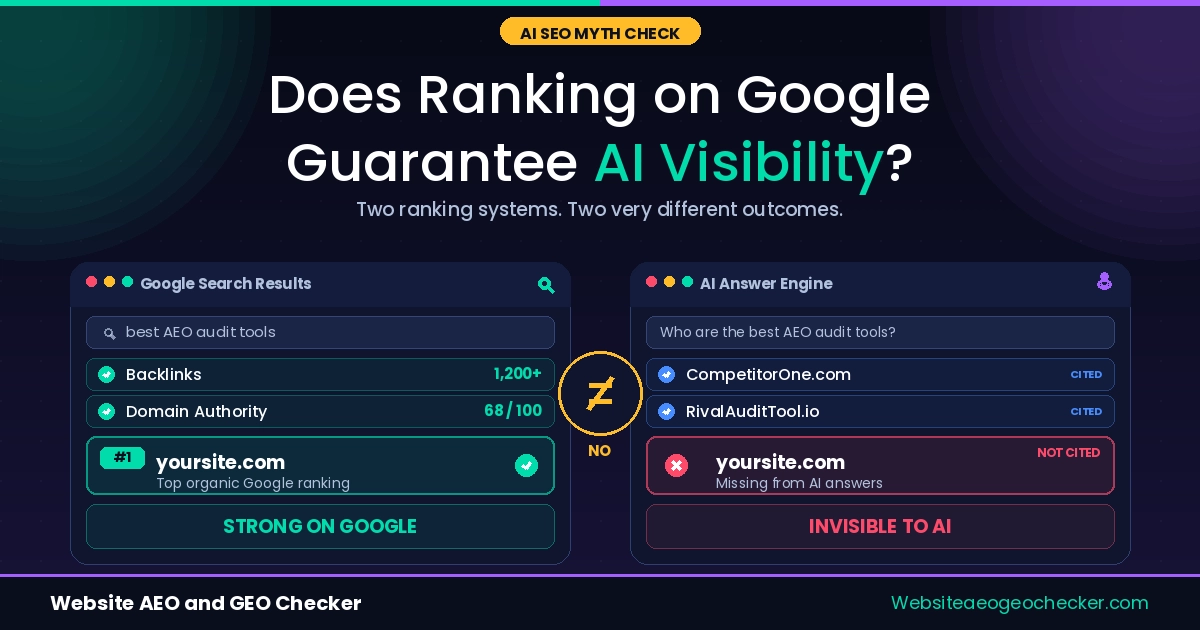
This matters because the overlap between ranking well in Google's map pack and appearing in AI recommendations is smaller than you would think. Only about 45% of businesses that rank well in traditional Google local search also show up in AI answers. More than half of the businesses winning the Google map pack are completely absent from AI answers. Strong local SEO does not transfer automatically. It has to be earned separately, on a different set of rails.
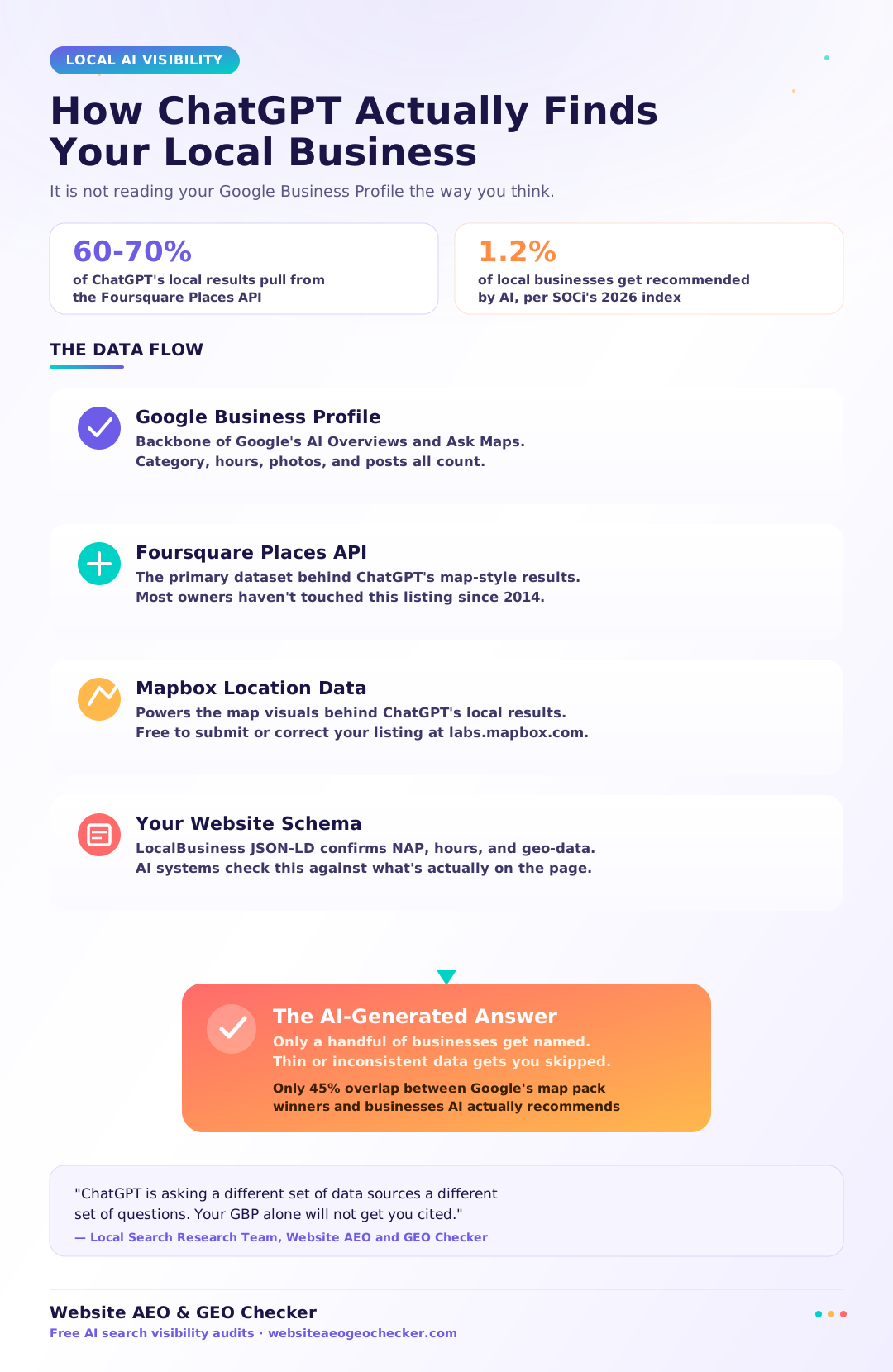
How does ChatGPT get its local data? Understanding Foursquare and Mapbox for AI maps

Step 1: Check Whether You Already Appear

Before changing anything, find out where you stand. Open ChatGPT and Perplexity and ask the exact question a customer would ask: "best [your service] in [your city]." Do this once a month and write down who gets named, not just whether you do.

Run the same check on your Free AI Visibility Checker, which tests whether AI systems can find, parse, and cite your business rather than guessing from a single manual prompt. Manual spot-checks are useful for a gut read, but AI answers vary by phrasing and by session, so one automated pass gives you a more reliable baseline than three manual tries.

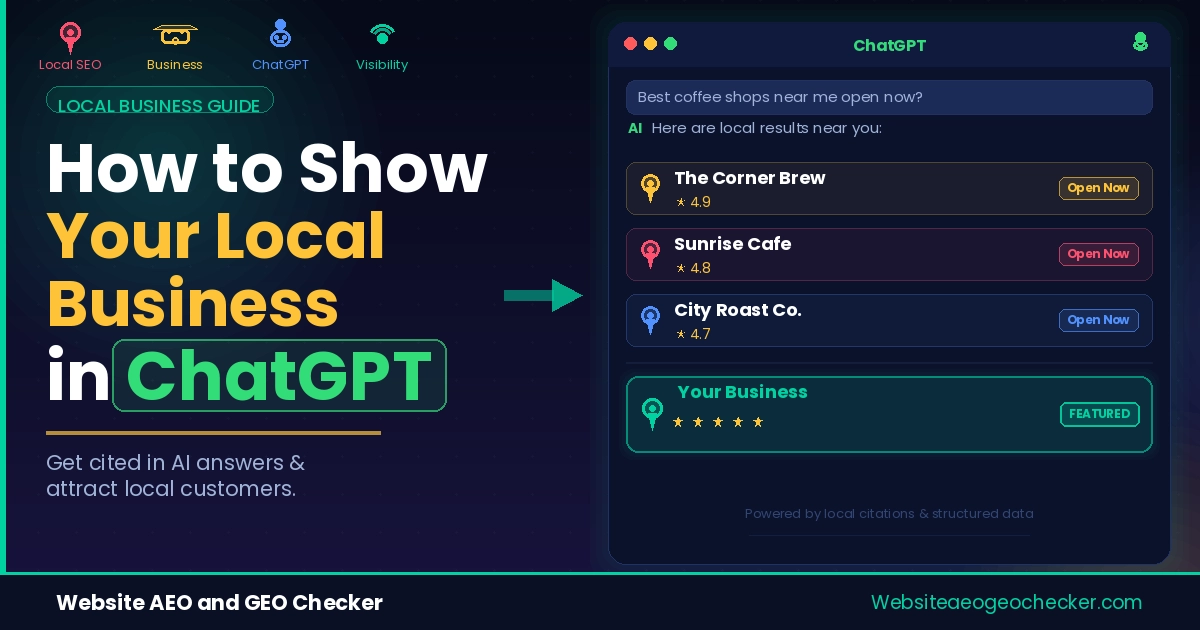
What a ChatGPT local answer actually looks like:

Prompt: "best HVAC company near Round Rock, TX"

ChatGPT: "A few well-reviewed options nearby: Lonestar Air Solutions (4.6★, 210+ reviews, listed on Foursquare with same-day service hours), CoolBreeze HVAC, and Round Rock Heating & Air. Lonestar stands out for consistent recent reviews mentioning fast response times."

Notice what earned the top spot: a review count and rating, a directory listing (Foursquare, not Google), and specific, recent review language. That combination is what Steps 2 through 6 are built to produce.

Step 2: Fix Your Google Business Profile First

Your GBP is important for local visibility, even with the recent ChatGPT tools that reference Foursquare and Mapbox. The Gemini integration with Google's AI tools, like AI Overview and Ask Maps, creates GBP-dependent products. The completeness of your GBP is an essential factor for both the AI tools from Google and the web reputation metrics read by ChatGPT and Perplexity.

You should add any applicable category to your profile, not just the primary one. Be thorough when adding your services, attributes, hours, and more. You should add new posts and pictures to your GBP regularly. It is clear to Google and AI crawlers that a profile that is further left blank with three-year-old logos is a neglected profile. This gives you little visibility in search results..

Step 3: Lock Down NAP Consistency Everywhere

For AI crawlers and tools, NAP means that your Name, Address, and Phone number need to be identical and consistent in Google Business Profile, your website, and other business listings, Foursquare, Apple Maps, Yelp, etc. Even small variations are perceived as differing signals for AI systems that are validating the existence of a business entity. For example, "St." vs "Street".

What a NAP mismatch looks like in practice:

Platform Listed Address Listed Phone
Website 123 Main St, Suite 4 (512) 555-0148
Google Business Profile 123 Main Street, Ste 4 (512) 555-0148
Foursquare 123 Main St (512) 555-0199 (old number)
Yelp 123 Main St., #4 (512) 555-0148

Four platforms, three different address formats, and one outdated phone number still live on Foursquare, the exact dataset ChatGPT reads from most. The fix is to standardize one format (for example, "123 Main St, Suite 4") and push that identical string to every listing, then correct the stale Foursquare number the same day it's found.

This is not a set it and forget it matter either. Addresses change when moving, contact numbers change with new providers, and business hours need to be updated when the season changes. You should audit your NAP at least once every three months and more often when a change occurs. An out-of-date listing is worse than no listing. This teaches the AI systems not to trust your business existence signals. NAP stands for Name, Address, Phone number.

Step 4: Add LocalBusiness Schema Markup

Schema is the translation layer between your website and the machines reading it. Without it, an AI system has to guess what your address field means, what your hours mean, what type of business you actually are. With LocalBusiness schema in place, none of that is a guess.

Use the most specific subtype available. A dental practice marked up as generic "LocalBusiness" gets less weight from AI systems than one marked up as "Dentist." A plumber should use "Plumber," not the parent type. Include your name, address, phone, geo-coordinates, opening hours, and a sameAs property linking to your verified social profiles and directory listings. And make sure everything in your JSON-LD schema matches what is actually visible on the page. AI systems now check for that alignment directly, and schema that describes content the page does not actually show reduces trust rather than building it.

A working example, for a dental practice (swap in your own subtype and details):

{
"@context": "https://schema.org",
"@type": "Dentist",
"name": "Example Family Dental",
"address": {
"@type": "PostalAddress",
"streetAddress": "123 Main St, Suite 4",
"addressLocality": "Round Rock",
"addressRegion": "TX",
"postalCode": "78664",
"addressCountry": "US"
},
"telephone": "+1-512-555-0148",
"geo": {
"@type": "GeoCoordinates",
"latitude": 30.5083,
"longitude": -97.6789
},
"openingHoursSpecification": [
{
"@type": "OpeningHoursSpecification",
"dayOfWeek": ["Monday", "Tuesday", "Wednesday", "Thursday", "Friday"],
"opens": "08:00",
"closes": "17:00"
}
],
"sameAs": [
"https://www.facebook.com/examplefamilydental",
"https://foursquare.com/v/example-family-dental",
"https://www.yelp.com/biz/example-family-dental"
]
}

Drop this in a <script type="application/ld+json"> tag on each location page, and swap Dentist for whatever subtype matches your business (Plumber, Restaurant, HairSalon, and so on).

Real example: Priya Nakamura runs a 3-location dental practice outside Austin. Her GBP was solid, but her site had no schema at all and her Foursquare listing still showed a phone number from 2019. She fixed the NAP mismatch She added Dentist-specific LocalBusiness schema to each location page; and ran a fresh listing through the Foursquare and Mapbox contribute portals. ChatGPT started citing her practice by name in local recommendations within 5 weeks.
Step 5: Build Review Signals That AI Trusts

Reviews carry more weight for AI recommendations than most local SEO checklists suggest. Studies show AI assistants rarely name a business with fewer than roughly 150 reviews, and the businesses ChatGPT does pick average around 4.3 stars. Volume and recency both matter more than a handful of five-star reviews from two years ago.

Respond to reviews, especially critical ones. Response rate and review velocity, meaning how many new reviews you earn per month, are both signals AI systems weigh when deciding whether your reputation is current and trustworthy. Never mark up reviews with aggregateRating schema unless they are genuinely visible on your page. Fabricated or hidden review markup does not just fail to help, it actively damages trust signals once flagged.

A 3-star review response, two ways:

Review: "Service was fine but they showed up an hour late and didn't call ahead."

Weak response: "Thanks for your feedback!"

Stronger response: "We're sorry about the late arrival, that's on us. We've since added a dispatch text alert so customers know the moment a tech is running behind. Appreciate you flagging it, and we'd love another shot at a five-star visit."

The stronger version names a specific fix and a specific timeframe, which is exactly the kind of current, detailed language that signals an active, trustworthy business to both readers and AI systems.

Step 6: Get Listed on Foursquare, Apple Maps, and Mapbox

This is the step almost nobody does, and it is the one with the most leverage right now. Since ChatGPT's map results draw primarily from Foursquare's Places API and Mapbox's location data, a clean, complete, and current listing on both platforms matters as much as your Google Business Profile does for Google Maps.

Mapbox opened a Contribute Portal that lets business owners submit or edit their own listings directly, syncing details across the more than 75 platforms Mapbox powers behind the scenes. Search for your business there first to see whether a listing already exists. If it is missing, add your details. If it is outdated, submit a correction. It takes a few minutes and it is free.

Apple Maps has Yelp integrated. In the past year, AI has been used for local searches 45% more than in the previous year. Businesses that treat directories as a core part of their operations rather than something from 2015 are the businesses that are benefiting from this.

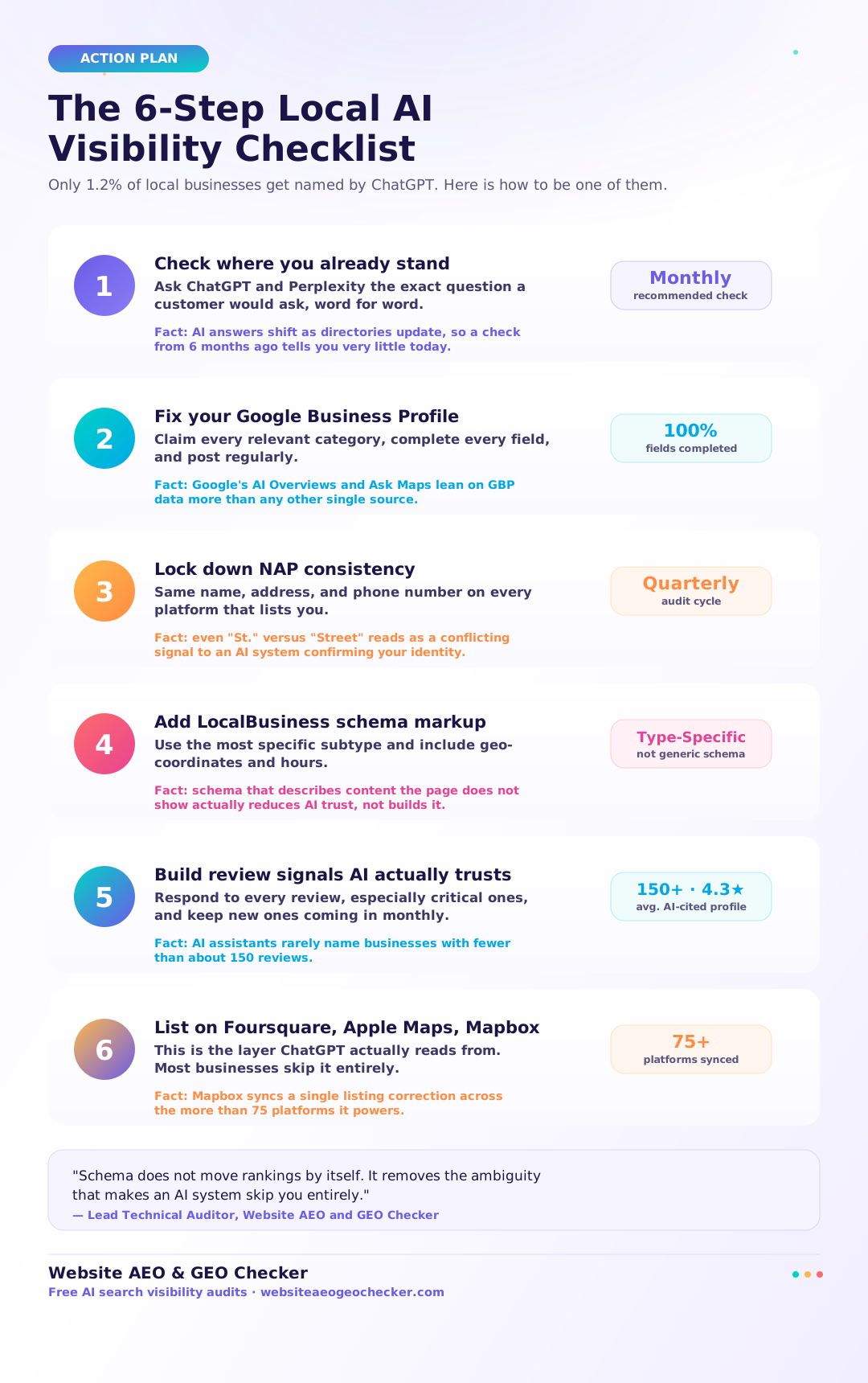
What are the 6 steps to appear in ChatGPT Maps? Checklist for local business AI optimization

Local AEO vs Local SEO: What's Actually Different

Local SEO focuses on reaching the top of Google's map pack and search results. Local AEO is about having AI systems mention your business name in their answers, whether or not there's a link. These two approaches measure success differently. For Local SEO, success means ranking high on search pages. For Local AEO, it means your business is mentioned often by AI in the same search.

The inputs overlap heavily. Your Google Business Profile, your reviews, and your on-page content matter for both. However, local AEO looks at the structured data, answer-first content, and third-party sentiment found on sites like Foursquare and Apple Maps. These sites are not touched by Google's map pack. The statistics show the disparity: businesses that are placed in Google's local 3-pack have the opportunity to be seen there 35.9% of the time. However, in a given comparable local search, ChatGPT mentions a specific business around 1.2% of the time. In addition, 45% of the businesses that appear in the Google map pack do not appear in AI answers.

That gap is why a business can look strong on every traditional local SEO metric, page one rankings, hundreds of reviews, a filled-out GBP, and still be completely absent when a customer asks ChatGPT the same question directly. You can rank first in the Google 3-pack and still be invisible in ChatGPT, because the two systems are reading different evidence to reach their conclusion. Read our full breakdown in AEO vs SEO vs GEO if you want the complete picture beyond local search specifically.

Schema does not move rankings by itself. What it does is remove the ambiguity that makes an AI system skip you entirely. That is a bigger lever for AI visibility than most business owners realize. - Website AEO and GEO Checker

FAQ about Local SEO and ChatGPT

How long does it take to show up in ChatGPT after fixing these signals?

Google Business Profile changes can shift your visibility in Google's AI Overviews within a few weeks. Earning a citation in ChatGPT or Perplexity usually takes longer, often a few months of consistent schema, reviews, and directory accuracy before you see a noticeable change.

Do I need a website to appear in AI local search results?

You can appear in some AI Overviews and voice assistant results with an optimized Google Business Profile, since those systems rely on structured business data. For ChatGPT and Perplexity, the emphasis is on web content that is not behind a paywall. A business that does not have a website will have a limited footprint on these platforms.

Is Local AEO replacing local SEO?

No. Local AEO builds on local SEO rather than replacing it. The businesses winning across both are running one unified data and content strategy that feeds Google Maps, AI Overviews, and AI chatbots at the same time, not four separate campaigns.

What is the single highest-impact fix for showing up in ChatGPT's local results?

Your Name, Address, and Phone Number need to be consistent across your website, Google Business Profile, and all of the directories that list you, including Foursquare and Mapbox. These are two of the main data sources that ChatGPT relies on for local results. Almost all other signals, including AI citation confidence and schema, depend on the correct consistency of your NAP.

How often should I check whether my business appears in ChatGPT?

Once a month, minimum. Ask ChatGPT and Perplexity the exact questions your customers would ask and see who is listed. AI answers rely on directories and other sources of data. Because of this, only your last coverage from six months ago is relevant for a historical context. You will be able to compare your progress.

Key Takeaways

Keep in mind that showing up in ChatGPT Maps is not about being the best business in your area. It is about being the most legible one to a system that is reading Foursquare, Mapbox, your schema, and your review velocity to decide who to name. Fix your NAP consistency first, add specific LocalBusiness schema, and get a current listing on Foursquare and Mapbox, since that is the layer ChatGPT actually reads from. Then check your Free AEO score monthly to see whether the changes are landing.

The businesses getting cited right now are not doing anything exotic. They just did not skip the unglamorous steps.

Suggested Read:

About the Author

This guide is created by Website AEO and GEO Checker.

We built this tool after testing many websites that ranked in search but did not appear in AI answers. The issue was often simple. Content was not clear, structured, or easy for AI to use.

Our free tool checks your website across 50+ AEO and GEO signals. It shows what is working, what is missing, and what you can fix.

Related posts

Why do your competitors appear in Artificial Intelligence (AI) answers and you do not?
2026-07-085 Reasons Your Competitors Appear in AI Answers

Find out why AI search tools recommend your competitors instead of you, and learn practical strategies to increase your visibility in AI-generated answers.

How does Search Experience Optimization (SXO) affect whether Artificial Intelligence (AI) engines trust your site?
2026-07-025 Ways SXO Affects AI Engines' Trust in Your Site

Learn how Search Experience Optimization (SXO) improves your website's trust and visibility with AI engines.

What are 7 ways to improve website LLMO (Large Language Model Optimization)?
2026-06-247 Ways to Improve Your LLMO (Large Language Model Optimization)

Learn how to improve your website's LLMO (Large Language Model Optimization) to increase visibility in AI search results, ChatGPT, Gemini, and more.

What is Artificial Intelligence (AI) Search Optimization (AISO) explained for businesses?
2026-06-21What Is AI Search Optimization (AISO)? A Plain Explanation

Understand AI Search Optimization (AISO), why it matters for SEO, and how businesses can increase visibility in ChatGPT, Google AI, and AI-powered search platforms.