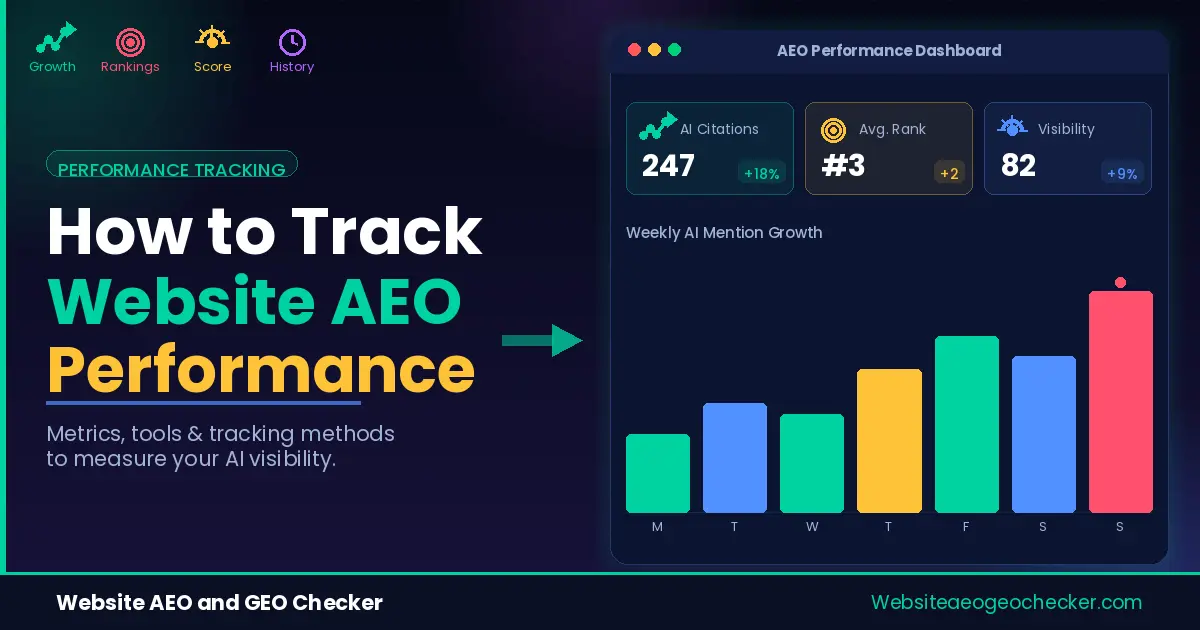
AEO does not have a keyword rank. You can't check a search position 1-10 every day to see where they rank. You also can't provide a client with a screenshot from a rank tracker that shows a dashboard. Frequently, the absences in AEO performance metrics or rankings will confuse highly skilled SEO practitioners. What exactly do you measure?
This article will describe the critical metrics from manually tracking your brand in ChatGPT, Gemini, and Perplexity, to setting up tracking for referrals in GA4, to measuring the trend in your AEO score. We'll also cover how to track AEO performance without spending a dollar on paid tools, and we'll be honest about where AI tracking still falls short. AI tracking is still primitive. However, your options will be a lot more limited if you really think doing nothing means the same as knowing nothing, and of course knowing nothing is always better.
Why AEO Needs Its Own Metrics
Traditional SEO gives you a rank, a click-through rate, and a conversion path you can trace end to end. AEO gives you none of that by default. An AI system can read your page, decide it's the best answer, and never send a single visitor your way, since the whole point of a generated answer is that the reader doesn't have to click anything.
Just because something is difficult doesn't mean you shouldn't measure it. It means you should measure a different dimension. The metrics below answer the two questions that really matter the most: are AI systems finding and citing them, and has this resulted in a measurable change in traffic to your website?
Metric 1: AI Citation Frequency
This is the most direct signal you have, and it costs nothing but time. Once a week, ask ChatGPT, Gemini, and Perplexity the exact questions your customers would ask, "best [your category] for [your use case]," and note whether your brand gets named.
Track it in a simple spreadsheet: platform, prompt, cited or not, and which competitors showed up instead. Do this consistently and you'll start to see patterns, certain prompt phrasings that reliably surface you, and others where you're consistently absent. Running this same check through our Free AI Visibility Checker automates the repetitive part so you're not retyping the same ten prompts every week by hand.
Metric 2: AI Referral Traffic in GA4
Citation frequency tells you if AI systems know about you. Referral traffic tells you if any of that actually reaches your site. AI platforms are sending real, growing referral traffic, and GA4 can pick up sessions where the referrer is chatgpt.com, perplexity.ai, or gemini.google.com, but a lot of that traffic gets silently miscategorized as "Direct" unless you tag your links properly.
Add UTM parameters to any link you control that might get pulled into an AI answer, your llms.txt entries, your directory listings, your social bios. Missing UTMs commonly push 25 to 30% of real traffic into GA4's "Direct" bucket, hiding the exact channel this article is about measuring. Set utm_source and utm_medium consistently and in lowercase, since GA4 treats capitalization as a different value entirely and will fragment your reports if you're inconsistent.
Real example: Aisha works in marketing for a small software company. She thought almost no one was visiting her website from AI tools like ChatGPT or Perplexity because Google Analytics (GA4) showed very little AI traffic; After adding simple UTM tracking tags to her website links, she discovered that 40% of the traffic marked as "Direct" was actually coming from AI tools. Google Analytics just was not able to identify those visits correctly before.
Metric 3: AEO Score Over Time
A single AEO score is a snapshot. The trend line is the actual signal. Run the same page or the same set of pages through the Free AEO Checker every month and log the score alongside the date, and you'll be able to tell whether your content changes are actually improving your content clarity or just moving words around.
This will also be the quickest way to answer how to check AEO score, with the expected response time in mind (weeks) for noticing anything in AI systems. A content edit that enhances your response formatting should appear in your score during the same scan, well before it updates citation frequency.
"A score with no history is just a number," says our Head of Data at Website AEO GEO Checker. "The moment you have four or five data points in a row, you can actually tell the difference between a real improvement & normal fluctuation in how the scan reads your page that week."
Turn This Into an AEO Tracker
What should you include on the tracking sheet? Only four pieces of info: date, score, page, and what changed from the last check. Don’t worry about fluctuations from a single week. Scoring engines have some noise from the timing of crawls. Only consider changes of 3+ points that persist for two months in a row. Anything else, wait and see the next score before adjusting.
Metric 4: Share of Voice vs Competitors
Citation frequency indicates presence. Share of voice indicates your standing in relation to your competition for the same query. For example, if ten AI responses are mentioning a competitor and three responses are mentioning your business, citation frequency may seem adequate on its own, but share of voice indicates a shortcoming.
Calculate it simply: your mentions divided by the total mentions across you and your named competitors, for the same set of prompts. Industry benchmarks put the average brand mention rate across AI answers at around 17%, so if you're tracking below that across your core prompts, you have real room to close the gap, and if you're well above it, that's worth knowing too.
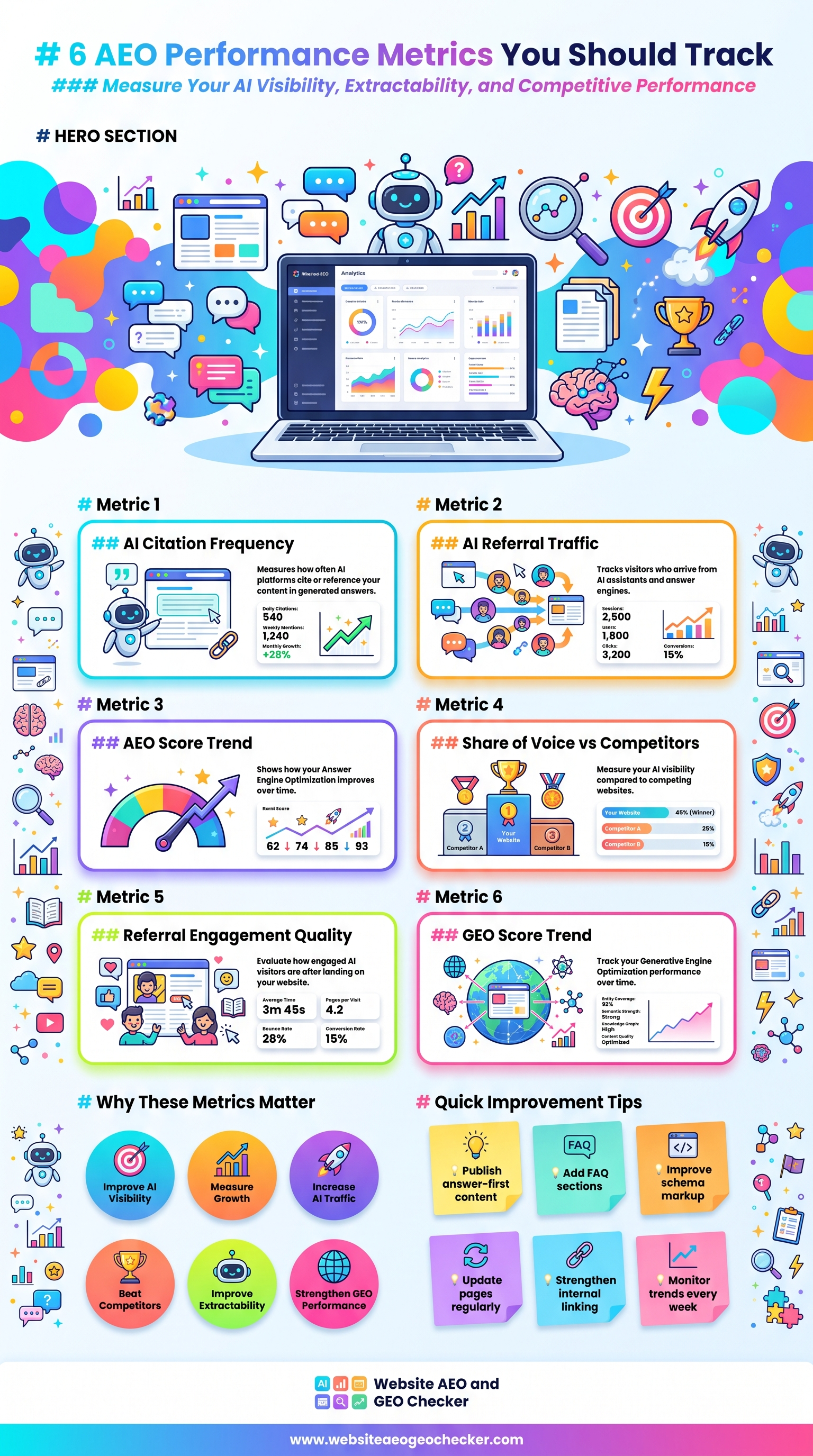
Metric 5: AI Referral Engagement Quality
Not all traffic is good traffic. It does not matter how impressive a referral source is if the traffic arrives and bounces. Once you properly set AI referral traffic from Metric 2, observe what that traffic does. Look for the comparison of session duration, pages per session, and conversion rates against your organic search metrics.
This one tends to be good news. Visitors arriving from AI-generated recommendations often convert at several times the rate of standard organic traffic and spend meaningfully more time on site, since they've typically already had their question partially answered before they ever clicked through. If your AI referral traffic isn't converting at least as well as organic, that's a signal the AI system's summary of you doesn't match what a visitor finds when they land.