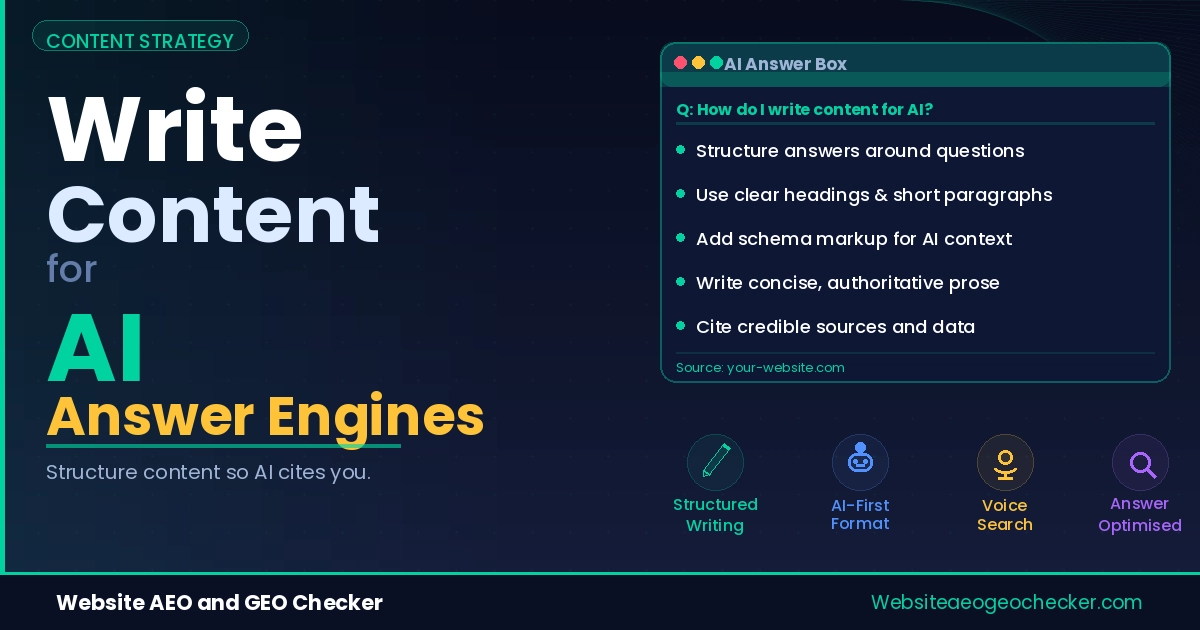
Most content is written to be read by humans. That is still important. But it is no longer enough on its own.
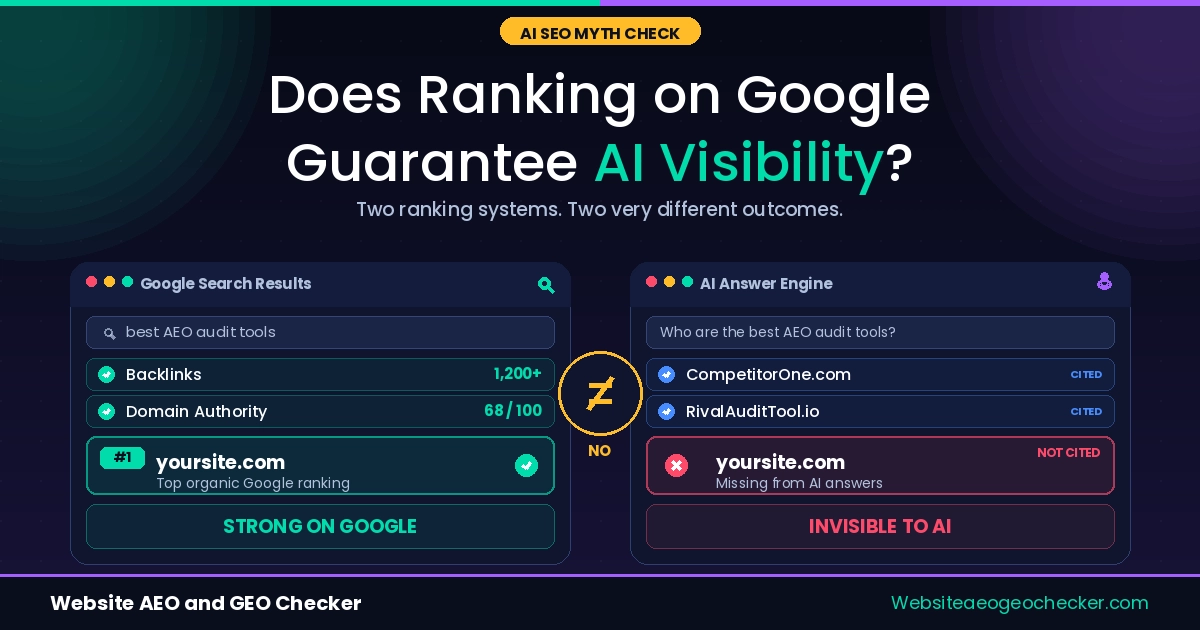
AI understands your content differently. Instead of scrolling and skimming, they search for a question and look for an answer just below it. If the answer is there, they extract the answer, and if it is not, they skip it for now. If your content is not organized in a way that helps them dispel a question, it won't be cited somewhere, regardless of its rank on Google.
The goal here is to distribute your content in a more meaningful, more structured way. We're talking about real change here. You definitely won't have to write a whole new piece for your pages, just a more streamlined, organized version.
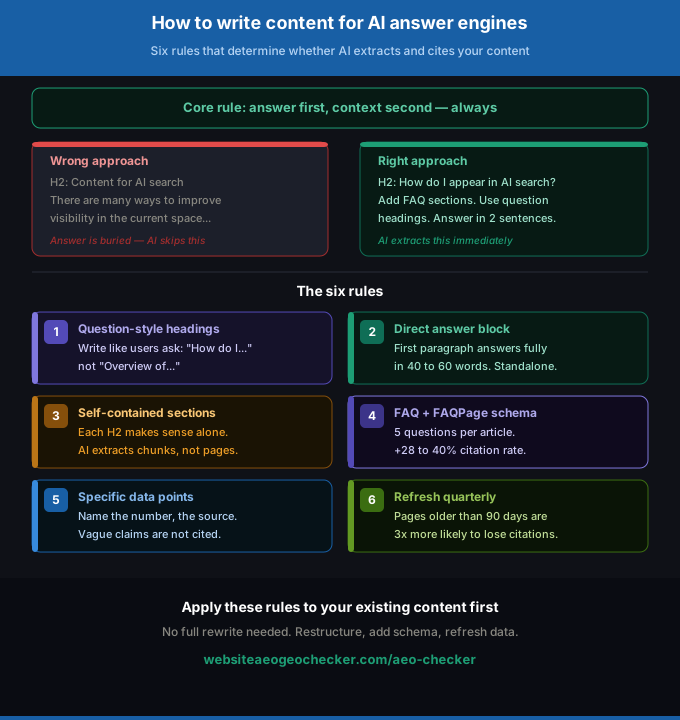
The Core Principle: Answer First, Context Second
Everything in AEO writing comes from one rule.
Put the answer before the context. Not after it.
Most content writers do the opposite. They open a section with background, build toward the point, and deliver the answer at the end. That works for human readers following a narrative. It fails completely for AI extraction.
Research from Frase shows that AI engines extract the first one to two sentences of a section to determine whether it answers the query. If your opening is context-setting or background, the engine moves on to a competitor whose opening is the actual answer.
The format is simple:
- Question as heading
- Direct answer in the first two sentences
- Supporting detail, examples, and context below
Every section on every key page should follow this pattern.
How to Structure Each Section
Use Question-Style Headings
Write your headings the way a user would ask the question. Not "Schema Markup Overview" but "What Is Schema Markup and Why Does It Matter?" Not "Page Speed Considerations" but "Does Page Speed Affect AI Visibility?"
LLMrefs notes that pages using close language matches to common query patterns, such as "what is", "how to", "why does", and "does X work", are consistently cited at higher rates than pages using descriptive or marketing-led headings. The heading signals the question. The AI matches it to the user's intent.
Open With a Direct Answer Block
Important parts of your paragraphs should be self-explanatory. When crafting an intro for a question and answer type section, try to answer fully and concisely in 40 words, but no more than 60. Make sure you can understand it without reading the whole thing.
This is a direct answer block. This is likely the section that AI answer engines will quote your content for. The chance they quote your content goes down exponentially if you give them something that's too long, too vague, or answers the question but needs the context of the previous section to be understood.
Before:
Page speed is something many website owners overlook. There are several factors that contribute to how quickly a page loads, and understanding these can help improve your overall performance...
After:
Page speed affects AI visibility because slow sites signal lower quality and reliability. AI answer engines apply performance as a trust signal when selecting sources to cite. A site that loads in under 2.5 seconds is significantly more likely to be cited than one that takes 6 seconds.
The second version answers the question immediately, includes a specific detail, and can be extracted and cited without any surrounding text.
Make Every Section Self-Contained
AI systems parse content by section, not by page. Each H2 or H3 block is evaluated independently. A reader who sees only that section, with no context from the rest of the article, should be able to understand it completely.
This means you cannot rely on "as mentioned above" or "building on what we covered earlier." Every section stands or falls on its own.
Real example: Nina runs a B2B SaaS blog covering project management. Her articles ranked well on Google but never appeared in ChatGPT or Perplexity responses. She ran our AEO Checker and found that while her technical setup was solid, every section of her content opened with a story or anecdote before getting to the point. AI systems were consistently skipping to competitor pages that opened with direct answers. She restructured five of her top-performing articles to lead with direct answer blocks. Within five weeks, three of them were being cited in Perplexity responses for queries she was already ranking for on Google.
Use FAQ Sections on Every Key Page
FAQ sections are among the most reliably cited content types across all AI platforms.
The reason is structural. A FAQ section is a pre-built question-and-answer format. The AI does not have to interpret whether a paragraph is answering a question. The format makes it explicit. FAQPage schema in JSON-LD takes this further by marking the question-answer pairs in machine-readable code, which AI systems can read directly without parsing the HTML.
Data from Frase shows that pages with FAQPage schema have a 28 to 40% higher citation probability than equivalent pages without it. That is a meaningful difference for one technical addition.
Every key page should have a FAQ section with 5 questions written the way a real user would ask them. Do not use vague questions like "Why choose us?" Use the questions people actually type or ask AI platforms: "Does page speed affect AEO?", "What schema types matter most for AI visibility?", "How long does it take to see AEO results?"
Keep each answer under 60 words. Clear. Complete. Standalone.
Write for Semantic Completeness, Not Keyword Density
AI answer engines evaluate content for meaning, not for keyword repetition.
The shift from keywords to entities is real and significant. Instead of asking "how many times does this page say 'AEO'?", the AI asks "does this page cover the topic of AEO comprehensively, including related concepts like structured data, RAG, citation signals, and EEAT?"
Cover your topic fully. Your content should focus on your subject surrounding several terms with the same meaning, and with the same context. When several terms of the same content surround your paragraph, this tells AI systems that your content is not just written for the sake of writing.
Redundant content is unfavorably rated. Content that is dense and explores the subject from different points of view is rated highly, especially with examples and verifiable details.
Our Complete AEO Guide covers topical completeness in detail with examples.
Add Specific, Citable Data Points
Generic claims do not get cited. Specific claims with numbers do.
Compare these two sentences:
Generic: "AI search is growing and website owners need to pay attention."
Specific: "ChatGPT processes over 2 billion queries daily, and AI-referred sessions to websites grew 527% year over year through mid-2025."
The second version gives the AI something concrete to extract and attribute. The first version offers nothing a reader could not have written themselves.
Every key article should include at least two to three specific, sourced data points. Statistics, percentages, named findings. These become citation anchors. They are the type of content that AI systems actively look for when building a synthesised response.