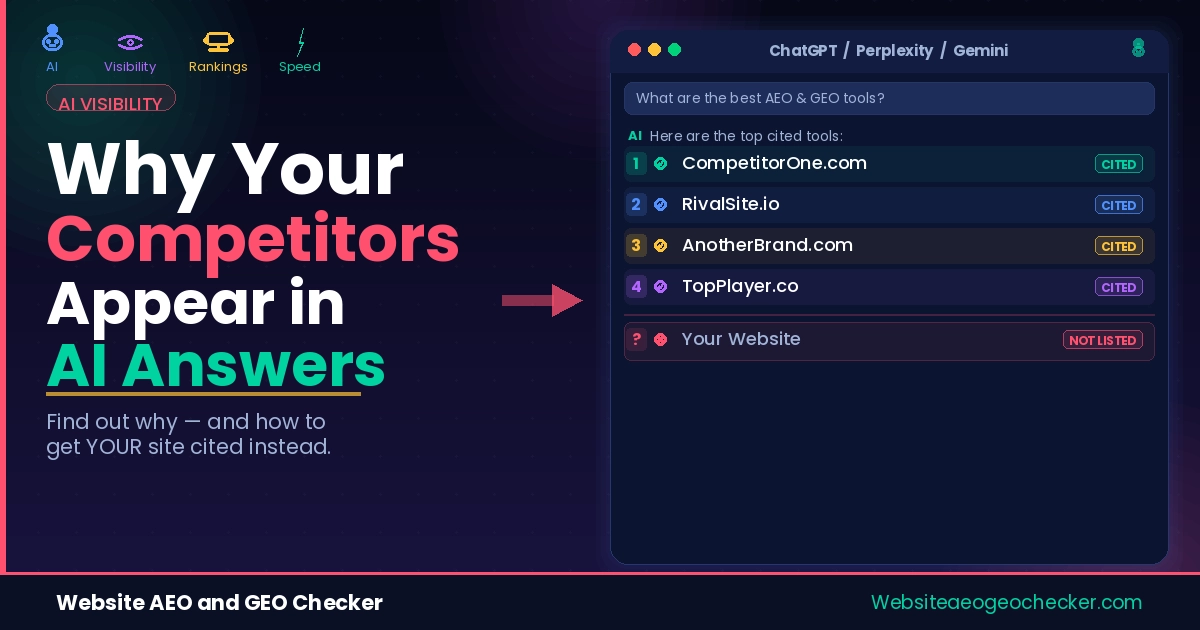
You type your own category into ChatGPT. Your competitor shows up. You do not.
You search Perplexity for the exact question your best blog post answers. Three other sites get cited. Yours is nowhere.
This isn't just a coincidence. This is almost certainly not due to the inferiority of your content. The sites that appear in AI responses do not have to be the best sites in your domain. Those sites are simply the easiest for the AI systems to find, parse, and trust. Those are solvable, structural, and technical issues, not a lack of ability.
In this article, we cover 5 of the most actionable insights you can use to prevent your competitors from dominating, AI speaks to your competitors, and, essentially, your competitors are not doing anything.
The Gap Is Not About Content Quality
Pages cited in AI Overviews earn 35% more organic clicks than non-cited competitors on the same results page. Visitors who come via Perplexity search convert on average 11 times more than visitors from a traditional search. The advantage of being referenced is that it represents a meaningful financial difference rather than a vanity metric.
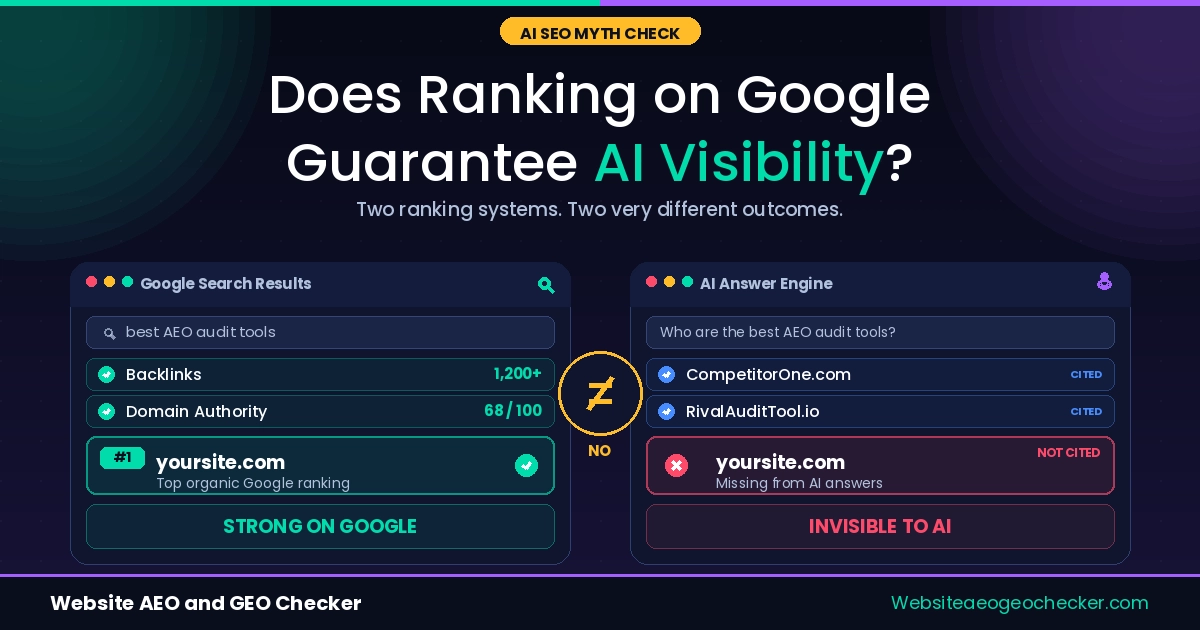
The frustrating thing is that the ability of traditional ranking in search engines has become weaker in predicting AI citations. In the middle of 2025-26, it was estimated that 76% of pages being referenced in AI Overviews ranked in the first 10 traditional search results. By the beginning of 2026, a separate study estimated that this number was 38%. This shows that your investment in SEO no longer guarantees visibility in AI, as it once did.
The sites closing this gap are not publishing more content. They are fixing the specific technical and structural signals that determine whether an AI system can access, parse, and trust what they have already written.
What Does It Actually Take to Appear in AI Answers
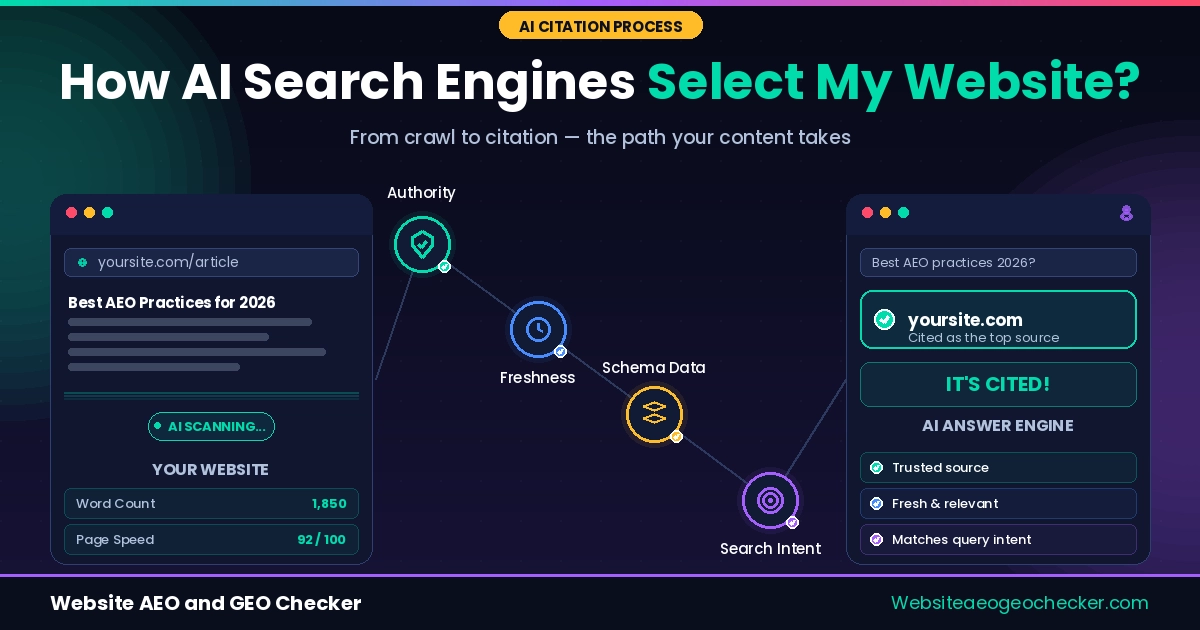
Before analyzing the five reasons, first understand how AI systems select sources. AI-based search engines aggregate information from many sources, extract and cite relevant passages, and cite only the pages from which those passages were selected. They do not sort or assess pages as a whole. They construct responses from several sources and pages.
Evidence now shows that almost 45% of all citations generated by LLMs come from the first 30% of page content. This figure should shape how you structure content, not only by section but also by where you place your most concise answers. The model will not read the content to the end. It will cite the page and move on to the next task.
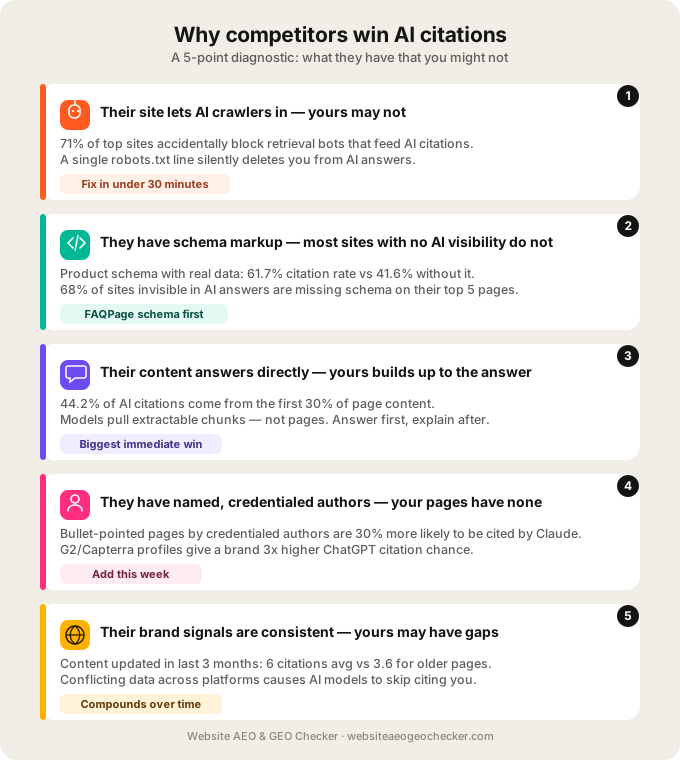
The 5 Reasons Your Competitors Are Getting AI Cited
1. Their Site Lets AI Crawlers In. Yours Does Not.
This is the most common fixable reason and the one most sites never check. An AI model cannot cite content it cannot read, and if your robots.txt or security configuration is blocking AI crawlers, your content is invisible no matter how good it is.
According to a BuzzStream analysis of the robots.txt files of the 100 most popular news sites, 79% block a least one AI training bot. More concerning is that 71% block at least one retrieval or live search bot. These are the bots that will determine if a site will show up in AI-generated answers, rather than showing up in the training data of the AI. The difference is very important. OpenAI runs GPTBot for training and OAI-SearchBot for ChatGPT search. The robots.txt rule that blocks one will no longer block the other. Therefore, the previous advice to "block all AI bots" is now harmful to site visibility.
The critical mistake is treating all AI crawlers as one thing. Your competitor may have deliberately allowed OAI-SearchBot and PerplexityBot while blocking training crawlers, giving them AI search visibility you have forfeited. A security plugin that auto-updates can also silently add a block rule overnight without anyone noticing.
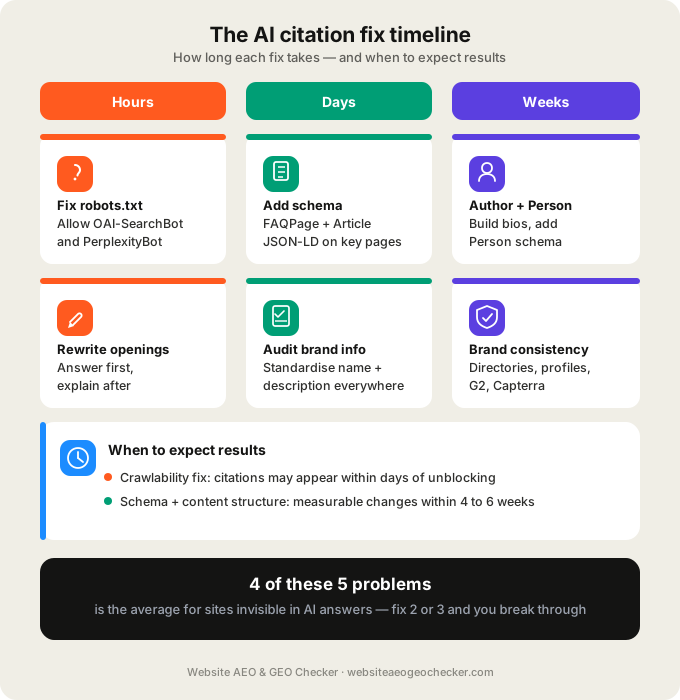
What to do: Check your robots.txt file at yoursite.com/robots.txt right now. Look specifically for rules blocking OAI-SearchBot, PerplexityBot, Google-Extended, and Claude-SearchBot. Run a full crawlability check with the Free AI Crawler Checker to see exactly which bots can and cannot reach you, including checks that go beyond robots.txt to catch CDN and firewall blocks.
2. They Have Schema Markup. You Do Not.
This one is more nuanced than it used to be. Recent large-scale research has complicated the earlier consensus that schema markup directly boosts AI citations. A study tracking 1,885 pages that added JSON-LD schema between August 2025 & March 2026, matched against 4,000 control pages. This study found that adding schema produced no major uplift in citations on AI Mode and ChatGPT for pages already heavily cited. However, the authors note that for pages not yet being cited by AI systems at all, schema markup might still play a role in helping them get crawled, parsed, or indexed in the first place.
The honest picture: The schema does not magically improve citations, with one notable exception. Pages that use Product or Review schema with clear attribute fields, price, ratings and reviews, and specs tend to get more citations than pages that use more general schema types (61.7% vs. 41.6%). This phenomenon is especially true for lower authority domains and can be explained by structured data and lower authority signals.
For most content-focused websites, schema appeals more because it improves machine readability. At SMX Munich, March 2025, Fabrice Canel of Microsoft said, "Schema markup helps Microsoft's LLMs understand content." Google's AI Overviews use structured data as one of their indexing signals, as well. Using schema clarifies content type, whether it is editorial, answer-based, or product, rather than leaving that content type to be determined by Google.
What to do: Add FAQPage schema where applicable, Article schema for each of your blog posts, and Organization schema across your website, if you haven't already. If you have an ecommerce or product-focused website, use Product schema and include real, current ratings and reviews. Although these additions, by themselves, are unlikely to impact citations, they reduce schema ambiguity and will be valuable in Google's AI Overviews.
Across the audits we have run, about 68% of sites with no AI visibility are missing schema on their top five pages entirely, not because schema alone fixes everything, but because it is part of a pattern of technical neglect that adds up across multiple signals, says the team at Website AEO GEO Checker.
3. Their Content Answers Questions Directly. Yours Builds Up to the Answer.
This is the most impactful change most sites can make, and it requires no technical knowledge at all.
AI systems favor content that places the answer in the first words of the paragraph, not at the end. Information structured in lists is easier to extract and cite. Quantified data, such as "the market grew 23% in 2025-26," is more citable than "the market grew strongly." Content that presents precise facts gets cited more than vague or opinion-heavy formulations.
The design of AI systems for content retrieval makes certain design choices necessary. RAG systems do not pull entire articles. Rather, they pull document-level chunks that correspond to the query vector. A system that pulls passages cannot discern a 2000-word answer that is a wall of text. An AI model will find wall text unsatisfactory, for wall text does not help isolate the answer the system is looking for. Rather, the system is looking for a text fragment it can pull with little context surrounding it.
Real example: Dani manages content for a B2B SaaS company and had spent 2 years building a detailed content library. Her posts were thorough, well-researched, and consistently ranking on page one. She was not showing up anywhere in Perplexity or ChatGPT answers. After a content audit, she rewrote the opening paragraph of her top 5 blog posts to state the direct answer immediately, before any context or background. She also restructured her FAQ sections so every answer opened with a clear yes or no followed by the explanation. Well.. Within 5 weeks, 2 of those pages began showing up in Perplexity citations for queries she had never ranked for in traditional search. The content had not changed. The shape of the answer had.
According to Search Engine Journal's coverage of AI citation patterns, structured, direct-answer content consistently outperforms prose-heavy pages regardless of domain authority, particularly in Perplexity which retrieves and cites in real time rather than relying on training data.
What to do: Open a draft of your three most important pages. Find the paragraph that contains the actual answer to the question the page targets. Move it to the first or second sentence of the relevant section, not the third paragraph. Check how this scores for direct-answer clarity using the Free GEO Checker.
4. They Have a Named, Credentialed Author. Your Pages Have None.
AI systems evaluate trustworthiness before deciding whether to cite a page. When it comes to AI systems that assess credibility, content that quotes named and credentialed sources gets referenced more often. These AI systems tend to favor content that cites reliable sources, which reflects well on the author's ability to provide trustworthy information.
Content structured with clear definitions and bullet points is up to 30% more likely to be selected by Claude 3 and later versions. Unlike ChatGPT's consensus approach, Claude favors single authoritative sources that provide comprehensive coverage of a topic. Author credibility is part of that authority signal.
Many site owners may not realize how important this is. An author's credibility extends beyond the web page. If the author's LinkedIn profile matches their bio, is mentioned, and shows a solid work history, it can boost both the author's and the page's reputation.
Web pages with question-based outlines and text that is sectioned into a series of frequently asked questions increase the odds that content will be referenced by ChatGPT. Citation counts tend to increase with pages that include three comparison tables (25.7%) and pages that have an average sentence length of ten words or less (18.8%). These effects are maximized when the page is authored by a named, credentialed author.
What to do: Always add a named author byline with a real bio to every article; Link the byline to an author page that names their credentials, their role, and their relevant background. Add Person schema for each named author linking them to your Organization schema. If articles are currently attributed to "admin" or to your company name, that is worth fixing this week before anything else.
5. Their Brand Signals Are Consistent. Yours Have Gaps.
AI models cross-reference information about your brand from different perspectives. They won't trust brands with competing data. Inconsistent descriptions across your website, LinkedIn, and third-party directories can lead AI models to neglect citing your brand.
Recently updated content is cited more than outdated content. Timeliness is important. Consideration must also be given to outdated content. Both blog posts and pricing content that are untouched for extended periods can become stale and unreliable.
Brands that maintain active profiles on Trustpilot, G2, and Capterra are cited three times more by ChatGPT than brands that don't. These platforms establish a presence and external consistency that are important for an AI's credibility assessment, thus preventing your competitors from getting a larger share of ChatGPT results than you.
The consistency fix is unglamorous work. It involves going through every directory your company appears in, every social profile, every review platform, and making sure the name, description, founding date, and service description match exactly. You can also add an llms.txt file at your domain root to give models a clear, authoritative summary of what your site covers, using the llms.txt Checker to see whether yours is in place.
What to do: Perform a quick evaluation of your brand on your website, LinkedIn, Crunchbase, G2, Capterra if relevant, and any directories where you are listed. Look for differences in your company name, description, or service categories. Always standardise them. Then check when your most important content pages were last updated. Anything unchanged for more than six months is worth refreshing, even if only to add a new statistic or update an example.
The Fix Is Not More Content. It Is Better Signals.
Every one of these five reasons has a common thread. None of them are fixed by writing more. They are all about the signals that sit underneath your existing content, making it accessible, trustworthy, and structurally readable to machines that are deciding whether to quote you.
That is a meaningfully different kind of work than traditional content marketing. It is closer to technical SEO than editorial work. And it is almost certainly what your most visible competitors have quietly been doing for the past year while everyone else was focused on publishing volume.