You have probably seen the acronym AISO somewhere in a marketing email or a LinkedIn post and wondered if it is just another rebrand of SEO, or something you genuinely need to act on.
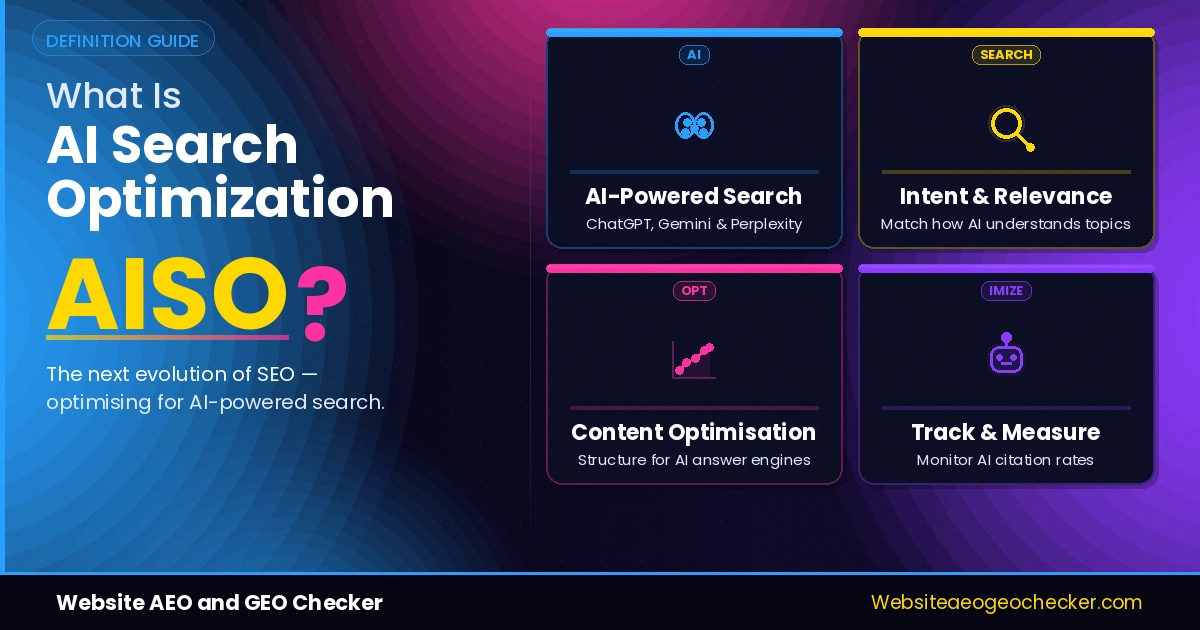
Here is the short version. AI Search Optimization (AISO) refers to the practice of organizing content on your website so that AI tools (e.g., ChatGPT, Perplexity, Google AI Overviews) can analyze it, understand it, and cite it. Your website can rank high on Google and still be overlooked by every AI tool your customers are interacting with.
This article explains AI Search Optimization, specifically how it contrasts with traditional Search Engine Optimization (SEO), and what role it plays with AEO and GEO (terms you may be familiar with)
AI Search Optimization in One Sentence
AI Search Optimization is the work of making your content easy for AI systems to find, read, and quote when someone asks a question your page could answer.
That is the whole idea. There are factors that complicate the understanding of AISO, the primary one being that AI systems and search engines are not analogous. As such, the factors you will optimize for will vary.
SEO is built around a straightforward event: a searcher generates a result and clicks a link. AISO relies on the fact that a user can pose a question, and an AI tool can respond to the question without ever visiting a website.
How AI Search Optimization Is Different From Traditional SEO
SEO and AISO share some DNA. Page speed matters to both. Clear writing matters to both. Backlinks still carry some weight in both.
This is the main divergence between the two practices. SEO is built on a system that is ranking your page in a finite list. AISO is built on a system that is assessing whether to interpret the content on your page and, if it does, whether it will cite the content in its response.
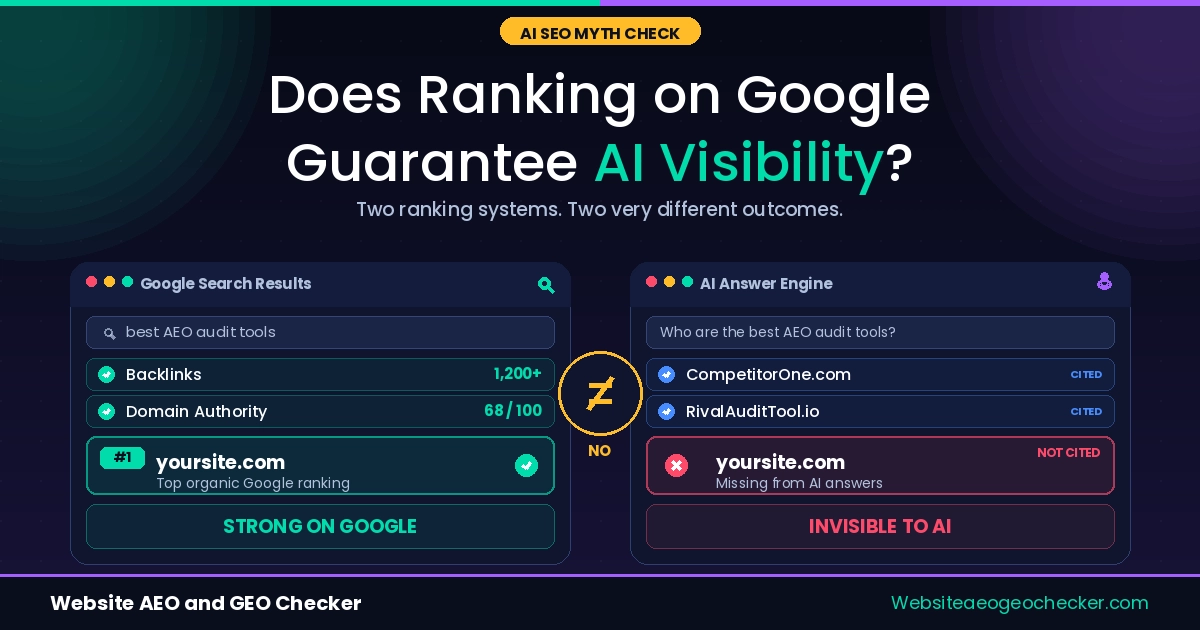
That shows how great performance in Google Search Console doesn't always mean positive ChatGPT or Perplexity results. We see this frequently. The site possesses links, decent rankings, and fair traffic. None of that guarantees an AI model will cite it. This is because citation signals are different from ranking signals.
We stopped worrying about which acronym a client uses the moment we realized every one of them points back to the same three questions: can a bot reach your page, can it understand the page once it gets there, and does it trust what the page says. Get those three right & the label stops mattering, says the team at Website AEO GEO Checker.
How AI Systems Actually Find and Use Your Content
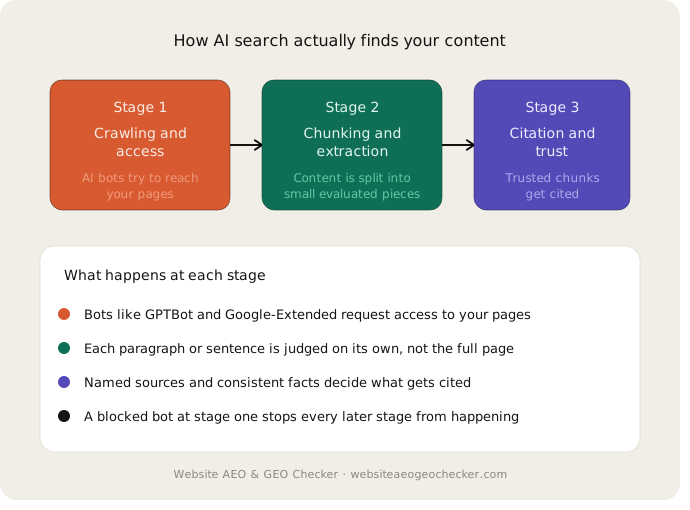
To optimize for something, you need to understand how it actually works. Here is the process AI search tools go through, broken into three stages.
Crawling and Access
For an AI model to use your content, it has to be able to access it first. AI companies create their own bots. For example, OpenAI GPTBot, Bing AI OAI-SearchBot, and Google's AI features with their own Google-Extended bot.
If your robots.txt file disallows these bots, your content is invisible to them, no matter how good it is. This happens more often than people expect. A security plugin gets installed, it blocks "unknown" or "suspicious" user agents by default, and your site quietly stops showing up in any AI answer. You can check exactly which bots can reach your site using the AI Crawler Checker.
Chunking and Extraction
AI systems rarely process a full page top to bottom the way a human reader does. They break content into smaller pieces, sometimes a paragraph, sometimes a single sentence, and evaluate each chunk on its own.
A page is negatively impacted if it has ten paragraphs of filler content, with one good answer to a question that inevitably gets buried. This is in contrast to a page where all the sections answer something specific and are coherent in and of themselves. Every section must be able to stand on its own without the support of the rest of the page.
Citation and Trust
Once an AI model has extracted a chunk it could use, it still needs a reason to trust it. This is where authority signals come in. Clear authorship, named sources, consistent facts across multiple places on the internet, and structured data that confirms what type of content this is.
A model is more likely to cite a page that backs up its claims with named, checkable sources than a page that states things with no attribution at all.
The Core Parts of AI Search Optimization
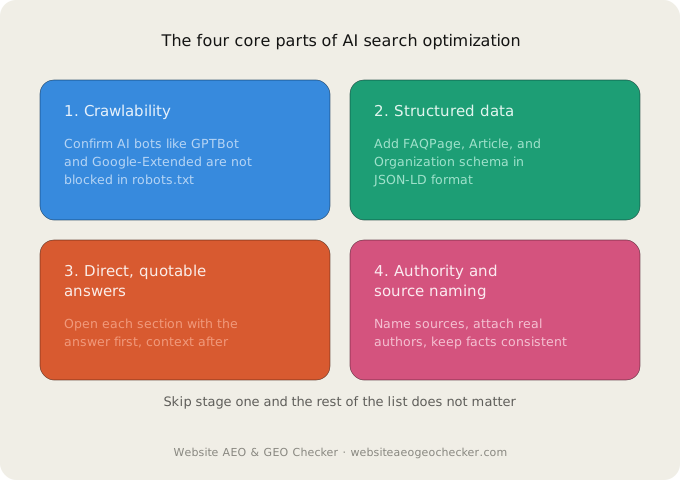
There are four areas that make up most of the actual work. None of them are exotic. Most are things you can start fixing today.
Crawlability
This is step zero. If AI bots cannot access your pages, everything else we mention is irrelevant. You should look at your robots.txt file. Look at the firewall and security plugin settings to make sure your site is not blocking AI bots' access.
Structured Data
Schema markup written in JSON-LD format tells AI systems what type of content a page contains. FAQPage schema, Article schema, and Organization markup are the three that carry the most weight for AI visibility. According to Google's search documentation, structured data helps systems understand page content more reliably, which extends to how AI-powered features parse and use that content. You can review the full vocabulary of available markup types directly on Schema.org.
Direct, Quotable Answers
Write the answer first, then explain it. AI Bots prefer content that is concise and states the answer in the first sentence and not in a series of three context building paragraphs.
Authority and Source Naming
Name where your data comes from. Attach an author with real credentials. Keep facts about your brand consistent across your site, your social profiles, and any third-party listings. AI models cross-reference this consistency when deciding what to trust.
Key Points: What AISO Means and Where It Fits
- • AISO, or Artificial Intelligence Search Optimization, grew 90% in search volume in 2025 and now dominates AI search hiring language, appearing as the most used term across 33,000 Indeed job postings analyzed.
- • AISO is the strategic frame that connects SEO as the foundation, AEO as the extraction layer, and GEO as the authority layer into a single coordinated approach to AI search visibility.
- • 40% to 60% of cited sources change month to month across Google AI Mode and ChatGPT, meaning AISO requires ongoing measurement rather than a one time optimization project.
- • At Website AEO GEO Checker, we consistently see websites optimized for traditional search rankings that are invisible in AI generated answers for the exact same queries they rank well on.