Let's deal with the obvious tension first. SXO was never built with AI search in mind. It is an older discipline, born well before ChatGPT or Perplexity existed, focused on making a website easy and rewarding to use once a visitor lands on it. So if you came here wondering whether SXO is secretly another AI search acronym in disguise, the honest answer is no.
The two are definitely related in some ways. SXO has been concerned with page speed, bounce rate, navigational ease, and mobile usability. These have been SXO concerns for a while, and they appear to correlate with the factors AI considers when deciding whether a site is worth referencing. This is not because AI cares about the experience of the user. In fact, AI does not browse like a human. However, the technical requirements of a page that makes it easy for a human user to use, also make it easy for AI to read, parse, and trust.
This article walks through five specific places where SXO work quietly supports AI visibility, and is equally clear about where the overlap ends.
What SXO Actually Means
Search Experience Optimization combines traditional SEO with user experience and conversion principles. The idea is simple. Ranking well is not the finish line if visitors leave immediately, get confused navigating the site, or fail to take the action the page was designed for. SXO looks at the full journey: did the page rank, did the visitor stay, did the visitor do what they came to do.
Human-centric metrics include bounce rate, average time on page, conversion rate, and task success rate. None of these are metrics AI models are using when deciding to cite a page.
Why SXO and AI Search Are Not the Same Thing
AI engines do not experience your site the way a person does. They do not scroll, click, hesitate, or convert. A bot extracts content, evaluates structure, and decides whether a chunk of text is worth using in a generated answer. There is no journey to optimize because there is no human journey happening at all.
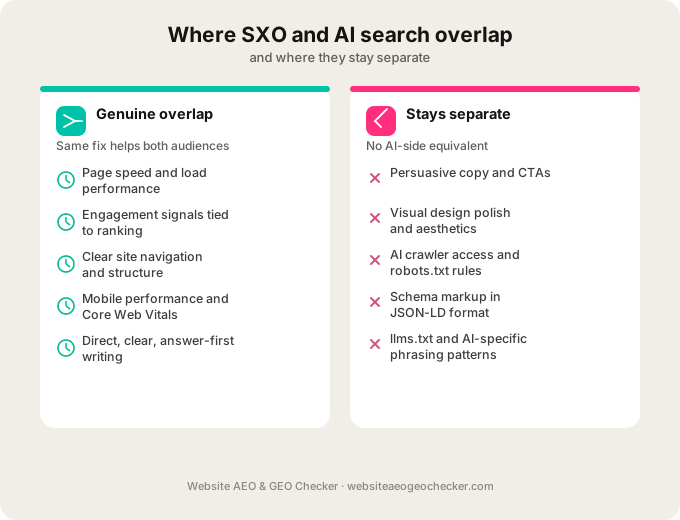
When working on SXO, things like copywriting, design improvements, and adding calls to action do not directly affect how AI systems review a page. You could have an SXO score that impresses a conversion consultant, but still be missed by an AI query. This happens because AI systems use a different set of criteria.
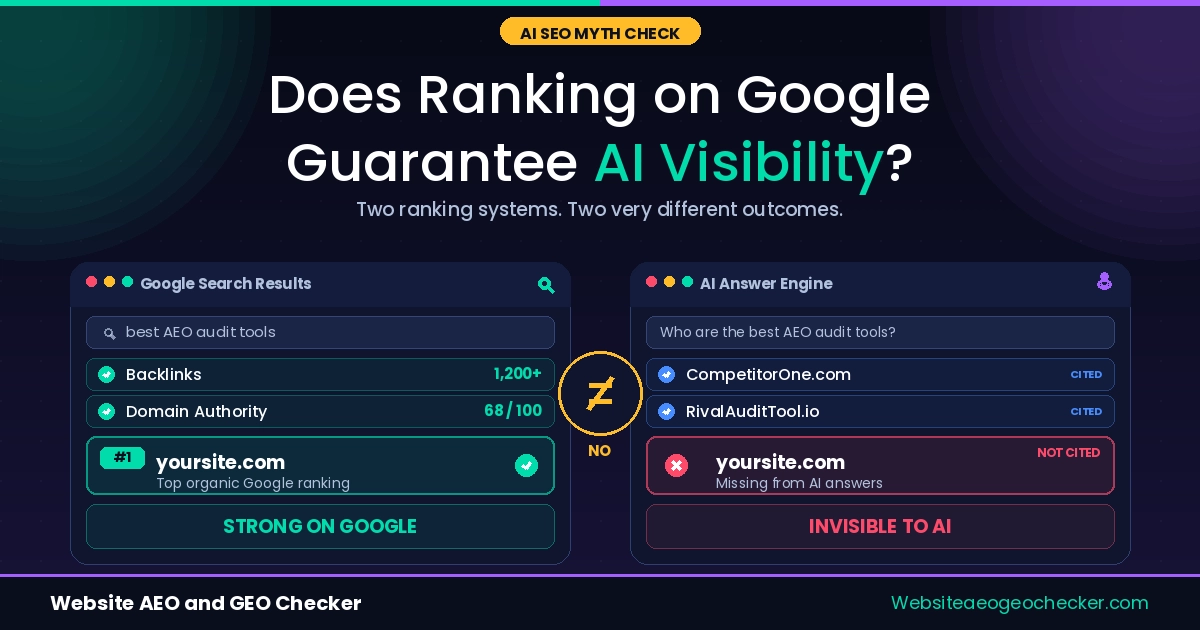
We get asked constantly whether good UX automatically means good AI visibility. It does not. They share some plumbing, but they are solving different problems for different audiences, says the team at Website AEO GEO Checker.
Where the two disciplines genuinely intersect is in the technical layer underneath both of them. That is what the next five points cover.
What Are the Ways SXO Affects Whether AI Engines Trust Your Site
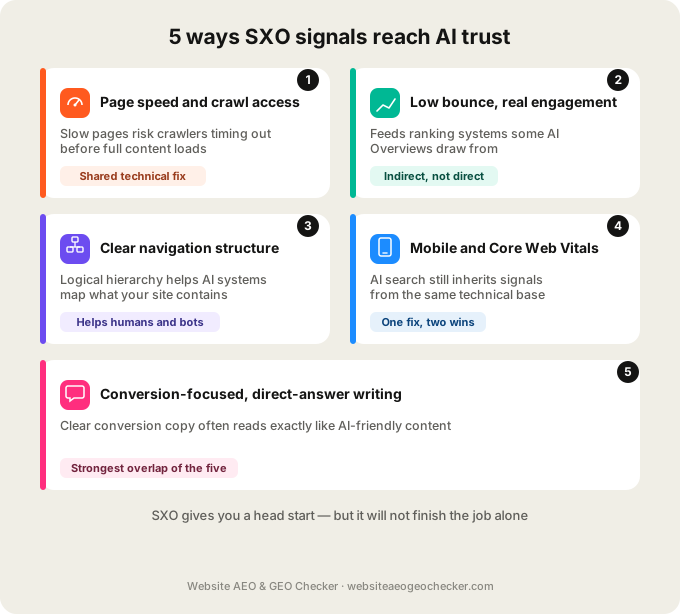
Five specific technical and structural overlaps connect SXO work to AI search visibility, even though the two disciplines were built for different audiences.
1. Page Speed Affects Whether Crawlers Get the Full Page
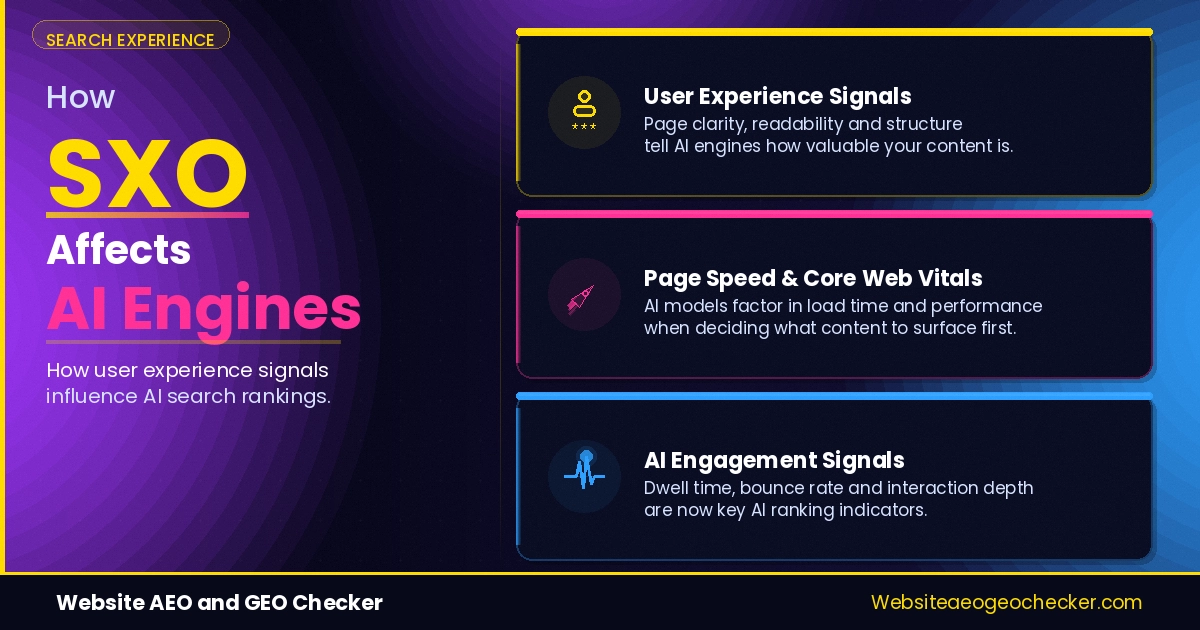
Slow pages increase bounce rate and frustrate visitors. That is why SXO has concerned itself with page speed for many years. Slow pages are also a concern for AI crawlers, but for different, albeit related, reasons. If pages take too long to load, they may time out before the crawlers finish capturing the full content of the page, especially if important information is slow to load due to other scripts firing requests after the page has been fully loaded.
If your SXO work has already pushed your load times down, you are likely already ahead on this point without realizing it. If it has not, this is worth fixing for both audiences at once rather than treating it as two separate projects. You can check your current load performance and what AI crawlers actually receive using the Page Speed Test with AI Readiness, and cross-reference it against the Free AI Crawler Checker to confirm bots are not being timed out or blocked entirely.
2. Low Bounce Rates Signal Real Value to Ranking Systems Feeding AI Overviews
This one requires a careful distinction. AI models don't get access to your Google Analytics bounce rate. They don't view it. However, many of the AI-generated answer features, including Google's AI Overviews, are built on search ranking signal constructs, which dictate what pages are included in the candidate pool for search models, among other things.
Engagement metrics like low bounce rate and longer time on page have long been associated, even if imperfectly, with how search systems judge whether a page satisfies the query that brought someone there. According to Moz's research on bounce rate, engagement signals interact with broader ranking factors in ways that are not fully transparent but are consistently observed across large datasets. If your SXO improvements are genuinely keeping people engaged rather than just looking better on a dashboard, that same underlying page quality may help you clear the first hurdle before an AI system ever gets a chance to read your content.
3. Clear Navigation Helps AI Systems Map Your Site's Structure
Good navigation design in SXO directs a site visitor to their goal and reduces the chance of backtracking. Navigation as a concept in SXO and AI has the same meaning. A good IA hierarchy with category organization, descriptors for internal links, and a predictable structure aids both SXO and an AI crawler in site comprehension.
A flat, well-organized site structure with descriptive internal linking text gives a model context it would otherwise have to guess at. A confusing structure, where everything links to everything with vague anchor text like "click here," gives a model very little to work with. The Nielsen Norman Group's usability research has documented for years how clear information architecture reduces cognitive load for human visitors, and the same structural clarity reduces ambiguity for a machine trying to parse your site without a person guiding it.
4. Mobile Experience Quality Ties to Core Web Vitals, Which AI Search Still Inherits
SXO focuses on the overall experience of the site visitor and, in particular, the mobile site visitor. Because most browsing is done using a mobile device, layout shifts that are unstable, elements that cannot be easily tapped, and slow loading times cause damage to a site visitor's experience and satisfaction of using the site.
These same issues are measured by Core Web Vitals, a set of metrics that web.dev's official documentation defines around loading performance, interactivity, and visual stability. AI search features that are layered on top of traditional search infrastructure still inherit signals from this same technical foundation. A page that fails Core Web Vitals for human visitors on mobile is very often the same page failing to render cleanly for crawlers attempting to extract content from it. Fixing one tends to fix the other, since the underlying cause, usually unoptimized images, render-blocking scripts, or layout instability, is identical.
5. Conversion-Focused Clarity Often Produces the Same Direct-Answer Writing AI Models Prefer
This is the most interesting and the most difficult to notice of the overlaps. Good conversion copy eliminates the extraneous, but good conversion copy also answers objections, and good conversion copy also does not bury the most important point for the reader. AI also values this same discipline, and for this reason, this style of good conversion copy is also usable content for AI-generated responses.
Real example: Elena, a CRO specialist, rewrote a SaaS company's pricing page to improve conversions. She cut the introductory copy down from four paragraphs to two sentences, moved the plan comparison higher on the page, and rewrote each FAQ answer to lead with a direct yes or no before explaining further. Conversions improved, which was the original goal. A few months later, she noticed the same pricing page had started showing up in ChatGPT responses to comparison questions about the product's plans, something that had never happened with the older, more padded version of the page. The conversion rewrite and the AI visibility improvement came from the same edit.
This does not mean every conversion tactic helps AI visibility. Urgency banners, countdown timers, and persuasive flourishes aimed purely at triggering a purchase decision do nothing for a model evaluating factual content. But the core instinct behind good conversion writing, respect the reader's time and answer clearly, maps directly onto what GEO work asks you to do. You can see how your own content scores on this specific dimension using the Free GEO Checker.
Where SXO Stops and AEO/GEO Begin
The five above points identify some real boundaries for SXO. SXO probably won't go near crawlability considerations for AI bots, structured data in JSON-LD, llms.txt, phrasing patterns for content generation lifts to AI-generated answers, etc. Those belong to AEO and GEO. There is no trick to user experience that will get those covered.
Think of it this way. SXO can put you in a good starting position because some of its core habits, speed, clarity, structure, happen to be shared prerequisites. But it will not finish the job. If your site has excellent SXO and zero AI visibility, the gap is almost certainly in the technical AI-specific work that SXO was never designed to cover. You can see exactly what is missing with the Free AEO Checker.