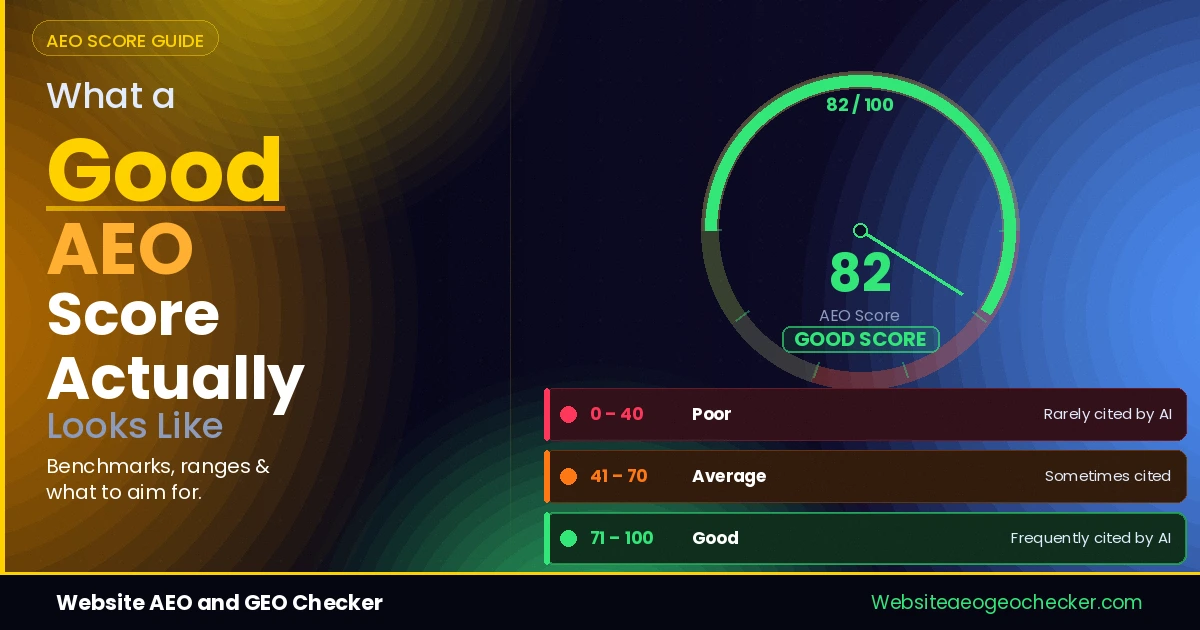
Almost every user who runs our checker asks the same thing immediately after: is my Answer engine optimization (AEO) score actually good?
A score of 54 sounds good and a score of 38 sounds bad. However, without a reference point, we cannot compare either score. You might get 54 and be ahead of most sites, or you might be average. Maybe there are only a couple of remaining issues, and you will easily reach a score of 70, or maybe you need a complete overhaul.
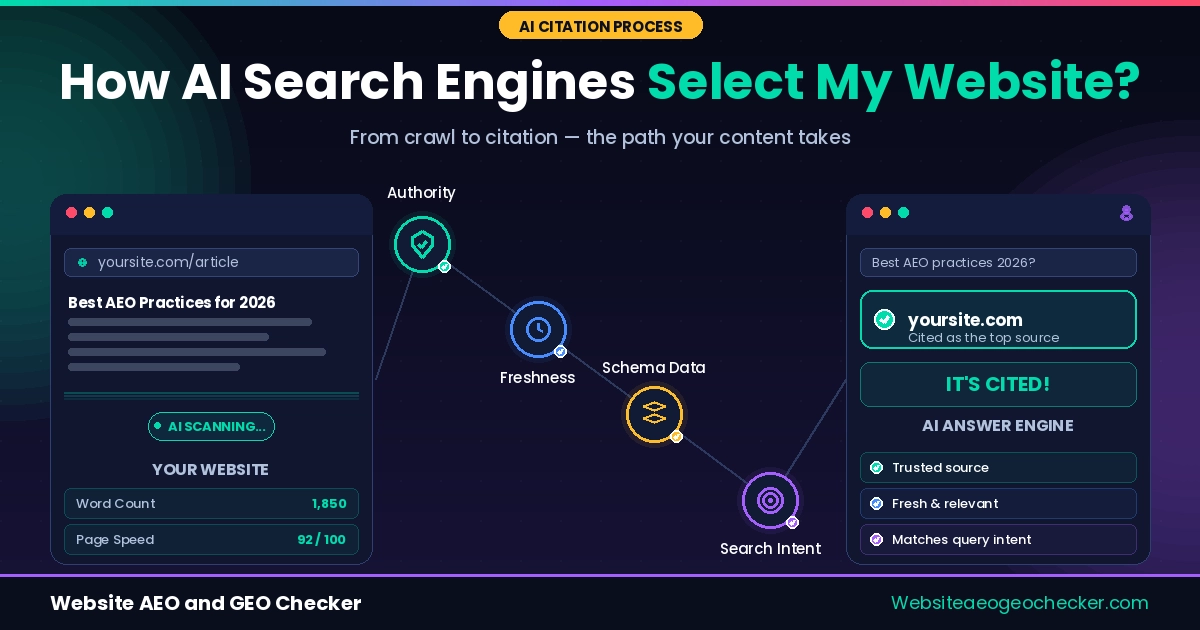
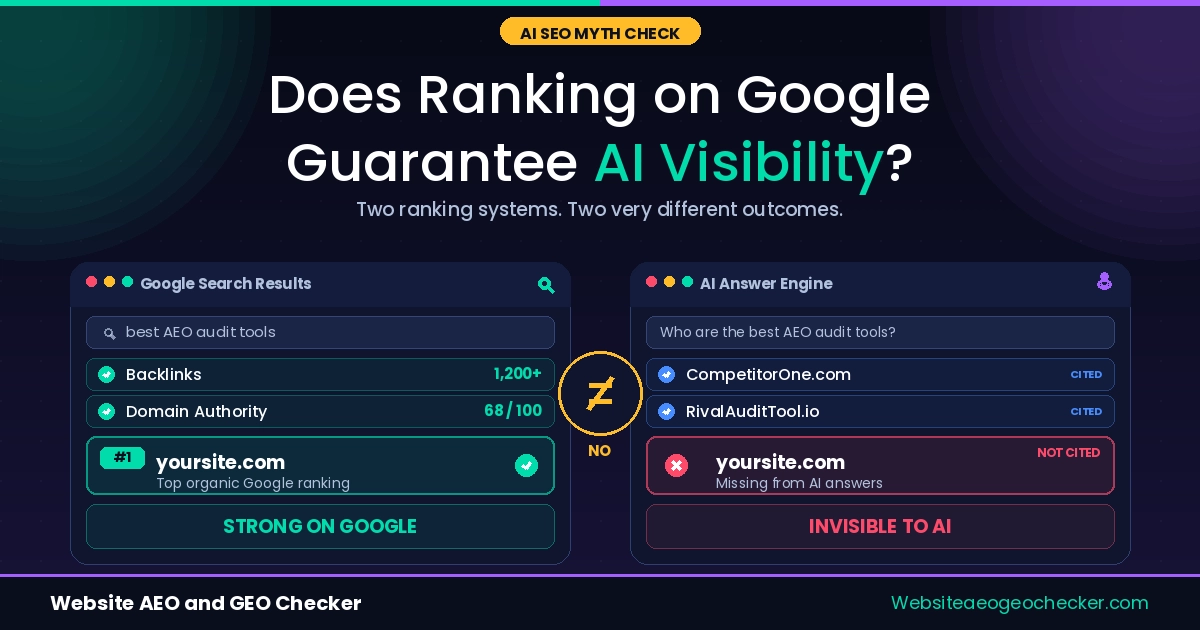
After assessing a thousand websites for each of the five types of signals, we are always surprised by the expectations of the site owners visiting us. Most site owners believe that their Google rankings will show us how their site performs with AI. This is not the case. Most sites that rank highly on Google have an AEO score lower than 50. This is due to the structural differences in how Google and AI evaluate your content.
This article breaks down what each score band means in practice, what the three failure points are that appear on almost every low-scoring site, and exactly what the sites scoring above 75 have done differently.
Key Points: What Makes a Good AEO Score
- • A good AEO score is not a fixed number. It is defined by whether you consistently outscore direct competitors on the queries that matter most to your business.
- • An AEO score measures five dimensions: citation frequency, prominence, factual accuracy, sentiment, and share of voice. Each tells a different story about your AI visibility health.
- • Adding statistics to content improves AI visibility by 41%, and content updated within the last two months earns 28% more citations than older pages, making freshness and data density the fastest levers to pull.
- • At Website AEO GEO Checker, we consistently see website owners focus on their total score while missing the dimension breakdowns that reveal exactly where effort should be concentrated.
What Does the AEO Score Actually Measure?
Our checker runs over 50 tests across five signal categories. Each one contributes to your overall score out of 100.
Crawlability checks whether your web pages can be reached and indexed by AI bots including GPTBot, OAI-SearchBot, ClaudeBot, and PerplexityBot. A single misconfiguration to your robots.txt can make your score in this category a zero, even if you have the best content on the web.
Structured Data is a measurement of whether you have the right JSON-LD to tell AI Retrieval Systems who your page is, who wrote it, and what questions it answers. The types that matter the most are FAQPage, Article, Organization, and BreadcrumbList. Without these markups, your page is an unidentified block of text to an AI engine, no matter how well it reads.
Content Format check whether your pages are designed to be easy to extract from. For example, do your pages start with the answer? Do your headings ask questions? Do your paragraphs stand alone so they can be cited on their own? AI systems cite passages, not pages. If your paragraphs are too context dependent, they won't get cited.
Authority Signals, such as EEAT metrics, show your site is a credible source worth citing. Real About pages show up, plus author markup that is linked with bios, Person schema on author pages, and consistent brand entity signals on and off your site. These are the things that make you a trusted resource and not an anonymous one.
Page speed checks your Core Web Vitals, LCP, and mobile performance. AI crawlers spend their crawl budget the same way Googlebot does. When two pages are covering the same content and one loads in 1.8 seconds but the other loads in 4.5, the one that loads first is crawled the most and cited the most.
Your score is a weighted composite of all five. According to Conductor's 2026 AEO and GEO Benchmarks Report, AEO scores show a 0.82 correlation with actual AI citation rates, which means your score is a reliable predictor of how often your content gets cited, not just a proxy metric.
AEO Score Ranges: What Each Band Actually Means
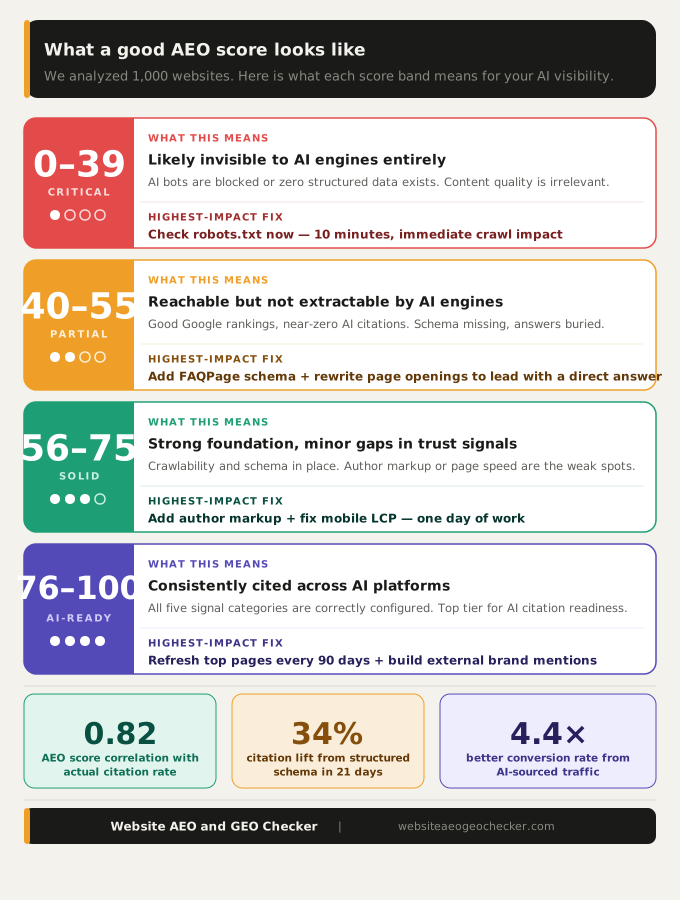
Here is how the 1,000 sites we analyzed break down, and what each score band signals about real-world AI visibility.
0 to 30: Critical gaps, likely invisible to AI engines
Sites in this range almost always have at least one of two problems: AI bots are blocked in robots.txt, or no structured data markup corresponds on the whole site. Sometimes both. At this level, it is all about quantity. A travel blog with 300 posts that are all well written and ranked in Google will pull an 18 if GPTBot is blocked and no schema exists. No crawler means no citation, full stop.
Research from Discovered Labs shows only 8 to 12% overlap between URLs cited by ChatGPT and top-10 Google rankings for commercial queries. For product comparison queries, the correlation was actually negative. Sites in this band typically find out they have an AI visibility problem only when a competitor mentions it, because nothing in Google Analytics shows the traffic that never arrived.
31 to 55: Partial visibility, good content, poor structure
This is where most sites land, and where the frustration is loudest. Real content, real Google traffic, close to zero AI citations. The content is not the problem. The structure is. Answers are buried under long introductions, schema is missing, headings are labels rather than questions.
Real example: Tom, an independent travel blogger with four years of content and first-page Google rankings on 12 keywords, scored 44 on his first run. He assumed that was passable. The checker flagged two issues: GPTBot was blocked in his robots.txt by a security plugin he had installed and forgotten about, and he had zero structured data across 80 posts. He fixed the robots.txt in 10 minutes and added FAQPage and Article schema to his top five posts over a weekend. His score jumped to 71. Two of those posts started appearing in Perplexity answers for travel packing questions within 6 weeks.
56 to 75: Solid foundation, gaps in authority or technical signals
At this level, the fundamentals are correct. Bots are able to crawl the site. Key pages on the site contain some form of schema. The content is formatted well enough. Gaps are recurring almost all the time in authority signals: no author markup, a weak About page, inconsistent brand entity signals across the web, and so forth.
The schema cases of App show that having stronger entity relations indicates a 19.72% increase in AI Overview visibility and helps connect the dots when a certain implementation is described to show a certain outcome.
The jump from 55 to 75 is usually two things: adding author markup to every post and rewriting the About page with real, specific credentials. Neither takes more than a day. Both move the needle more than most people expect. - Website AEO GEO Checker
76 to 100: AI-ready, consistently cited
Sites that rank in this group usually start with a direct answer, use different schemas like FAQPage, Article, and Organization, include author bios with Person markup, allow easy crawling by all major AI bots, and keep their LCP at 2.5 seconds or less. These sites do not have to be the biggest or oldest. Most often, they are simply set up better. Top sites in this group see over 30% success on category queries, and traffic from AI sources converts at 4.4 times the rate of other traffic.
The 3 Most Common Failure Points We Found
Across 1,000 sites, three issues appeared on nearly every low-scoring audit. They are not exotic problems. They are simple failures invisible to traditional SEO tools.
1. GPTBot or OAI-SearchBot blocked in robots.txt
This was the single most common issue we found, and in most cases it was not intentional. A security plugin, a CDN firewall setting, or a wildcard disallow rule had silently blocked AI crawlers. The fix is two lines in robots.txt. The impact is immediate on the next crawl cycle. Check your current configuration with the robots.txt Checker.
2. No FAQPage schema on any page
Pages with FAQPage, HowTo, Article, and Person schema are significantly more likely to earn AI citations than equivalent pages without markup, according to multiple 2025 and 2026 studies. Google Search Central's structured data documentation shows Rotten Tomatoes reported a 25% higher click-through rate on pages enhanced with structured data, and that same machine-readable formatting sharpens AI retrieval context directly. We found FAQPage schema missing on the majority of sites we audited, including sites that had implemented other schema types like Product or LocalBusiness.
3. Answers buried under long introductions
Now, 37% of product discovery searches start in AI tools like ChatGPT and Perplexity. When someone asks a question, these engines look for a clear answer near the top of your page. If your page starts with a long story instead of the answer, the engine will just pick a competitor's site. This means competitors have formatted their answers better. Clear and direct responses work best. Of all the changes you can make, this one delivers results the fastest.
We have audited thousands of pages. The most common pattern on sites scoring below 45 is not bad content. It is good content with a buried answer. Move the answer to the first 100 words and you change score categories. - Website AEO GEO Checker
What Separates a 40-Score Site From an 80-Score Site?
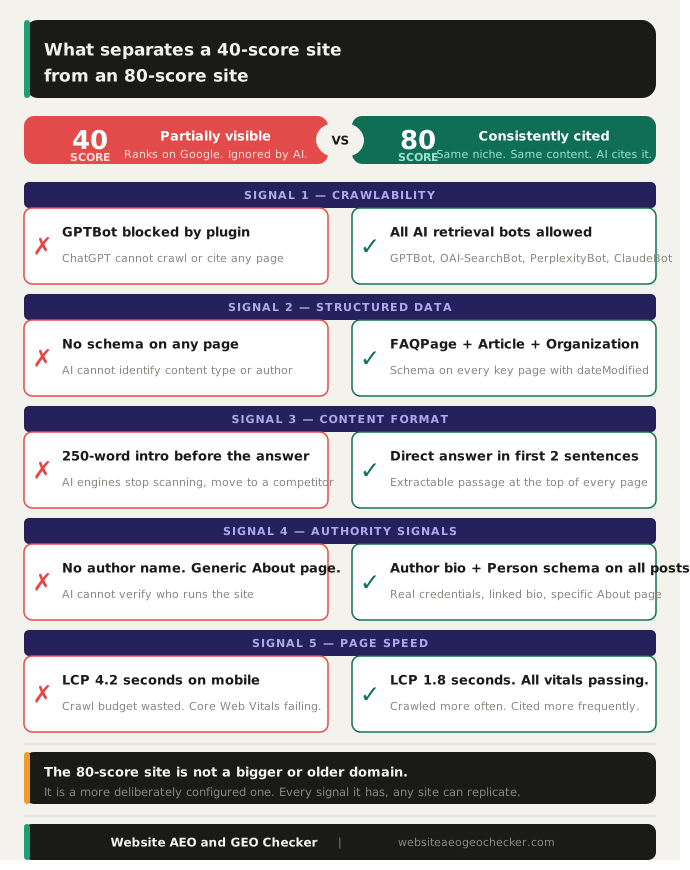
The gap between these two sites is almost never content quality. Here is what the diagnostic picture actually looks like when we compare them side by side.
A typical 40-score site:
- Good content, well-ranked on Google
- GPTBot or OAI-SearchBot blocked by a plugin or CDN rule
- No FAQPage or Article schema on any page
- Pages open with 150 to 250 words of context before reaching the answer
- About page is generic, no author names or verifiable credentials
- LCP between 3 and 5 seconds on mobile
A typical 80-score site:
- Same or lower domain authority than the 40-score site
- All major AI retrieval bots explicitly allowed in robots.txt
- FAQPage schema on every page with a Q&A section
- Article schema on every post with dateModified and author fields populated
- Organization schema on the homepage with sameAs links to social profiles
- Pages open with a direct two-sentence answer to the primary question
- Author bios with visible credentials linking to a page with Person schema
- LCP under 2.5 seconds and Core Web Vitals passing on mobile
The 80-score site is not a bigger or older domain. It is a more deliberately configured one. Every signal it has, any site can replicate. For a complete list of all 25 signals with specific checks and fixes, read the AEO checklist.