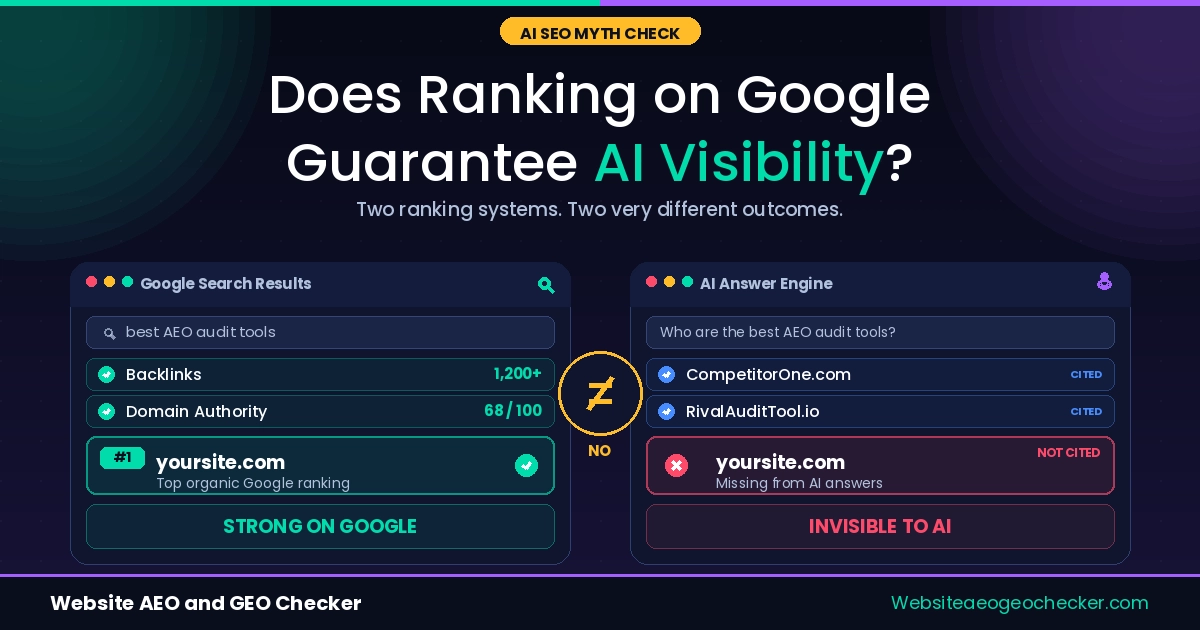
Two pages can cover the same topic with the same depth and the same accuracy. One gets cited in ChatGPT answers, Google AI Overviews, and Perplexity results. The other gets nothing. Same niche, similar authority, comparable backlinks.
The difference is almost never the quality of the writing. It is the shape of the content on the page.
AI systems do not read articles as humans do. AI systems look for easily extractable passages. This includes a direct, concise answer near the top, a neat, clean, and concise numbered list, and a concise, self-contained, context-free passage.
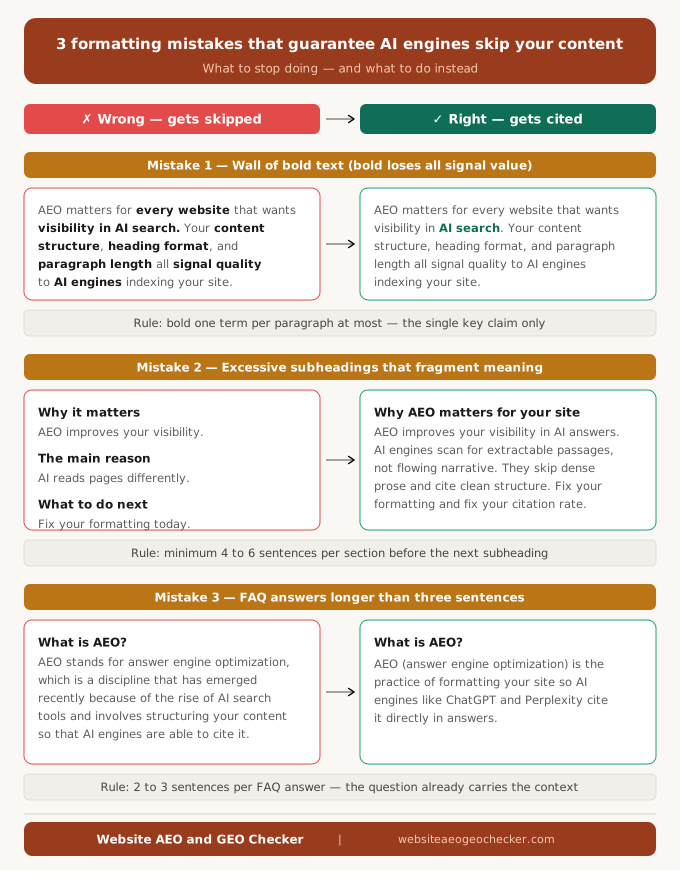
It is clear that webpages that make information easy to extract are cited and referenced. Webpages that contain information in dense paragraphs that are long and hard to read are not referenced.
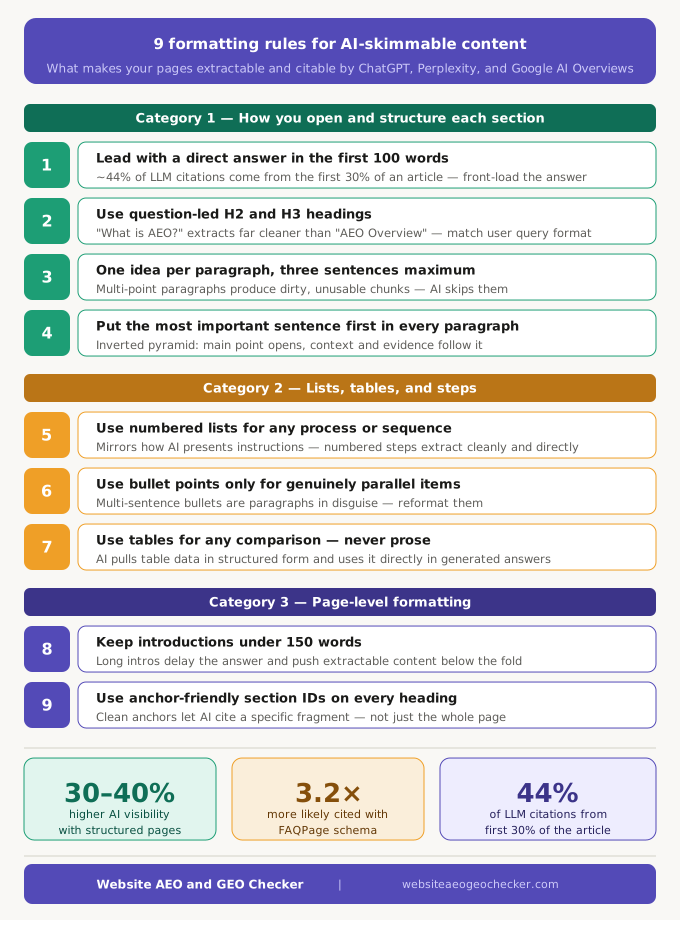
LLMrefs is a study that examined more than 5.5 million answers from LLMs. This study showed that webpages that contain topical information in self-contained passages and include structured lists and direct quotations or self-contained passages with embedded data and statistics can expect a 30 to 40 percent higher probability of being referenced by LLM systems. This is in comparison to webpages that present a given topic in an unstructured way. Structuring information is a citation signal.
These nine rules cover exactly what to change. Not vague advice about making content readable. The specific formatting patterns that AI engines pull from, and the specific habits that get your pages skipped.
Why AI Engines Read Differently From Human Readers
When a person reads your article, they follow your logic. They move from the problem to the context to the answer. They carry meaning between paragraphs.
AI systems do not evaluate documents like humans do. AI systems look for passages that can stand alone. A dense and long paragraph that is hard to read is a poor citation candidate. A dense and long paragraph that is hard to read is a poor citation candidate. A self-contained passage with a specific and concise claim is a strong citation candidate.
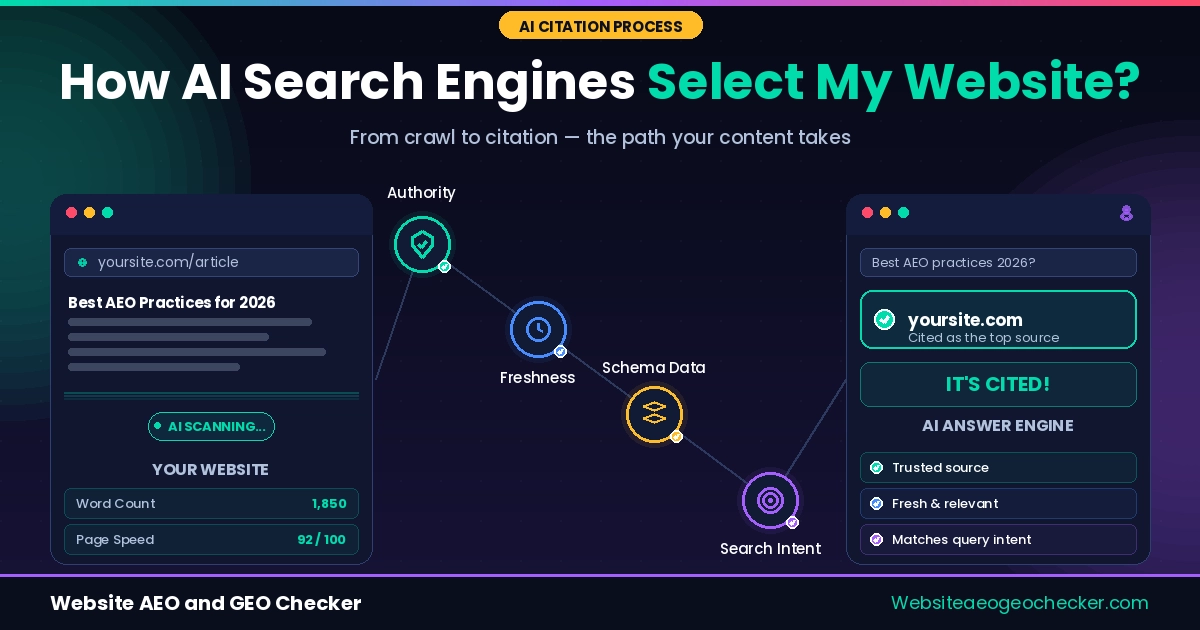
How AI answer engines rank content comes down to this: can the engine extract a passage from your page that directly answers a query without needing the surrounding context to make sense? If yes, your page gets cited. If no, it gets summarised into nothing or skipped entirely.
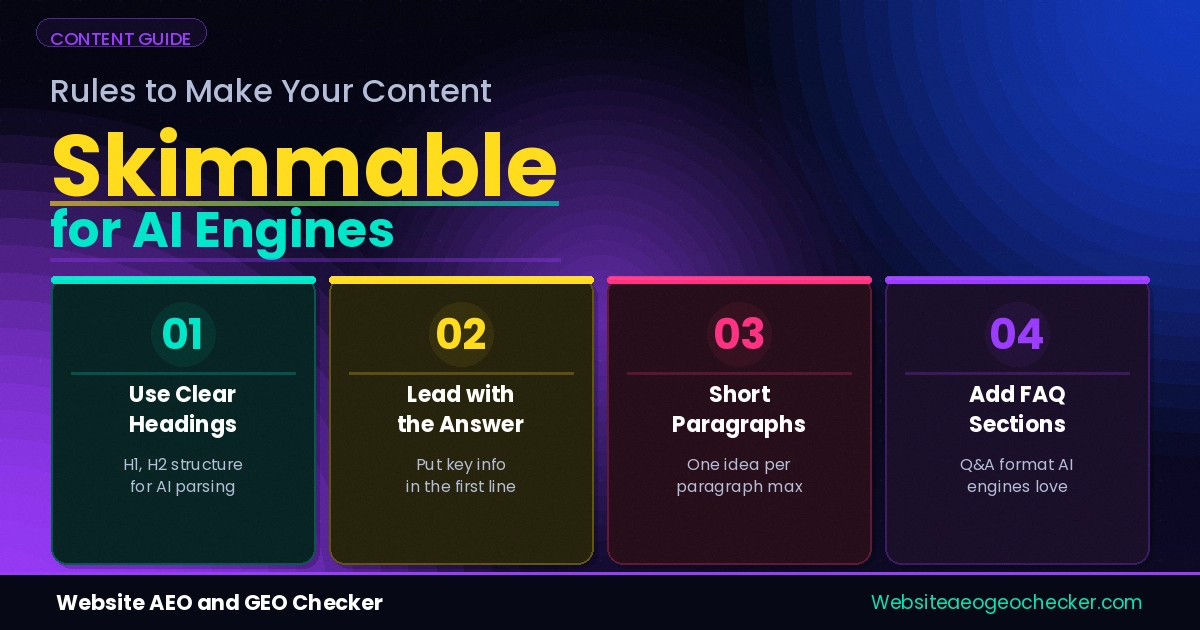
This is why formatting matters at a structural level, not a cosmetic one. The nine rules below are formatting decisions that directly affect how easily AI engines can chunk, extract, and cite your content.
Rule 1 to Rule 4: How You Open and Structure Each Section
These four rules cover the decisions you make before you write a single body paragraph. Get these right and your content is already structured for extraction before the detail starts.
Rule 1: Lead Every Page With a Direct Answer in the First 100 Words
AI systems often cite the first one to two sentences after headings. The opening paragraph of your page or section is the highest-value real estate on the entire page for AI citation purposes.
When someone searches for "what is answer engine optimization", your AEO page should answer that in the first two sentences, not after a long anecdote on your motivation to care about AEO, or an explanation on the relevance of the topic. Answer first, context later.
Real example: James, a personal finance blogger with four years of content and solid Google rankings, had no presence in ChatGPT or Perplexity answers despite covering over 150 topics. He ran his three highest-traffic posts through the Free AI SEO Checker and found that all three opened with a 180 - 200-word personal story before reaching the actual point. He rewrote just the opening paragraph of each post, putting the direct answer first and moving the story to the 2nd section. One of those posts started appearing in Perplexity answers for "how to build an emergency fund" within 5 weeks.
This is called the inverted pyramid format, a structure borrowed from journalism where the most critical information leads and supporting detail follows. Research on inverted pyramid content confirms that around 44 percent of LLM citations come from the first 30 percent of an article. Front-loaded writing is not just easier to read. It is structurally more citable.
Rule 2: Use Question-Led H2 and H3 Headings
AI engines are built to answer questions. When your headings are phrased as questions, they match the exact format these engines use to surface answers.
"What does answer engine optimisation mean for small businesses?" is a better heading than "AEO for Small Businesses," because the engine can match the former directly to a user query and extract the subsequent section as a complete answer.
Review your key pages and transform flat, label-style headings into questions that the content beneath answers. Not all headings will require this, but any section that explains, defines, or solves something will benefit from a question-style phrasing.
Rule 3: One Idea Per Paragraph, Three Sentences Maximum
Paragraphs that contain multiple points are hard to chunk cleanly. When an AI engine extracts a passage and it contains three different ideas, none of them comes out clearly. The engine moves on.
Each paragraph should make one point, support it once, and stop. If you find yourself using "also" or "additionally" inside a paragraph, that is a signal to break it into two.
We have audited thousands of pages. The single most common formatting issue we find on otherwise strong content is paragraphs that do too much. One point, three sentences, full stop. - Website AEO GEO Checker
Rule 4: Put the Most Important Sentence First in Every Paragraph
This is the inverted pyramid applied at the paragraph level, not just the page level. The first sentence in a paragraph should always include the main point of that paragraph. The second and third sentences help to support and/or expand upon it.
Context-building paragraph structures add difficulty for citation. On the other hand, point-leading paragraph structures are easy to extract in context.
Before: "There are several things that affect how AI engines read your page, and one of the most important ones relates to how your paragraphs are structured internally."
After: "How you structure your paragraphs determines whether AI engines can extract them cleanly. The first sentence should contain the main point. Everything after it adds context or support."
Same information. The second version is extractable. The first is not.
Rule 5 to Rule 7: Lists, Tables, and Steps
These three rules govern how you present information that has more than one part. This is where most content either earns citations or loses them.
Rule 5: Use Numbered Lists for Any Process or Sequence
To make content more comprehensible to AI when explaining tasks or outlining procedures, structure it in a numeric step format. This matches the way AI provides access to steps. An engine can easily generate a list. If content is written as a structured paragraph, the engine needs to add context before delivering it to the user.
If your content walks through a how-to process and it is written in paragraphs, convert it to numbered steps. Each step should be one to two sentences. The action comes first, the reason comes second.
Rule 6: Use Bullet Points Only for Genuinely Parallel Items
Bullet points are not a prose substitute. They are for lists of genuinely parallel, equivalent items where order does not matter and each item is independent.
Using bullets for things that are not parallel creates noise. If your listed items require multiple sentences, they are not true lists. They are long paragraphs made to appear structured.
The rule is that if removing one bullet point from the list removes the meaning of the other items, it is not a bullet list. If each item stands alone without the others, it is.
Content that uses bullets as a crutch for dense prose does not get cleaner citations. It gets harder extraction. Real parallel lists work. Fake ones do not. - Website AEO GEO Checker
Rule 7: Use Tables for Any Comparison
If your content compares two or more things, a table communicates that comparison faster than prose and extracts far more cleanly. AI engines pull table data in structured form and use it directly in answers. A paragraph explaining the difference between AEO and SEO is readable. A table showing it side by side is citable.
Convert any "A vs B" content into a table with clear, short column headers. This applies to tool comparisons, format comparisons, before-and-after examples, and feature breakdowns. See our breakdown of the differences in our article on AEO vs SEO vs GEO as an example of how comparison content can be structured for easy extraction.
Rule 8 and Rule 9: Length Signals and Page-Level Formatting
These two rules operate at the whole-page level rather than the paragraph level. They are often the last thing people fix, but they affect every extraction decision the engine makes.
Rule 8: Keep Introductions Under 150 Words
Long introductions delay the answer. They also reduce the density of extractable content near the top of the page, which is where AI engines look first.
Count the words in your current introductions. If any of them are more than 150 words before the first H2, you have an overlong introduction. The solution is not to cut words, but to bring the context to the bottom of the paragraph, and put the answer to your questions at the top.
The intro has to tell the reader what to learn or fix, and by framing the answer as briefly as possible, it has to leave as soon as possible.
Rule 9: Use Anchor-Friendly Section IDs
When AI engines cite a specific section of your page, they reference a URL fragment: yourpage.com/article#section-heading. Pages where headings have clean, readable anchor IDs make it easier for engines to cite a specific passage rather than the whole page. A specific citation is more useful and more likely to be surfaced.
Most CMS platforms generate heading anchor IDs automatically from the heading text. Make sure your headings are clean, short, and descriptive rather than long-winded. A heading like "The Complete List of Every Reason Why AI Engines Skip Your Page" generates a messy anchor. "Why AI Engines Skip Your Page" generates a clean one.
Pair this with the structured data guidance in our article on how structured data helps AI find your content. Schema markup and clean anchor IDs work together to give engines precise extraction targets, not just a whole-page context.