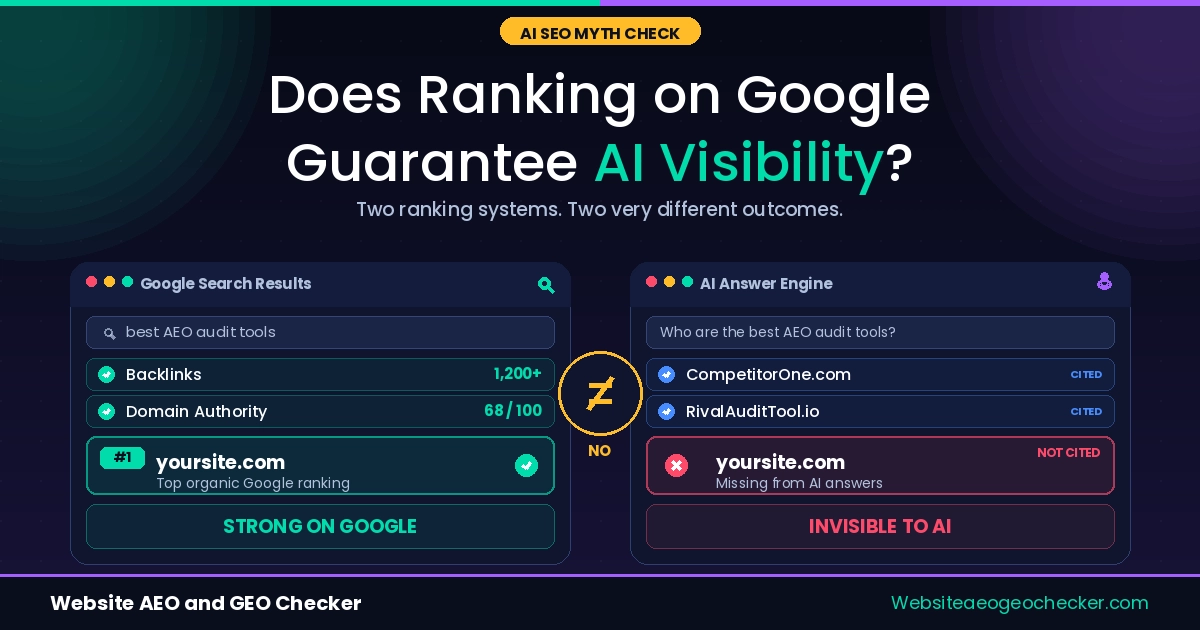
No. You can rank #1 on Google for your most important keyword, but this still means that you can be completely missing when someone asks ChatGPT the same question. This is a very common finding when site owners first check their site's AI visibility. Site owners believe that because Google trusts them, every AI engine will also.
Trust can't be transferred from one engine to another. Google ranks pages based on links, on-page relevance, and years of accumulated authority. AI engines, like ChatGPT, Perplexity, and Google's AI Overviews, provide synthesized answers based on a few sources. Even if you are visible on Google, you cannot expect an answer based on that visibility.
This article describes the gap in the data, why the two systems differ, which AI systems still rely on Google rankings, and which ones do not, as well as what you can do to reduce that gap.
The Short Answer: No, and Here's the Data
If you want the number, here it is. A 2026 study by Chatoptic covering 15 brands across five categories found top-ranking Google pages were mentioned in ChatGPT answers just 62% of the time. That sounds close to a guarantee until you look at the correlation between the two: 0.034. Almost zero. A brand's Google rank barely predicted its position, or even its presence, inside ChatGPT's response.
It gets more specific. Research from AAPTA found that ChatGPT sources roughly 70% of what it recommends from pages that do not appear in Google's or Bing's top 10 at all. Your competitor buried on page three might be the one getting quoted, while your page one listing gets skipped entirely. And the AI engines barely agree with each other either. Only about 11% of the domains ChatGPT cites also show up in Perplexity's citations for the same query.
Ranking on Google tells you that Google trusts your page. It does not tell you whether ChatGPT has ever read it. - Website AEO GEO Checker
That gap is not a glitch. It is the result of two fundamentally different systems making two fundamentally different decisions about your content.
Why Google Rankings and AI Citations Are Different Systems
Google's ranking algorithm hinges on years of observations of links, clicks, relevant pages and site authority. It decides which page is the best match for the query.
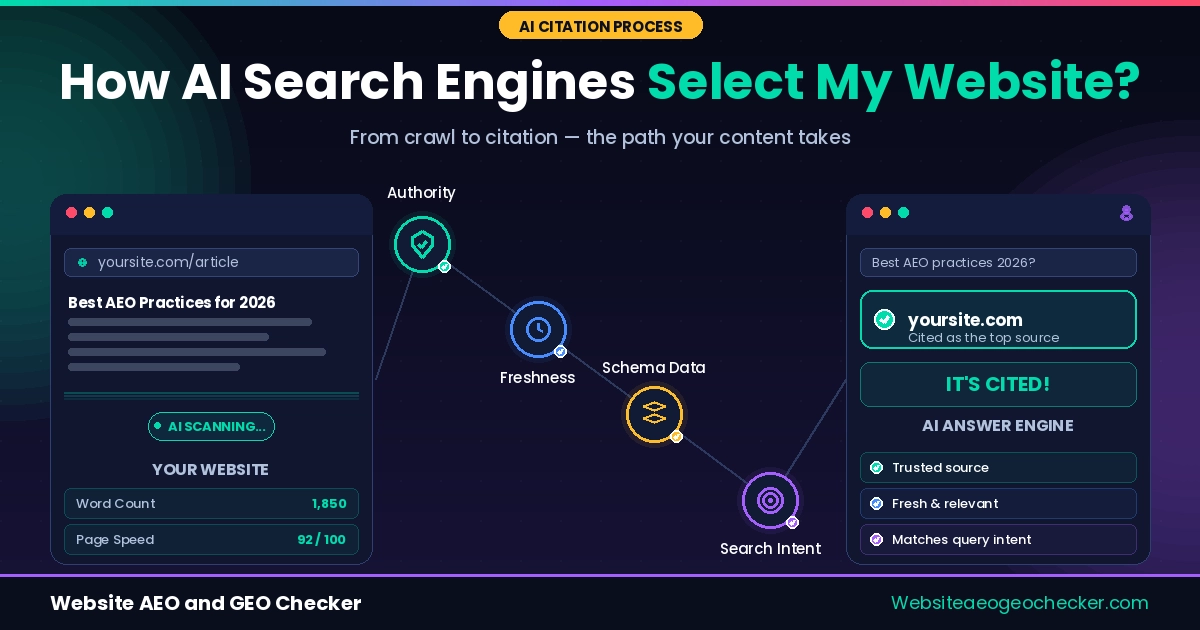
Most AI engines do not perform this calculation. ChatGPT and Perplexity, for instance, build an answer by retrieving a few sources that they believe are the clearest, most current, and most pertinent, and then synthesize them into a response. Less important to AI systems is your backlink profile. More important is whether your content answers the prompt in a format that is easy to copy. That discipline is what differentiates AEO and AGEO, and what most AEO tools and Free GEO Checkers are measuring, and what is a different mandate from classic SEO. If you have not looked at how the three overlap, our breakdown of AEO vs SEO vs GEO covers where they split and where they still support each other.
This is why a page can rank on authority built five years ago and still lose out to a newer, thinner page that happens to structure its answer more clearly. AI engines are not rewarding history. They are rewarding retrievability, right now.
Which AI Platforms Still Respect Google Rank, and Which Don't
Not every AI system operates the same, and lumping them together is where most strategies crumble.
Google's AI Overviews and AI Mode cite largely from Google's top 10. This is to be expected because it is the same company. If your SEO is legitimate, you are in a good position if it is your page that is ranking high in searches.
Perplexity leans on similar signals but casts a noticeably wider net. Location data from SOCi's 2026 Local Visibility Index found brands appearing in Google's local 3-pack 35.9% of the time, but only 7.4% of the time in Perplexity's recommendations. Being active across Google, industry directories, and third-party sites matters more here than it does for a straight Google ranking.
ChatGPT is the outlier, and it is also the platform most people actually use. It shows the least correlation to Google rank of any major engine. A DR 93 domain, one of the highest authority scores you can get, was found in one recent study to generate just 9 AI citations across a full sample of queries, while a much lower-authority competitor with more organic keywords and traffic pulled in over 26,000. Authority alone does not translate.
We check over 50 signals across a site, and the pages that show up in AI answers are rarely the ones with the highest domain authority. They are the ones an AI engine can parse and quote in a single pass. - Website AEO GEO Checker team
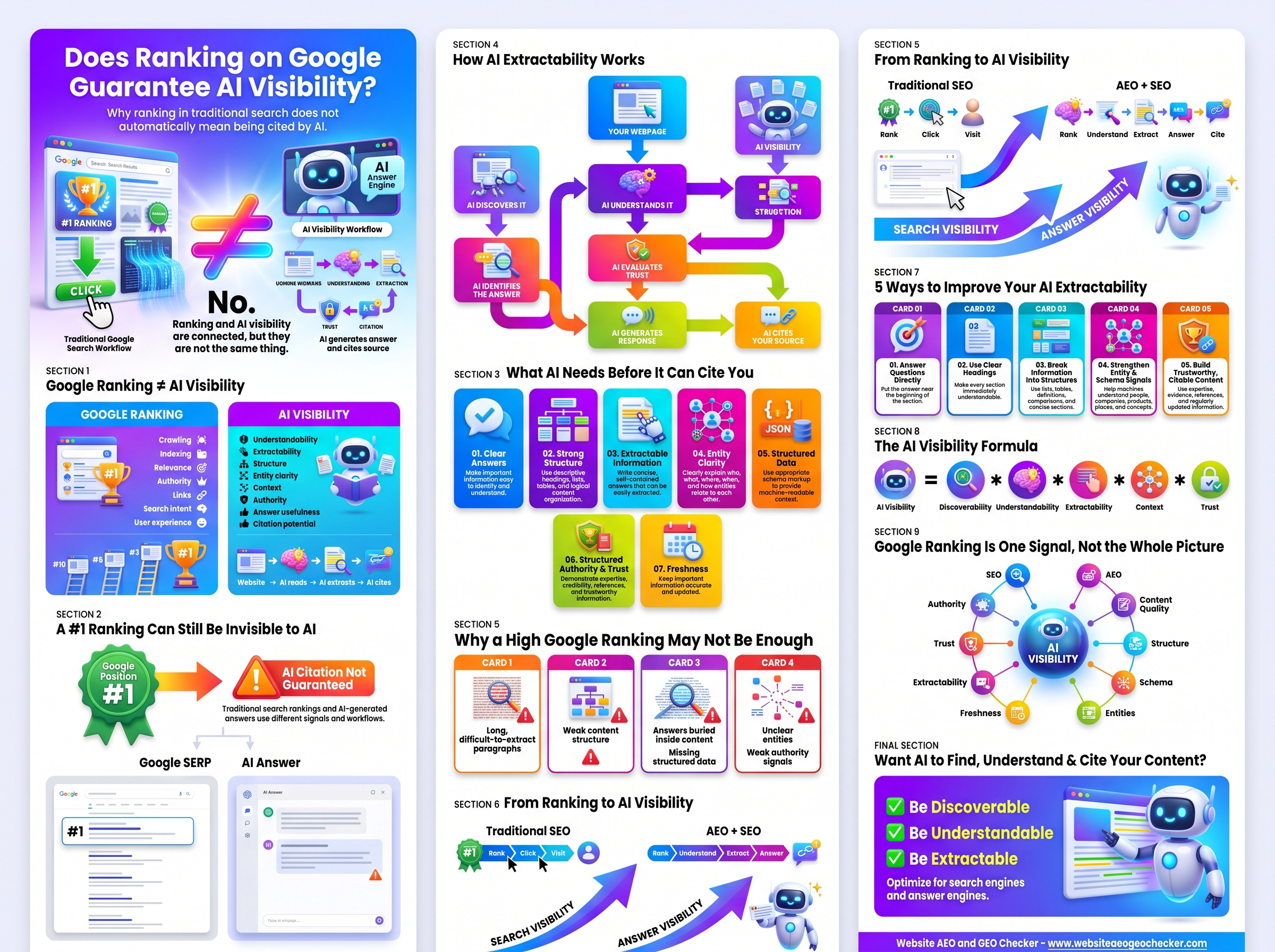
What Actually Drives Your AI Visibility Score in AI-Generated Answers
Much of what drives AI visibility differs greatly from what impacts rank for Google searches, and in most cases, much of it can be solved in a few hours.
Start with crawl access. If GPTBot, OAI-SearchBot, or PerplexityBot are blocked in your robots.txt, none of your content reaches these engines no matter how well it is written. Check yours with our Free AI Crawler Checker before touching anything else, since this is the kind of failure that produces no error message, you just never show up.
Next comes structure. AI engines favor content that answers the question in the first few sentences, not content that builds up to the answer through three paragraphs of context. Our guide on writing a direct-answer opening covers exactly how to restructure a page without gutting the rest of your content.
Structured data helps by clarifying the purpose of your page without the use of "magic." FAQPage, Organization, and Article schema help AI engines understand your page better. This is important in all of the AI search visibility domains across ChatGPT, Perplexity, and Gemini.
Real example: Tom runs a B2B SaaS review site that ranked #2 to #4 on Google for its core comparison terms, and assumed that was enough. He checked ChatGPT for the same queries and found his site mentioned zero times. Nothing in his robots.txt was blocking GPTBot, so that was not the problem. What he found instead was a site with no FAQPage schema & every answer buried under a 400-word intro before getting to the point. He added direct-answer blocks near the top of each page & implemented FAQ schema across his comparison pages. ChatGPT started citing his page within four weeks.
Keeping your content up to date also helps. AI search tools are less likely to use older pages, while pages with recent updates and a visible "last updated" date are more likely to appear in answers.