You ask ChatGPT about your industry. Your competitor's name will be there. Your brand does not appear at all.
You search Perplexity for the kind of problem you solve. It recommends three services. Yours is not one of them.
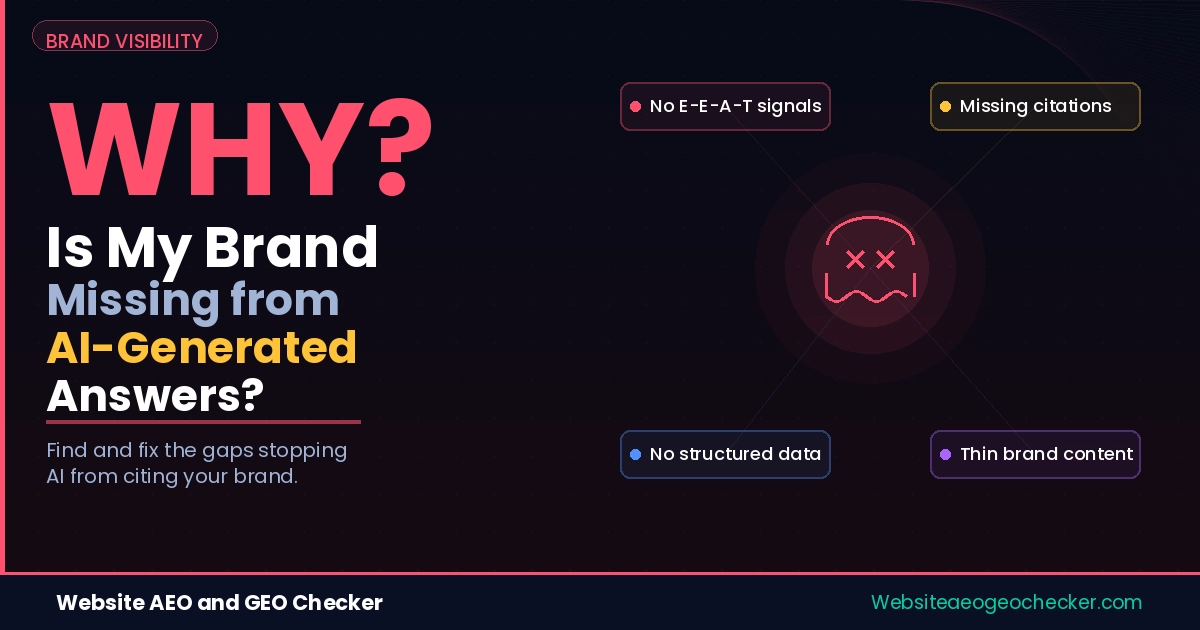
This is not a fluke. And it is almost certainly not because your brand is unknown or your content is poor. What is most likely the cause of your brand's absence from AI-generated responses is four easily fixable content issues: a technical impediment that AI cannot read your content, issues inhibiting users from extracting your content, a lack of outside presence to support your content, or your content being contradictory in the data processed by AI systems.
Your brand stays undetected in AI-generated responses due to large language models selecting brands by frequency of citation, authority of content, and the extent to which your content answers user prompts in a straightforward manner, and not due to the traditional SEO approaches, such as backlinks or domain authority.
This article diagnoses each cause and gives you the specific fix. Run a free check first with our AI Visibility Checker to see which of these issues your site has right now.
Why AI Answers Work Differently from Google
Before the diagnosis, one thing needs to be clear. Large language models index and learn from your website and every other credible digital content available on the web. Once a user poses a prompt, the models generate a predicted response of what the best answer would be based on learned content in digital space that also poses credibility.
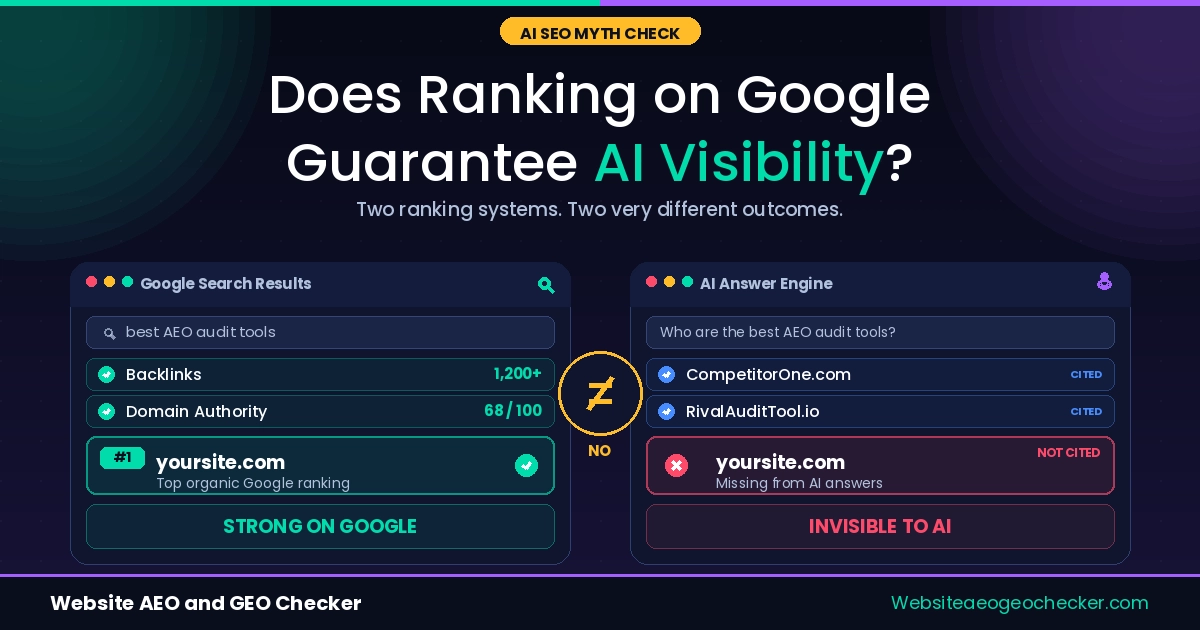
AI models do not work the same as default search engines either. Instead of relying on traditional ranking content based on their backlinks or domain authority, they work by extracting meaning based on content that is organized, clear, and easy to read.
A lot of brands that rank high on Google can be completely invisible in AI answers because AI and Google use different content evaluation methods that do not work the same way. Fixing one content issue in one model is not a guarantee that the other would partially fix the other content high road issues either.
Assuming traditional SEO transfers to AI is the most common mistake. Companies invest heavily in backlinks and keyword optimisation but neglect the signals AI models actually use:
Direct answers to questions, third-party citations, and clear brand identity. The fix requires a different strategy, not just more of what worked for Google.
Brands lacking structured content and clear topical signals are up to 50% less likely to appear in AI-generated answers. - Website AEO GEO Checker
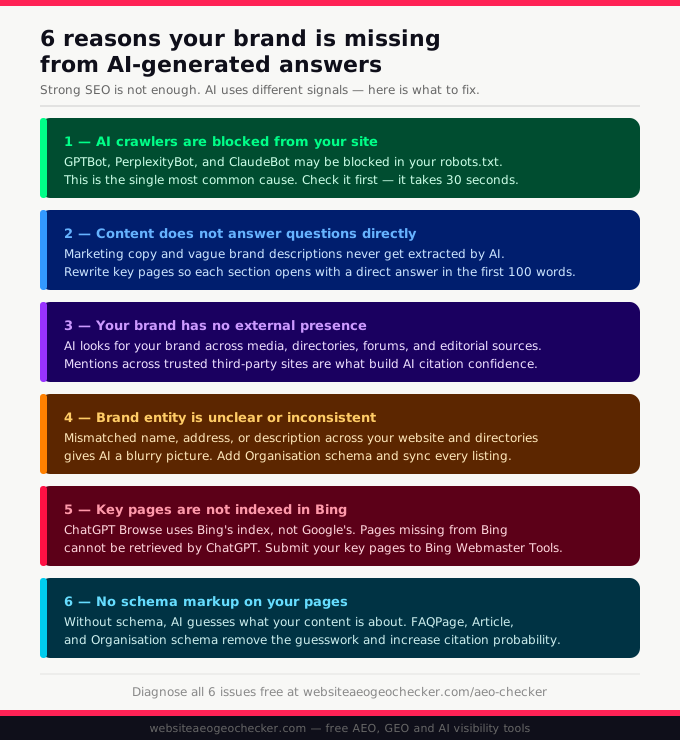
The 6 Reasons Your Brand Is Missing from AI Answers
Reason 1: AI Crawlers Are Blocked from Your Site
This is the most common cause and the easiest to fix. This is the single most common cause of zero ChatGPT visibility. GPTBot is a web crawler of OpenAI. If it is blocked in your robots.txt file, ChatGPT cannot read a single page on your site.
The same applies to other platforms. PerplexityBot, ClaudeBot and Google-Extended all need access to your website pages. Many security plugins, CDN configurations, and hosting providers block these crawlers automatically, without you knowing.
Check exactly which AI bots can and cannot access your site with our free AI Crawler Checker. It takes 30 seconds.
Real example: Marcus a guy from Netherlands, runs a SaaS platform for freelance project management. His site ranked well on Google for several relevant queries, but neither ChatGPT nor Perplexity ever mentioned his brand; He ran our AI Crawler Checker and discovered that his Cloudflare firewall had been blocking GPTBot and PerplexityBot for over four months following a security rule update. He removed both blocks the same day. Within 3 weeks, Perplexity started citing his feature comparison page in responses about freelance project management tools.
Reason 2: Your Content Does Not Answer Questions Directly
ChatGPT Browse mode retrieves and parses web page content. If your content is rendered by JavaScript, buried in complex DOM structures, or formatted in ways that make text extraction difficult, ChatGPT cannot read it reliably.
AI cannot extract work that appears as marketing material, even if it can access your pages. Your brand story, mission statements, and service descriptions all fall into this type of material. AI assistants gather responses to questions. They do not present sales offers. Your content reflects more marketing material than informative text, which is a warning sign.
To improve this, include unambiguous answers within the first 100 words on your key pages. Imagine a potential customer asks "What is [your product category]?" and visits your page. Will the AI model that answers this question extract a clean, easily understood definition? If the answer is no, you're making things more difficult than they need to be.
Rewrite your key service and product pages so every section opens with a direct answer to a real question. Turn headings into questions. Answer immediately below. Keep each answer self-contained.
Our guide on how to write content for AI answer engines covers the exact format with before and after examples.
Reason 3: Your Brand Has No External Presence
In SEO, a strong website with good backlinks could get you onto page one. In GEO, a strong brand presence across many credible sources is what gets you into the answer. AI does not just look at your domain authority. It looks at how often your brand is mentioned, how consistently it is associated with a topic, and whether those mentions appear in places it deems reliable.
LLM models like ChatGPT and Perplexity quote material from the media, report, and major information portals. If your brand is not mentioned there, it will be bad for your visibility in AI.
This is why brands like Nike do not need to rank for something in particular in order to be found in AI. Nike is featured in product reviews, customer testimonials, news related to sports, blogs, Wikipedia, YouTube, and Reddit. Because of widespread coverage, AI tools can confidently include Nike and related products.
You also do not need that many mentions. You need to be mentioned on platforms AI trusts, such as industry directories, editorial mentions, Q&As, relevant blogs, and the Reddit and Quora blogs. Focus on your PR efforts and focusing on trusted resources to build your mentions.
Reason 4: Your Brand Entity Is Unclear or Inconsistent
AI systems interpret your brand with information they gather from multiple sources. If your brand name, location, service, specialization, etc., are not uniform between your website, Google Business Profile, social accounts, and directory listings, the perception AI will build about you will be contradictory or blurry.
Unstructured content, unclear entities, and contradictory information can all prevent brands from appearing in AI responses.
The fix is entity consistency. Your brand name, address, phone number, and service description should be identical everywhere they appear online. Add Organisation schema to your homepage with accurate, specific details. This gives AI systems a single authoritative source to draw from when forming a description of your brand.
Check your structured data and entity signals with our AEO Checker.
Reason 5: Your Key Pages Are Not Indexed in Bing
This one surprises many people. ChatGPT Browse uses Bing. Content will take time to be indexed in Bing, and new domains take even longer. If specific pages or your domain are within 3 to 4 months, ChatGPT may not have enough Bing index evidence to give you a citation.
SEO efforts have focused a lot more on Google Search Console. For ChatGPT, Bing indexation will be a lot more important. As pages are submitted and indexed through Bing Webmaster Tools, they will be available on ChatGPT Browse.
Reason 6: Your Content Has No Schema Markup
Schema markup tells AI what type of content you have. Is this a product? Is this a review? Is this a how-to? It expands categorization. AI now uses schema for traditional search engines and as something that helps to trust information.
AI has to classify the content before interpreting it. It will cite the content. This will not have to be the case with the FAQPage schema, Article schema, and Organization schema. From this, AI will be able to directly read the structure.
Create or expand FAQ sections that mirror how people actually query AI assistants. People do not ask Perplexity "learn more about project management software." They ask specific questions like "how do I track team tasks remotely?" or "what is the difference between Kanban and Scrum boards?"
Use our AEO Checker to see which schema types are missing from your key pages and which to add first.
The Diagnosis Test: Ask AI About Your Brand Right Now
Before you do anything else, run this five-minute test.
Open ChatGPT with browsing on, Perplexity and Google. Ask each one three questions:
"What is [your brand name] and what do they offer?"
"Who are the best [your category] providers?"
"What should I look for when choosing a [your service type]?"
Write down what comes back. The results tell you exactly which of the six reasons above applies to your situation.
If question 1 draws a blank or gets your brand wrong - your entity is unclear or your site is not being read. If you do not appear in questions 2 or 3 - your content or external presence is the gap. If competitors appear consistently & you do not - their content is better structured for extraction or they have more external citations.
For a structured technical audit of all these signals, read our Complete AEO Guide or run a full check with our GEO Checker.
Inconsistent publishing and weak entity recognition often lead to near-zero visibility in AI responses. - Website AEO GEO Checker