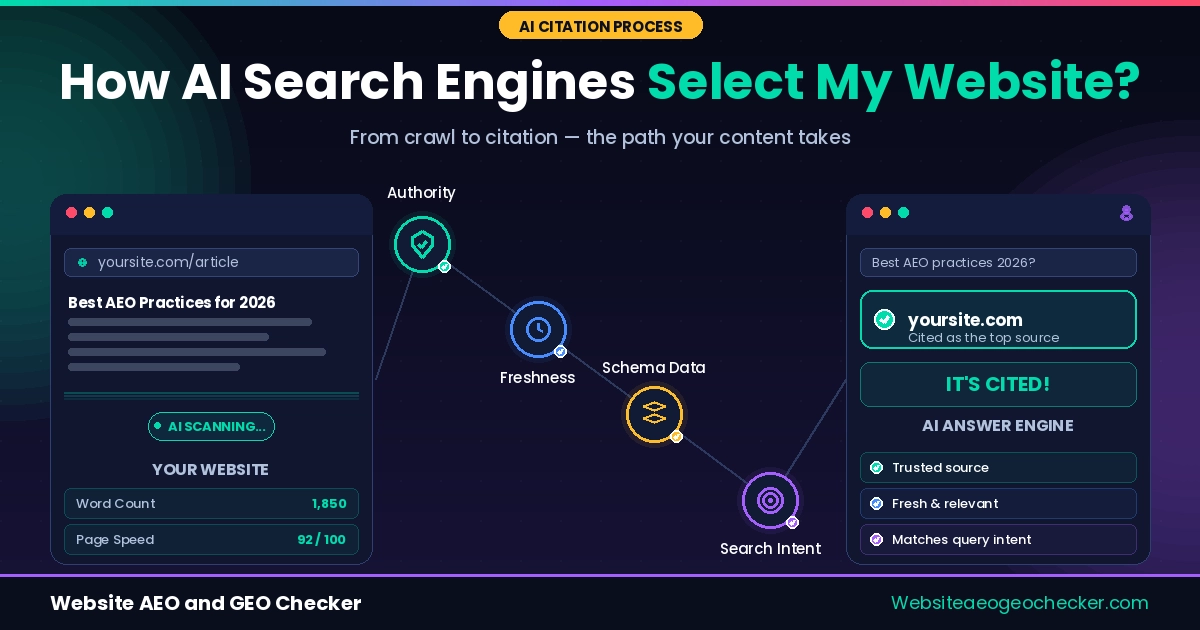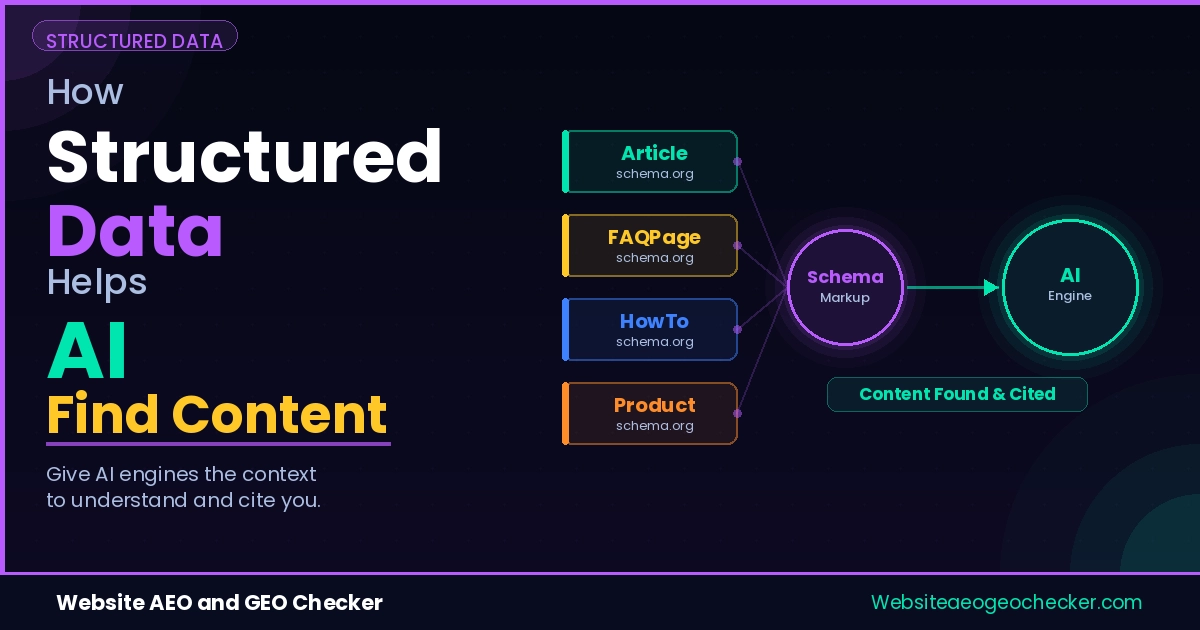
AI platforms do not read your website the way a human does. They scan for signals that tell them what your content is about, who created it, and whether it is reliable enough to cite in an answer.
Structured data is the most direct way to send those signals. It is code you add to your pages that labels your content in a format machines read natively. Without it, AI systems have to guess. When they guess wrong, or when the content is too ambiguous to classify, they skip your page and move to a competitor who made it easier.
Structured data gives AI systems the context they need to understand, trust, and accurately cite your content in search and generative answers. - Website AEO GEO Checker
Pages with properly implemented structured data are cited in AI responses significantly more often than equivalent pages without it. Research published by WPRiders found structured data can boost citation chances in AI-generated summaries by over 36%. A separate analysis found that sites with clean, interconnected schema see a 40% higher citation rate in AI search responses compared to those relying on plain HTML.
This article covers exactly what structured data is, which schema types matter most for AI visibility, and how to implement them on your site. Check which schema your pages are missing right now with our free Website AEO Checker.
What Is Structured Data and Why Does It Matter for AI?
Structured data is code added to your web pages that explicitly labels what type of content each element is. Instead of asking an AI crawler to figure out whether a section of text is a question, a review, a product description, or a how-to step, structured data tells it directly.
The most widely used format is JSON-LD - a block of JavaScript placed in the <head> of your page. It does not affect what visitors see. It is written entirely for machines.
This is why it is especially relevant for AI systems. ChatGPT, Perplexity, and Google AI go through a retrieval and extraction process where they first determine whether a page can be crawled, and then parse and extract content best suited to answer a question. Speeding up the process is structured data, as it precategorizes the content found on a page. With this, a page with a FAQPage schema can briefly tell the AI that it contains questions and answers, and in what order, without requiring interpretation. The AI can read the schema and will know what order they are in.
Without structured data, AI has to infer all of that from the HTML. Inference introduces errors. Errors reduce citation probability.
The 5 Schema Types That Matter Most for AI Visibility
1. Organisation Schema
Organisation schema goes on your homepage and tells AI systems who you are as an entity - your name, website, description, logo, contact details, and social profiles.
This is the most important schema type most sites are missing.The FAQ schema is the most overlooked schema type: it does not produce rich answers on Google, so many SEO articles skip it, but it is fundamental for AI. The AI systems have an "understanding" of a specific brand after collecting data from many different sources. The organisation schema is an authoritative source of data within your own domain that confirms your identity without any ambiguity.
Include sameAs links pointing to your social profiles, Wikipedia page if applicable, and major directory listings. This entity disambiguation tells AI systems that all these references point to the same organisation.
{
  "@context": "https://schema.org",
  "@type": "Organization",
  "name": "Your Brand Name",
  "url": "https://yoursite.com",
  "logo": "https://yoursite.com/logo.png",
  "description": "What your organisation does in one clear sentence.",
  "sameAs": [
    "https://twitter.com/yourhandle",
    "https://linkedin.com/company/yourcompany"
  ]
}
2. FAQPage Schema
FAQPage schema is the highest-impact schema type for direct AI citation. It pre-formats your question and answer pairs in a machine-readable structure that AI systems can extract without any interpretation.
With the FAQPage schema, the AI does not need to process and interpret paragraphs to extract questions. It will tell the AI that a specific line is a question, and the answer to that question is that specific line. Instead of using FAQ sections with no FAQPage schemas, AI systems might skip the entire information extraction process and go to the pages that have FAQPage schemas.
Research from Frase found FAQPage schema produces a 28 to 40% higher citation probability compared to unstructured equivalent content. That is a meaningful lift for one technical addition that takes under an hour to implement.
Add FAQPage schema to any page with a question and answer section — blog posts, service pages, guides, and product pages. Keep each answer under 100 words. Write answers that stand alone without needing surrounding context.
{
  "@context": "https://schema.org",
  "@type": "FAQPage",
  "mainEntity": [
    {
      "@type": "Question",
      "name": "What is answer engine optimization?",
      "acceptedAnswer": {
        "@type": "Answer",
        "text": "Answer engine optimization (AEO) is the practice of structuring your content so AI platforms can find it, understand it, and cite it as a direct answer to a user's question."
      }
    }
  ]
}
Real example: Priya runs a financial planning blog covering tax, savings, and investment basics. Her articles ranked consistently in Google's top 10 but rarely appeared in ChatGPT or Perplexity responses. She ran our AEO Checker and found that despite having strong FAQ sections on every article, she had no FAQPage schema anywhere on her site. She added FAQPage schema to her 12 most-visited articles over a weekend using a WordPress plugin. Within 5 weeks, four of those articles were being cited in Perplexity responses for queries she had previously ranked for only in Google.
3. Article Schema
Article schema tells AI systems that a page is a piece of editorial content, who wrote it, when it was published, and when it was last updated.
Freshness is a significant factor in AI citation selection. Data from Stackmatix shows that AI Overview citations skew strongly toward recently published or updated content, with roughly 44% of citations coming from content published within the last year. Article schema with an accurate dateModified field makes your freshness signals machine-readable, which is faster and more reliable than AI having to infer a date from visible page text.
Include author with a nested Person type, datePublished, dateModified, and publisher pointing back to your Organisation schema. The author field is particularly important for EEAT signals — named authorship on Article schema is one of the clearest trust indicators AI systems can read.
{
  "@context": "https://schema.org",
  "@type": "Article",
  "headline": "Your Article Title",
  "author": {
    "@type": "Person",
    "name": "Author Name"
  },
  "datePublished": "2026-01-15",
  "dateModified": "2026-05-01",
  "publisher": {
    "@type": "Organization",
    "name": "Your Brand Name",
    "url": "https://yoursite.com"
  }
}
4. HowTo Schema
HowTo schema is for any page that explains a process in sequential steps. It pre-formats each step as a discrete unit with a name, description, and optionally an image. AI systems that encounter HowTo schema can extract individual steps as direct answers to process-based questions.
Without a HowTo schema, identifying a step in a manual requires the reading AI to determine where the step begins and ends, assign a title to the step, and also determine the key action. This is all done for them with a HowTo schema. This ultimately results in the reading AI being able to process citations faster and with a higher rate of accuracy.
Any page that instructs the reader on a particular process and includes a list of organized steps (such as setup guides, tutorials, how-to articles, and ways of doing things) should have the HowTo schema.
5. BreadcrumbList Schema
BreadcrumbList schema tells AI systems where a page sits within your site structure. This matters for topical authority signals. An AI that sees a page on "FAQPage schema implementation" sitting under a breadcrumb path of Home > Guides > Structured Data > FAQPage Schema understands that this site has a structured content hierarchy around this topic. That context increases trust.
BreadcrumbList schema is quick to add and works across all pages. Most CMS platforms and SEO plugins generate it automatically once configured.
Without structured data, your content may be readable to humans but invisible to AI-driven discovery and citation systems. - Website AEO GEO Checker
Combining Schema Types for Maximum Impact
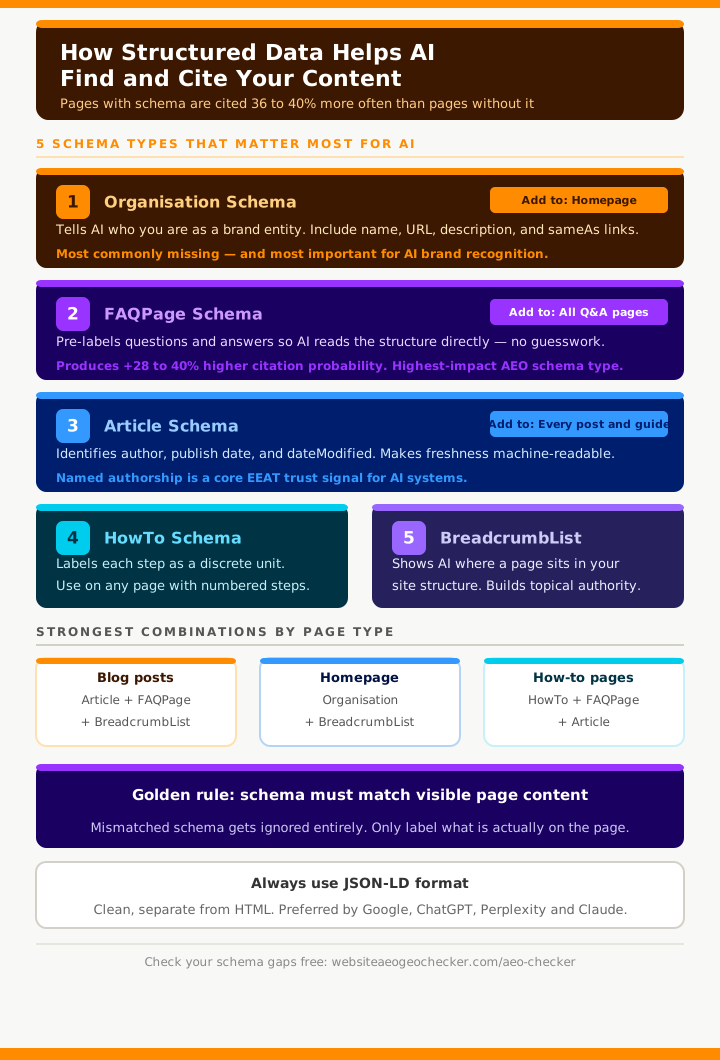
Pages with multiple complementary schema types earn significantly higher citation rates, than pages with a single schema type.
The strongest combinations for AI visibility:
Blog posts and guides: Article + FAQPage + BreadcrumbList. Article identifies the content type and authorship. FAQPage pre-labels the Q&A section. BreadcrumbList establishes topical context.
Homepage: Organisation + BreadcrumbList. Organisation establishes entity identity. BreadcrumbList shows site structure.
How-to content: HowTo + FAQPage + Article. HowTo labels the steps. FAQPage handles follow-up questions. Article provides authorship and freshness signals.
The key rule: only add schema that matches actual content on the page. Adding FAQPage schema to a page with no FAQ section, or HowTo schema to a page with no steps, creates a mismatch that AI systems detect and penalise.
How to Add Schema to Your Site
JSON-LD Method - Recommended
Paste a JSON-LD block into the <head> section of each page. This is the format Google explicitly recommends and the format all major AI platforms prefer. It keeps the schema completely separate from your HTML, which makes it easier for machines to parse.
All the website and page builders give a custom code field that allows you to add code to the head of the page. In WordPress, you can use plugins like Yoast SEO, RankMath, or Schema Pro. All of these plugins generate JSON-LD for you based on the page you are working on and the plugin settings you have.
Validate Before Publishing
Use Schema.org's documentation to check required and recommended fields for each type you implement. Then validate with Google's Rich Results Test tool to confirm the schema parses correctly. Missing required fields suppress the schema entirely - the AI reads no structured data rather than partial structured data.
Check What You Currently Have
Our AEO Checker shows which schema types are present on any URL, which required fields are missing, and which schema types your key pages need. Start there before implementing anything to avoid adding schema you already have or duplicating types incorrectly.