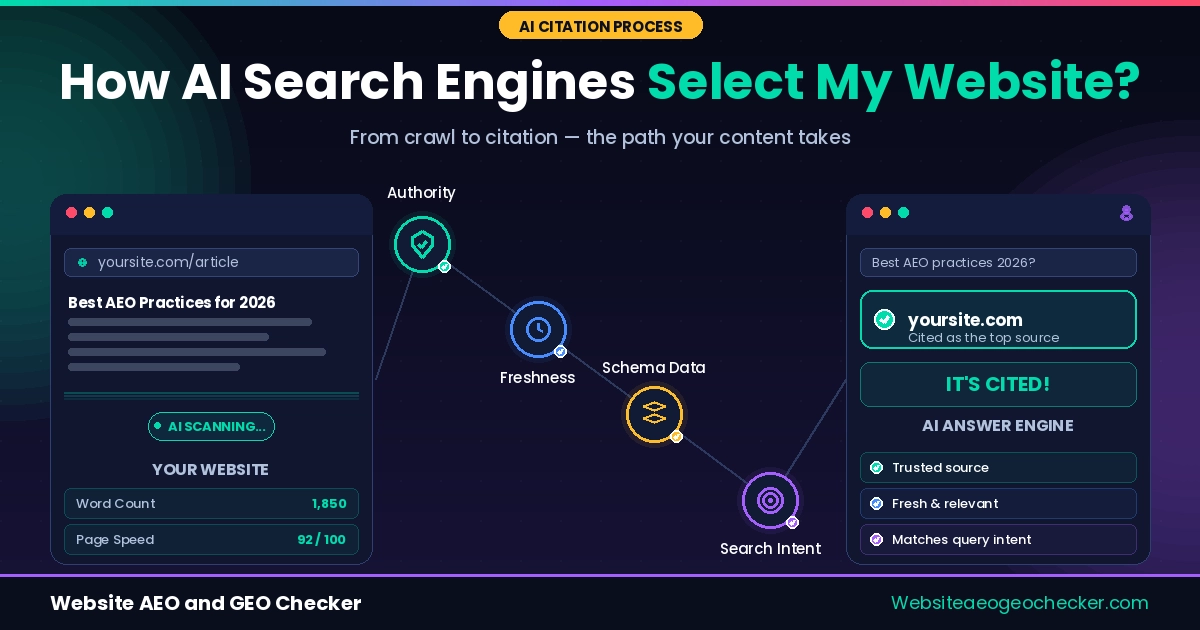
You search for something on Google and an AI-generated summary appears at the top, before any organic results, even sometimes before any ads. That box is a Google AI Overview. And right now, it is the most valuable piece of real estate in search.
Check your current AEO score before reading on, it gives you a baseline so you can measure what changes.
Here is the problem. AI Overviews now appear in around 30% of US searches, and organic click-through rates drop 61% when they are present. But if your content gets cited inside one? Cited pages earn 35% more organic clicks and 91% more paid clicks than competitors, that are not cited.
That gap between being cited & being ignored is what this article is about. Here is what actually decides whether Google AI Overviews pull from your site, and what to fix first.
Pages with clear structure and concise answers are up to 40% more likely to appear in Google AI Overviews. - Website AEO GEO Checker
What Are Google AI Overviews and How Do They Work?
Google AI Overviews are autogenerated descriptions that show up at the top of search results for some queries. When a user searches, Google checks the index for web pages, videos, and other things that are relevant to the query. Gemini generates a paragraph or list of items based on the information it finds across all resources. While the overview is being read, users can click on the link icons to go to the original sources.
They are built, not copied. AI Overviews take relevant parts from several resources and then construct an answer. Citation of a source, or no appearance at all, is also a possibility for your page.
AI Overviews show no more than 8 resources. Featured snippets, a different Google technology, involve a single resource. Showing no more than 8 is a good thing.
Why SEO Alone Is No Longer Enough
Traditional SEO gets you into the organic list below the AI Overview. That still matters. But appearing in the AI Overview itself requires additional signals, that standard keyword optimisation does not cover.
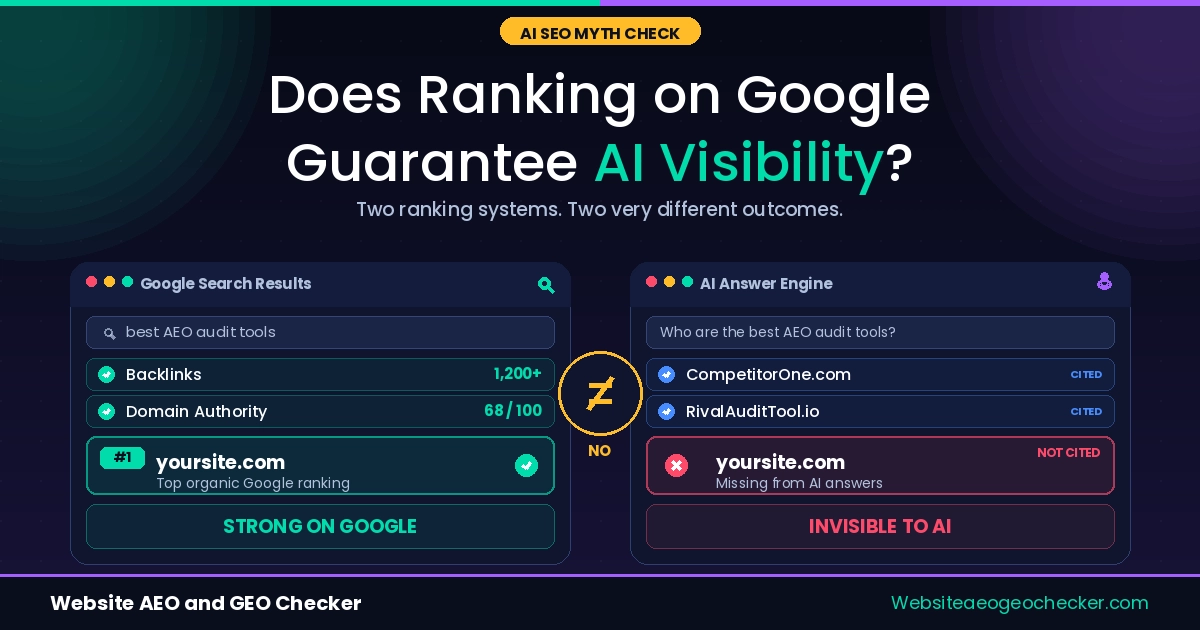
93% of AI Overviews cite resources that are among the top ten in Google search results. Good search engine optimization is incredibly important, but not everything. Many resources are among the top ten and still show no citation in AI Overviews. The potential reasons for this are that the resources may not be constructed in an easy-to-extract format or may not show the trust Google AI requires.
Ranking is the entry requirement. Structure, trust, and topical depth are what get you cited.
Our AEO vs SEO vs GEO guide covers this distinction in full if you want the broader picture.
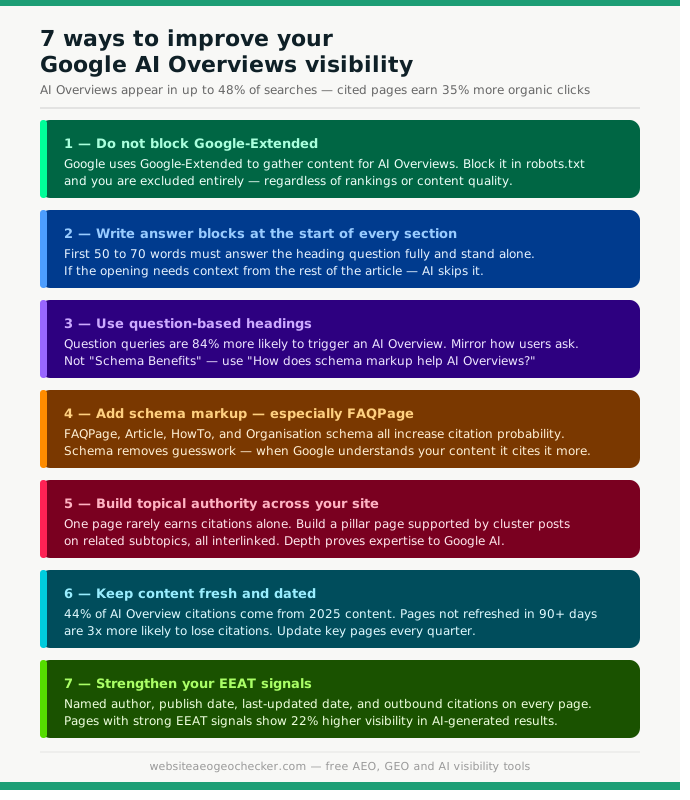
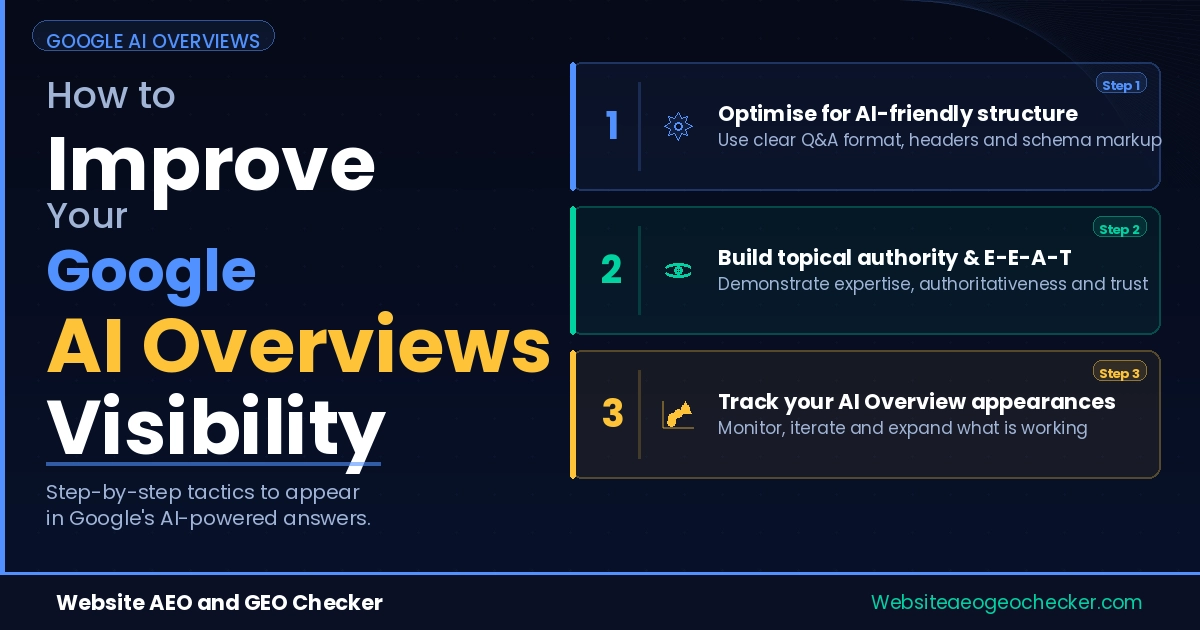
7 Ways to Improve Your Google AI Overviews Visibility
1. Do Not Block Google-Extended
This is the first thing to check. Google uses a crawler called Google-Extended to gather content for AI Overviews. If your robots.txt file blocks it, you are excluded from AI Overviews entirely, regardless of how good your content is.
Web teams are actively debating what to do about AI crawlers in robots.txt. The effects of denying the wrong one can include being taken out of consideration for AI Overview citations. The broad consensus is not to prohibit Google-Extended.
Check every AI crawler your site allows or blocks with our free AI Crawler Checker.
Real example: Daniel runs a digital marketing agency & had invested heavily in SEO for three years. His pages ranked consistently in positions 3 - 7 for his target queries. But Google AI Overviews never cited him. He ran our AI Crawler Checker and found that his hosting provider had added Disallow: / for Google-Extended in his robots.txt during a security update six months earlier. He removed the block. Within 5 weeks, two of his cornerstone articles were being cited in AI Overviews for queries he already ranked for.
2. Write Answer Blocks at the Start of Every Section
Google's AI needs to easily pull definitions, steps, and explanations from your page. Better content will be better able to perform steps, definitions, and descriptions in structured content win include headings, short chunks of text, and answer boxes, rather than record long, unstructured posts. If the AI is reading your page in detail and struggling, it is unlikely to cite your content as a source in its answer.
A question will win a clearly stated and direct answer in 50-70 words, with further supporting information below it. AI is able to pull text directly with little formatting from that initial paragraph. To achieve that, self-sufficiency is key. AI will pull text from structured paragraphs. Unstructured long text will be cited almost 6 times more.
Each major section of your page should contain a 60-word, evidence-based answer to the question in the header.
Our guide on how to write content for AI answer engines covers this format in detail with before and after examples.
3. Use Question-Based Headings
Queries phrased as questions or how-to's are now 84% more likely to display an AI Overview, up from 60% in early 2025. Long-tail question queries of eight or more words show the highest trigger rates.
Your page's content must serve to be cited in response to questions. Take a look at Schema Markup. Instead of saying, "What are the Benefits of Schema Markup?" you should ask, "How Can Schema Markup Help Us to be Found in AI's Overviews?" Use a question.
Ahrefs suggests that the median, standard search has a search value of 33, while AI Overviews has a search value of 12, both indicative of search difficulty. AI Overviews are easier to rank for due to a lower median and search difficulty.
4. Add Schema Markup - Especially FAQPage
Schema markup tells Google exactly what type of content each section contains, removing the guesswork from AI extraction.
FAQ, HowTo, Article, and ImageObject schema are all critical. Combining multiple relevant schemas on one page produces the best lift. Schema helps Google understand your page. When Google has less to guess, it is more likely to extract and cite your content.
At minimum, add FAQPage schema to any page with a FAQs section. Add Article schema to blog posts and guides. Add Organisation schema to your homepage if you have not already.
5. Build Topical Authority Across Your Site
One well-written page rarely earns AI Overview citations on its own. Google AI sees a single main guide, with related articles expanding on each individual aspect, as a demonstration of authorship. This establishes your expertise, as opposed to your singular, one-page accomplishment.
When constructing expansive topical guides, plan to make a big impact over multiple pages, showing AI Overviews what a clustered topic looks like, and, over the breadth of a topic, the depth they desire.
Internal linking matters here. Connect your supporting articles back to your pillar pages. Each link tells Google these pages belong to the same expertise cluster.
6. Keep Content Fresh and Dated
AI Overviews include content that isn't over a year old. One study measured 2025 published content at 44% of AI Overview citations analyzed, 2024 at almost 30%, and 2023 at around 11% , or a total of 85% from within the last 2 years.
Pages that aren't updated in the last 90 days are 3x more likely to lose AI Overview citations. And, pages that do not renew don't need a complete overhaul; you can change the last updated date, for example, and place a new FAQ in.
This applies to your existing high-ranking pages most of all. They already have the SEO authority. Adding freshness signals on top of that is one of the fastest wins available.
7. Strengthen Your EEAT Signals
Google's EEAT framework - Experience, Expertise, Authoritativeness, and Trustworthiness- now functions as a ranking filter. Pages with strong EEAT indicators show 22% higher visibility in AI generated results.
For most websites, showing authorship in articles, citing other authoritative pages, and showing updates and publications from an external, trusted site are the most important.
Trust is the final but most important factor. Google AI relies on the same quality systems that power Google Search. If your content does not look reliable, it will not be cited - regardless of how well it answers the query.
What Google AI Overviews Will Not Cite
Knowing what gets excluded is as useful as knowing what gets included.
These factors may make your content invisible to AI Overviews: journalism pop-ups or interstitials that cover the main content, short-lived editorial ads, bad user experience, and poor content separation and organization.
AI Overviews citations are less likely to happen for content that is vague and serious with no claims, pages that are anonymous and lack authors, and pages that are not updated for over a year, as well as content that is created to merely cover a keyword and does not address actual user questions.
Improving entity signals and topical authority can increase AI Overview visibility by over 2x within a few months. - Website AEO GEO Checker