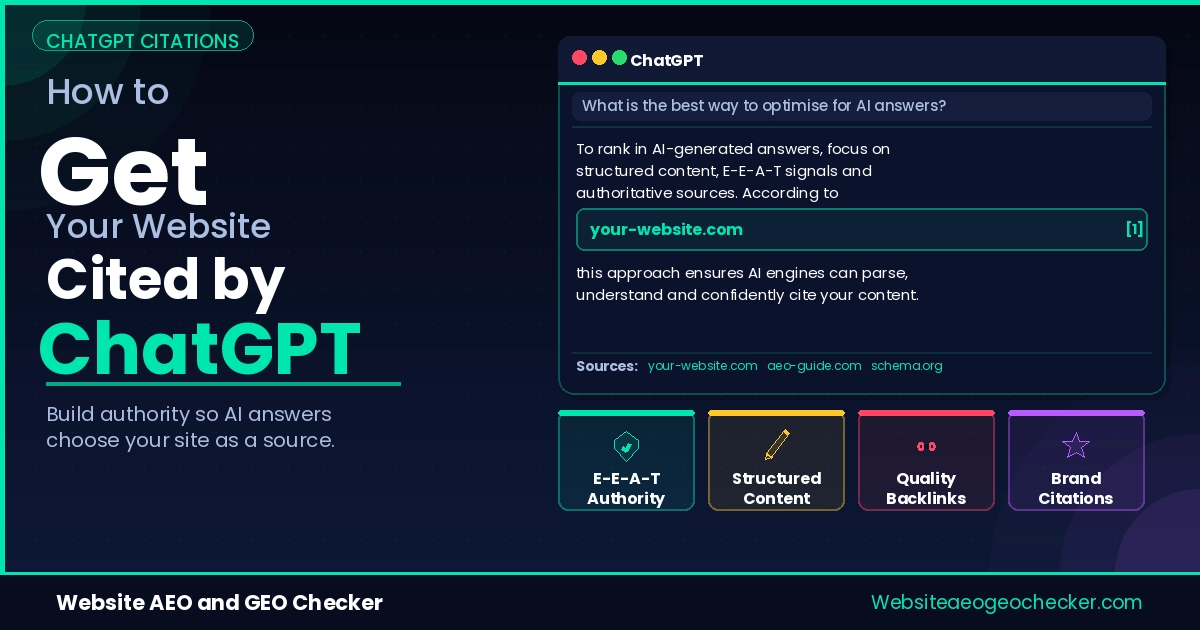
ChatGPT processes over 2.5 billion queries every day. Each response cites three to four sources on average. That is a very small window. But it is also a window that is open to any website that does the right things — regardless of how big or established you are.
Many websites, despite having good content, remain invisible by ChatGPT. This is primarily due to a website’s inability to allow ChatGPT to extract and attribute its information in the proper way. The main difference between a cited website and one that is not is in its structure. It is not the quality of the website.
This is the step-by-step playbook. Seven steps, in the order that gets results fastest. Run a free check on your site first with our Free Website AEO Checker - it shows you which of these steps you have already done and which need attention.
How ChatGPT Actually Decides What to Cite
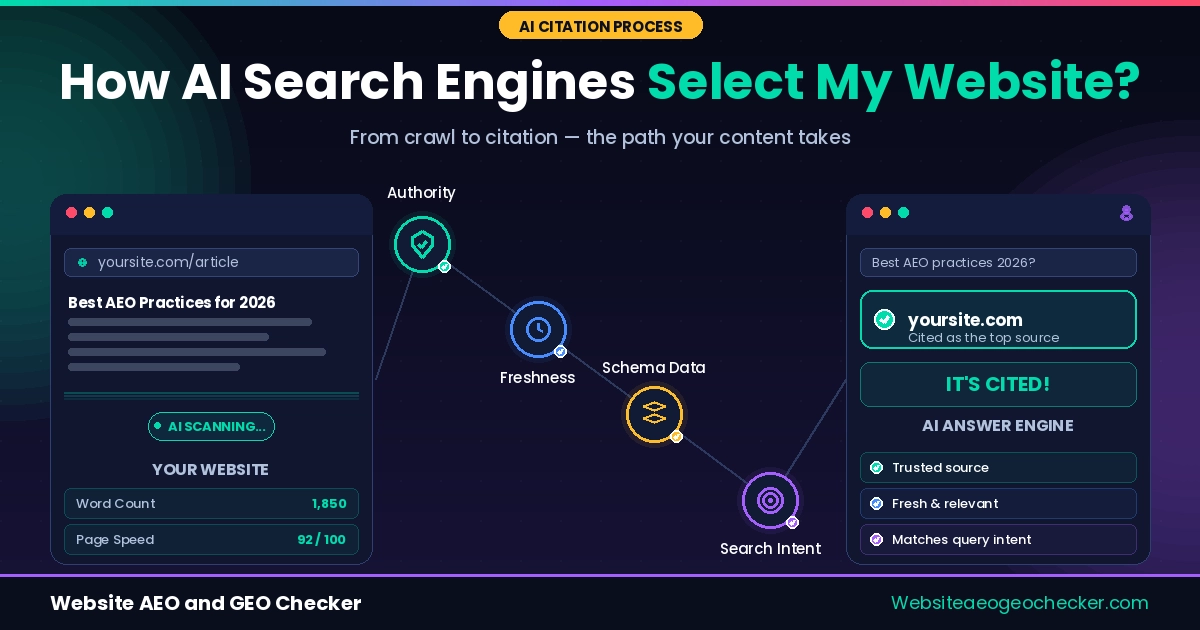
Before explaining the steps, there is one concept to understand. ChatGPT does not rank web pages. ChatGPT extracts claims. When a person types a request, ChatGPT finds web pages relevant to it. It then determines which pages are relevant based on how many claims can be extracted and how clear the structure is. It then claims the sources from which it can extract and attribute the information.
Getting cited by ChatGPT is no longer just about ranking on Google. AI systems look for structured, trustworthy, and clearly written content that can be easily extracted, verified, and referenced. — Website AEO GEO Checker
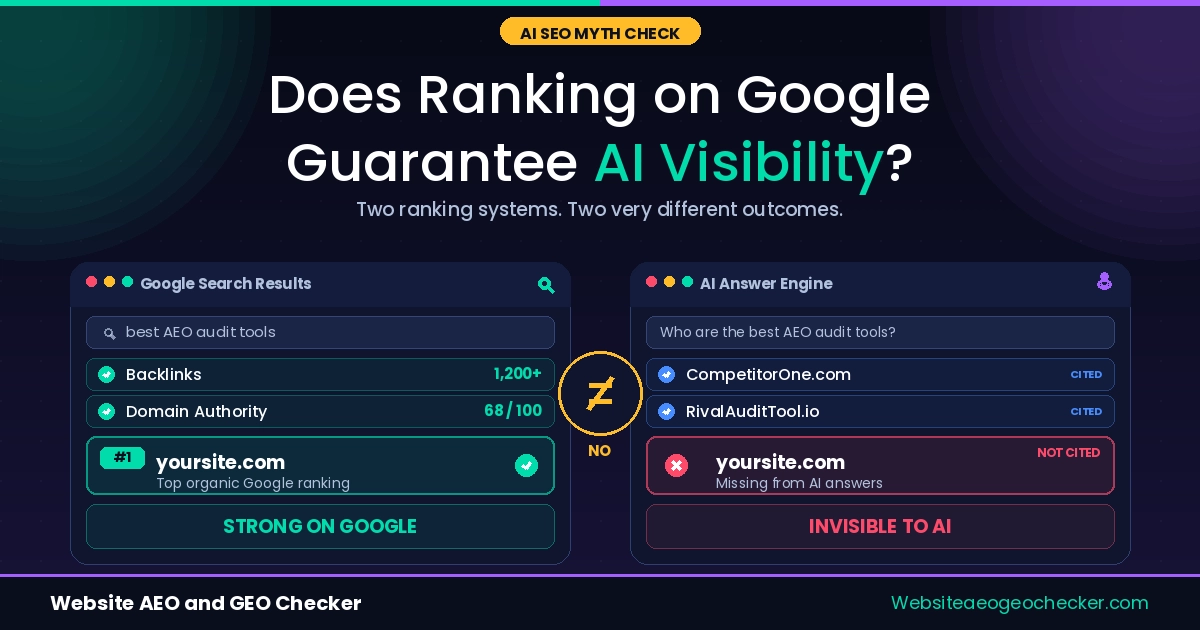
This is unlike search engines such as Google. With Google, you have to focus on getting a good ranking. With ChatGPT, you have to make your claims as extractable as possible. A web page that ranks number 3 on Google will extract better claims than a web page that ranks number 1, if the page that ranks number 3 focuses on giving answers with a clear, specific, and direct structure, and the web page that ranks number 1 answers claims in long preambles.
That reframe changes how you approach every step below.
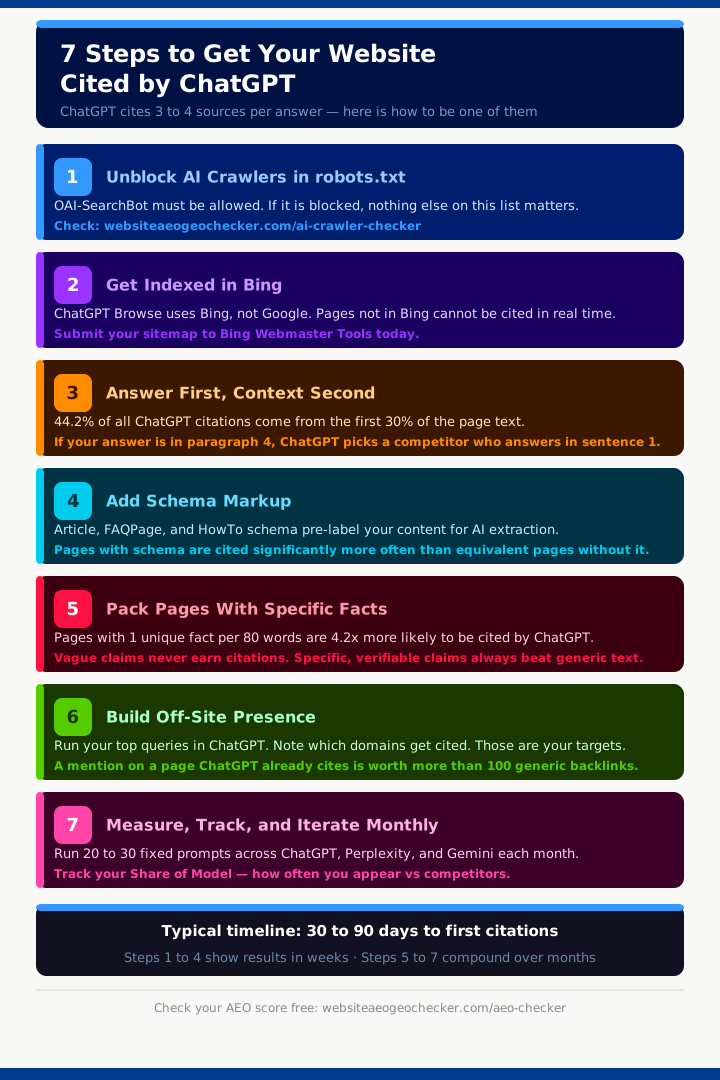
7 Steps to Get Your Website Cited by ChatGPT
Step 1: Unblock AI Crawlers in Your robots.txt
This is the gate. Everything else in this list is irrelevant if ChatGPT cannot read your pages.
Many sites have accidentally blocked their own AI visibility by grouping all bots under a single disallow rule. ChatGPT's search crawler is called OAI-SearchBot. If your robots.txt file blocks it, ChatGPT cannot retrieve your pages in real time regardless of how well-optimised your content is.
Open yourdomain.com/robots.txt in your browser right now. Look for Disallow: / under either User-agent: * or User-agent: OAI-SearchBot. Either one removes you from ChatGPT search results completely.
Use our free AI Crawler Checker to see the status of all 14 AI crawlers on your site in seconds. If OAI-SearchBot is blocked, fixing that is your most urgent action. Our full robots.txt fix guide walks through the exact changes for every platform.
Step 2: Make Sure Your Key Pages Are Indexed in Bing
This one surprises most people. ChatGPT Browse retrieves pages from Bing's index, not Google's. A page that ranks on page one of Google but has never been indexed by Bing cannot appear in ChatGPT's real-time search results.
You need to focus on Bing as well, because you need content that ChatGPT finds worth citing. Without ranking on Bing, you cannot expect ChatGPT to give you any visibility, even with high rankings on Google.
Check Bing Webmaster Tools to make sure your domain is listed. Make sure you have submitted the sitemap. You can also use the URL submission tool to ensure that the most important pages to your business are indexed. Doing this step will only take a few minutes, and it will allow access to a previously unclaimed retrieval channel.
Step 3: Answer First, Context Second
This is the most impactful content change you can make. Research from Citegrade analysing thousands of ChatGPT citations found that 44.2% of all LLM citations come from the first 30% of the text on a page. If your key claim is buried in paragraph four, ChatGPT will skip to a competitor who answers in sentence one.
The rule is simple: answer the question in the first sentence under the heading. Not after a preamble. Not after context-setting. Immediately. Every H2 & H3 heading should be followed by a direct, complete, standalone answer in the first one or two sentences. Context, examples, and supporting detail come after.
Real example: James runs a freelance HR consultancy and had been writing detailed, well-researched articles for two years. None appeared in ChatGPT responses. He audited his top 5 pages & found the same pattern everywhere: each section started with background information before reaching the point. He spent one afternoon restructuring five articles so every section opened with a direct answer. Six weeks later, 2 of those articles were being cited in ChatGPT responses for queries he had previously only ranked for on Google.
This is the single change that produces the fastest visible improvement in ChatGPT citation frequency. Read our guide on how to write content for AI answer engines for the full formatting approach.
Step 4: Add Schema Markup to Every Key Page
Pages with schema markup see significantly higher citation rates than equivalent unstructured pages. The three types that matter most for ChatGPT citations are Article schema (with named author and dateModified), FAQPage schema for any question and answer sections, and HowTo schema for step-by-step content.
A schema is like a bridge that connects the content to its structure, and it provides context when ChatGPT tries to understand it. It has to interpret the raw HTML. When it is presented with a schema, the labeling is done beforehand. This allows for faster and more reliable content extraction and citation.
Add at minimum: FAQPage schema to every page with a Q&A section, Article schema with a named author and updated dateModified on every post and guide, and Organisation schema on your homepage. Our structured data guide covers implementation for every schema type with copy-ready JSON-LD code examples.
Websites that combine topical authority, schema markup, crawl accessibility, and concise answers are far more likely to appear in AI-generated responses and conversational search results. — Website AEO GEO Checker
Step 5: Pack Your Pages With Specific, Citable Facts
Research from Citegrade found that pages with a fact-to-word ratio above 1:80 — one unique, verifiable fact per 80 words — are 4.2 times more likely to be cited by ChatGPT than pages with lower fact density.
Generic content never earns citations. Specific, attributable claims do. Compare these two sentences:
Generic: "AI search is growing quickly and website owners need to adapt."
Specific: "ChatGPT processes over 2.5 billion queries per day, and AI-referred sessions convert at 4.4 times the rate of traditional organic traffic."
The second gives ChatGPT something concrete to extract and attribute. The first offers nothing a reader could not have assumed themselves.
Choose the most important pages and count all the specific factual claims, statistics, and findings. The aim is to have at least one for every eight words. If a page contains a lot of generalizations with little to no documented evidence, consider a rewrite and remove if necessary.
Step 6: Build Your Off-Site Presence on Pages ChatGPT Already Cites
Contently's analysis of ChatGPT citation behaviour found that the strongest practical move is not traditional link-building. It is earning mentions on the pages ChatGPT already cites. A mention on a roundup article that ChatGPT regularly pulls from is worth far more than a hundred backlinks from sites ChatGPT has never cited.
The approach: run your top category prompts through ChatGPT right now. Write down which domains and specific URLs get cited most consistently. Those are your outreach targets. If ChatGPT cites a specific comparison article in your category, reach out to the author with a clear, factual description of your product or service. Not a sales pitch. A contribution.
Building your brand presence online in conjunction with outreach means making contributions across multiple online platforms. Directories, Reddit, Quora, articles in the press, and guest articles on niche sites are all tools for creating a multi-source presence, and contributions to these places help users to validate the importance and trustworthiness of your brand.
Step 7: Measure, Track, and Iterate Every Month
You cannot improve what you do not measure. Most site owners check their Google rankings weekly and never check their ChatGPT visibility at all.
Set up a prompt panel: Select a fixed set of 20 to 30 questions specific to your business. Each month, use the same prompts in ChatGPT, Perplexity, and Gemini (with the search feature on). Take note of whether your business appears, which pages are referenced, and how the AI describes your business. Over time, the amount of time your business appears in reference to others becomes a deciding factor in gauging the success of your work.
Month-on-month improvement in citation frequency across your prompt panel is the clearest signal that your AEO and GEO work is having an effect. For a full measurement framework including how to track AI-referred traffic in GA4, read our guide to measuring AEO and GEO performance.
How Long Does It Take?
The timeline depends on which steps you are fixing. Steps 1 to 4 are technical and produce the fastest results. Unblocking AI crawlers and adding schema can show improvement in ChatGPT's live search within two to four weeks. Content restructuring (Step 3) typically shows results within four to eight weeks.
Steps 5 through 7 are the most important to have in place. Building external presence becomes more straightforward after these are in place, and helps with your online presence in the long term. Earning two to three high-quality external articles in the press and completing the set of seven actions means most sites will experience a significant increase in their presence in citations over a period of 30 to 90 days.
The sites that build this foundation now will have a compounding advantage over the next 12 months as AI search continues to absorb more of the queries that used to go to Google.