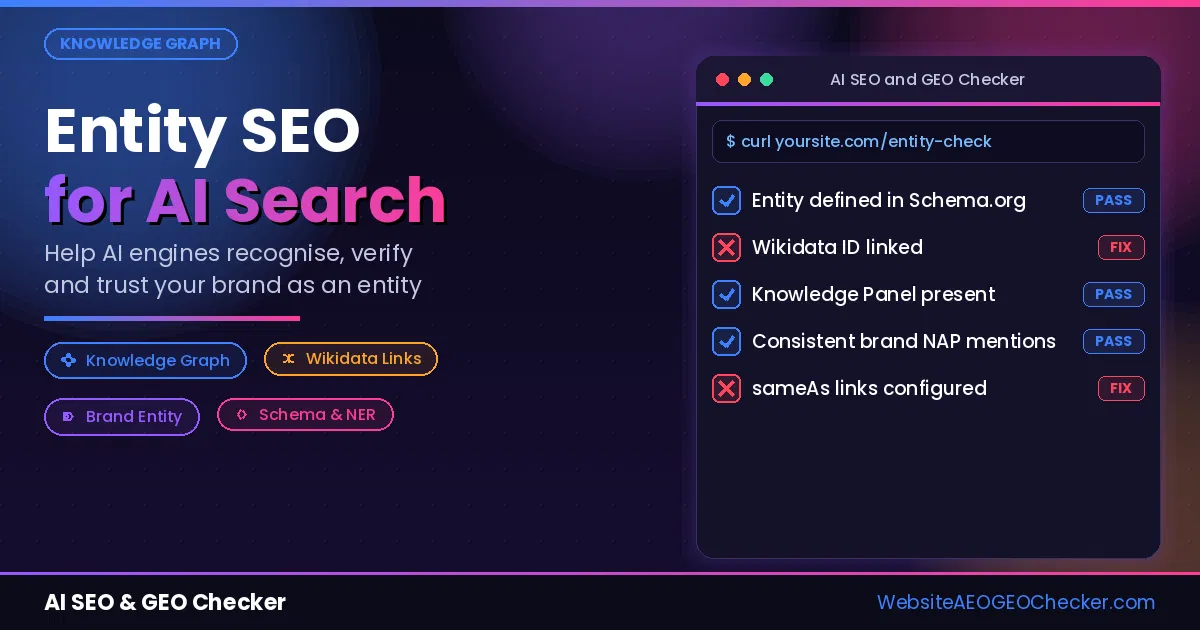
Ask ChatGPT "What is [your business]?" and see what comes back. Sometimes it describes you perfectly. Sometimes it mixes you up with a company that has a similar name. Sometimes it says it has never heard of you.
The difference is rarely your content. It is whether AI engines understand your business as a clear, single "thing", with a name, a location, an owner and a purpose. That is what entity SEO is about.
This guide explains what entity SEO means in plain words, why AI search engines think in entities, a before-and-after entity SEO example and 8 practical steps to make ChatGPT, Google and other AI tools understand exactly who your brand is.
What Is Entity SEO? (A Plain Definition)
Entity SEO is the work of helping search engines and AI tools understand exactly who you are as a real-world thing, not just as a set of keywords on a page.
An entity is any distinguishable, definite thing: a person, a business, a place, a product, or an idea. "Apple", referring to a company, and "apple", referring to the fruit, are two separate entities but use the same word. Search engines have to be aware of which entity a webpage discusses.
In 2012, Google began its journey in this area by presenting its Knowledge Graph, based on the concept of "things, not strings". Rather than analyzing the words you enter, Google analyzes the things you are referring to and how these things are related. Your business is among the things. Your founder, your city, your products, and your competitors are some of the other things.
In simple terms:
- Keyword SEO asks: does this page contain the words people search for?
- Entity SEO asks: does the search engine know which business this is, what it does, and how it relates to everything else?
Why AI Search Engines Think in Entities
AI answers are built from facts about entities. When someone asks "best family dentist in Austin", the AI needs to know which businesses are dentists; which are in Austin, which treat families and what other people say about them. Every one of those facts is attached to an entity.
When your entity is clear, AI can connect those facts to you with confidence. When it is unclear, three things go wrong:
- AI confuses you with another business. It borrows their address, their reviews or their founder.
- AI skips you. If it is not sure the facts belong to you, it recommends a business it understands better
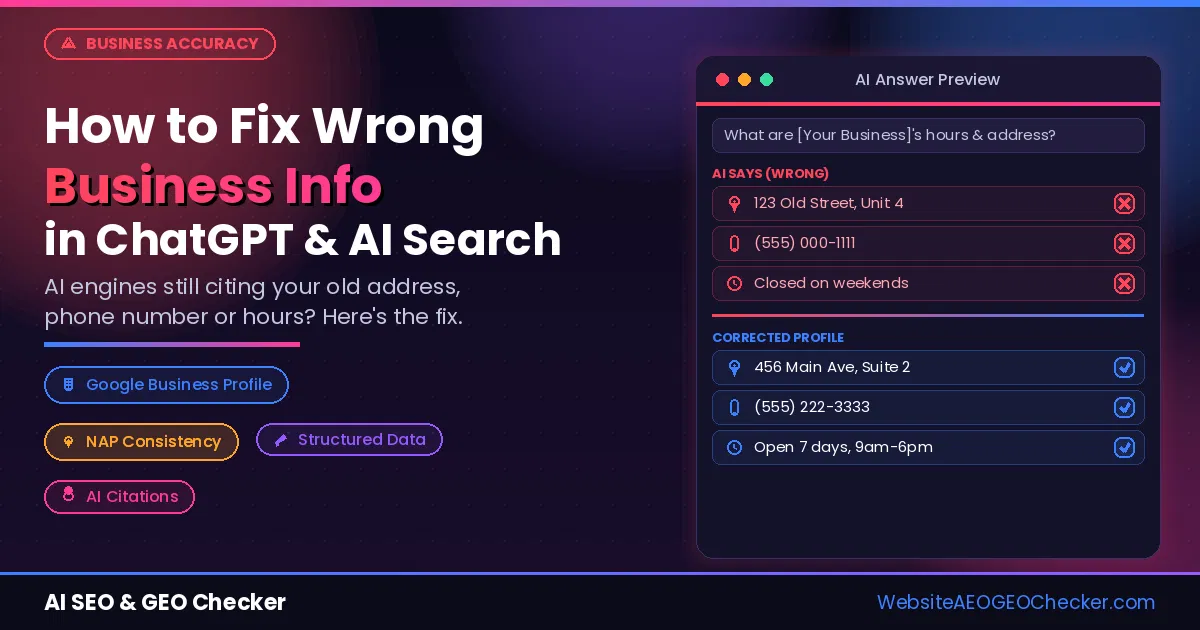
- AI fills gaps with guesses. Missing facts become hallucinated ones.
AI engines lean heavily on sources that are built around entities. In Peec AI's analysis of 30 million sources cited by AI search, Wikipedia was among the top 5 domains Perplexity cited, alongside Reddit, YouTube, LinkedIn and G2. Wikipedia is, at its heart, a giant database of entities and the facts about them.
The cost of getting this wrong is real; When the Tow Center for Digital Journalism tested eight AI search tools in 2025, the tools were wrong on more than 60% of queries, often by attributing content to the wrong source. A clear entity gives AI less room to make those mistakes about you; If AI is already saying wrong things about your business, our guide on how to fix wrong information AI says about your business walks through the repair process step by step.
Entity SEO Example: Before and After
Here is a fictional example of a small business, to show what changes. "BrightPath Dental" is a family dentist in Austin, Texas.
| Signal | Before | After |
|---|---|---|
| Business name | "BrightPath Dental", "Bright Path Dentistry" and "BrightPath Family Dental" used on different sites | "BrightPath Dental" used everywhere |
| Website schema | None | Organization and LocalBusiness schema with name, logo, address, phone & sameAs links |
| About page | Two lines of marketing copy | Founded date, founder, address, services, areas served, written as plain facts |
| Business profiles | Google Business Profile half complete; Yelp shows an old address | All profiles complete & identical |
| Founder | Mentioned only by first name | Full name, Person schema, linked LinkedIn profile |
| AI answer to "What is BrightPath Dental?" | Mixes in details from a dental lab with a similar name | Describes the practice, its location & services correctly |
Nothing in the "after" column is complicated or expensive. It is mostly about saying the same clear facts, in the same way, everywhere your business appears.
8 Steps to Build a Strong Brand Entity
Step 1: Pick one exact brand name and use it everywhere
Pick your exact business name spelling (spacing and capitals), and use it on your website, social media accounts, directories, invoices, and email signature. "BrightPath Dental" and "Bright Path Dental" will be treated as two separate companies by the machine. In case you have rebranded, include a sentence on your About page saying "Formerly known as [old company name]", so AI can see that these are one and the same entity.
Step 2: Add Organization schema with sameAs links
Organization schema is the code on your website that describes the factual information about your company in a language that machines understand. The most important attribute of an entity for its SEO is called sameAs. SameAs is your list of official profiles on other websites that represent the same company.
Google's Organization structured data documentation says there are no required properties & recommends adding every property that is relevant to your organization. It also notes that some properties, such as your logo, can affect what Google shows in search results and the knowledge panel. Here is a simple example:
<script type="application/ld+json">
{
  "@context": "https://schema.org",
  "@type": "Organization",
  "name": "BrightPath Dental",
  "url": "https://www.brightpathdental.com",
  "logo": "https://www.brightpathdental.com/logo.png",
  "foundingDate": "2016",
  "founder": { "@type": "Person", "name": "Dr. Maria Lopez" },
  "sameAs": [
    "https://www.linkedin.com/company/brightpath-dental",
    "https://www.facebook.com/brightpathdental",
    "https://www.yelp.com/biz/brightpath-dental-austin"
  ]
}
</script>
The full list of properties is on the schema.org Organization page. For a local business, use LocalBusiness or a more specific type such as Dentist, and add your address, phone number and opening hours. Our guide to how structured data helps AI find and cite your content explains the basics, and 8 schema types that boost AI citations includes ready-to-copy code.
Step 3: Write an About page that states the facts plainly
The AI gets an idea of who you are from the About page. Most About pages are filled with marketing fluff and few factual details. Rewrite it so that factual information comes first: the year the business was established, founder(s), owners, location, products or services offered, target audience, and uniqueness. It should have full sentences that can be easily used as a quote, such as “BrightPath Dental is a family dental practice located in Austin, Texas and founded in 2016 by Dr. Maria Lopez.”
Step 4: Complete your business profiles with identical details
Search engines verify your information with other reliable sources. Set up your Google Business Profile, Bing Places, Apple Business Connect, LinkedIn company page, and Crunchbase profile, as well as the main directories in your industry. Provide identical business name, address, telephone number, website, and description in each of those places. Inconsistencies of the information provided are one of the top reasons AI merges your business with another one. Our guide to getting your local business into ChatGPT Maps covers the local listings that matter most.
Step 5: Create a Wikidata item, if you qualify
Wikidata is a free, open database of entities that search engines and AI tools use widely; Each entity gets an item with an ID and structured facts. Unlike Wikipedia, many established businesses can have a Wikidata item, but only if they meet the Wikidata notability policy. In short, an item must be clearly identifiable and described by serious, publicly available references, such as news coverage or official registers.
If you are qualified, make a piece of content with your company's official name, URL, founded date, location, and official profiles' URLs, and support all of them with a reference. Do not write a Wikipedia article about your own business. It is against the conflict of interest policy of Wikipedia and is almost sure to be deleted.
Step 6: Add Person schema for founders and authors
People are entities too. If founders, owners, or experts of your business are mentioned and identified, AI will connect that expertise with your business. You should include Person schema on the pages of your authors and your About page, including their full names, roles, and URLs of LinkedIn and other professional profiles. You should link people to organizations using properties such as worksFor or founder.
Step 7: Earn mentions that describe who you are
Not all entity signals come from your own website. Anytime a news item, podcast, review site, or Reddit post references your company along with what it does and where it is located, you are reinforcing the relationship between your company and its information. A mention such as "BrightPath Dental, family dentistry in Austin," is way more valuable than a simple mention of the name. Whenever you receive press or partner mentions, request that your full company name, your category, and location be included.
Step 8: Summarise your brand facts in llms.txt
A llms.txt file is a text file placed in the root directory of your website which serves as a concise, clean summary of your website and important pages. Include a short brand facts section with your official name, description, location, services, and links to your About and Contact pages. It isn't a substitute for schema, but it is yet another source of consistency about who you are. Read what llms.txt is and whether your site needs one, then test yours with the free llms.txt Checker.